Andrew is a post-doctoral researcher in North Carolina focused on population and conservation genetics in hydrothermal vent communities.


David is a graduate student in Florida. He studies the ecology and conservation of sharks.


Amy is a graduate student in North Carolina studying local ecological knowledge within small scale fisheries.


Chuck is a graduate student in North Carolina focusing on apex predators and how they interact with fisheries.


Lyndell is a graduate student in North Carolina, studying the feeding ecology of cownose rays.


Iris is a graduate student in Washington studying habitat use and feeding habits of juvenile Pacific salmon and herring in Puget Sound.


Michael is a graduate student in Maryland investigating the visual systems of mantis shrimp.


Archives

Giant manta rays protected by Convention on Migratory Species

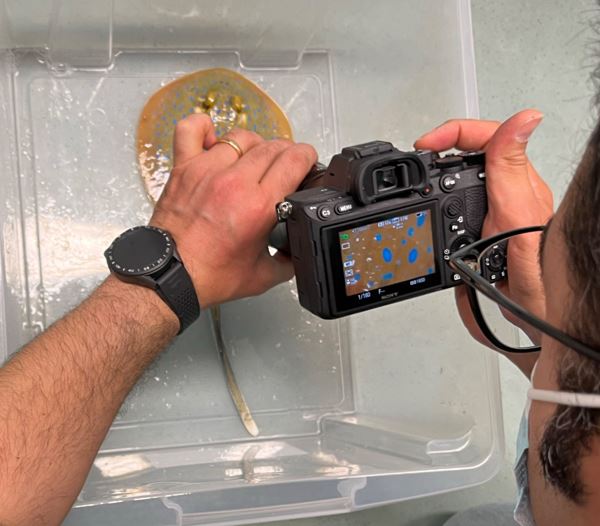
Photo credit: David Shiffman (Georgia Aquarium)

A few weeks after they were listed as Vulnerable on the IUCN Red List, giant manta rays (Manta birostris) have received major international legal protection. The Parties to the Convention on Migratory Species of Wild Animals (CMS) just agreed to list giant mantas on Appendix 1 and II of CMS at their tri-annual meeting in Bergen, Norway.  An Appendix I listing requires that any of the 116 CMS Party nations who have giant manta rays in their waters to protect them along with their habitat, while an Appendix II listing encourages global and regional cooperation. This proposal was introduced by Ecuador, and was supported by the European Union, United States, Australia, Senegal, Madagascar, Mozambique, Chile, and Uruguay. This year’s host country, Norway, also supported the proposal and proposed discussing the reef manta (Manta alfredi) at the next CMS meeting in 2014.

“We are elated that the CMS Parties have embraced Ecuador’s proposal for protecting the magnificent and exceptionally vulnerable giant manta ray,” said Sonja Fordham, President of Shark Advocates International. “CMS is an excellent vehicle for facilitating much needed national and international safeguards for this wide-ranging, globally threatened species and its key habitats.”

Giant mantas (the giant is appropriate as they can grow more than 7 meters across) are the target of directed fisheries for their gill rakers, which are used in traditional Chinese medicine. Their large size, predictable movement patterns, and relatively slow swimming speed makes them easy to catch, while many of their widely-distributed subpopulations number only a few hundred individuals. A listing under CMS appendices I and II is a welcome first step in the conservation of these gentle giants.

6 comments to Giant manta rays protected by Convention on Migratory Species

  • Hey David, that’s great news. Have you got a link to the original announcement?

    Like or Dislike: Thumb up 0 Thumb down 1

  • Mark Bradfield

    Great news! So pleased for Mark Harding, Andrea Marshall and all the other people working hard to raise the plight of mantas worlwide. Just need the relevant countries to step up with some appropriate enforcement action now…

    Like or Dislike: Thumb up 0 Thumb down 1

  • Sam Orrange

    I’m so happy to hear this! More countries really need to get on board though and do more. It seems like fishing or protection policies, even in the countries that do sign these treaties, are never quite enforced or strong enough, but at least this is a good step for the mantas!

    Like or Dislike: Thumb up 0 Thumb down 0

  • Sue Ferguson

    Great news for the manta rays! They grow slowly, and only have one pup a year. Thank goodness something is being done to protect these gentle giants.

    Like or Dislike: Thumb up 0 Thumb down 0

  • Paul Crooks

    Brilliant, but where you say Australia and where F.A.O zone 57 extends 77˚.00′E and throughout the bay of Bengal does this include Sri Lanka?
    I understand it that these critters are a favourable target of Sri Lanka.

    Like or Dislike: Thumb up 0 Thumb down 0