 The deep-sea, by virtue of no light, cold temperatures, and high pressures, leaves an environment ripe for evolving some pretty strange critters. One of my personal favorites, mostly because of the crazy teeth it boasts, is the viperfish.
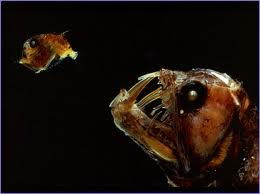 To me, the viperfish looks like a dessicated version of some sort of alien. In reality, it’s a fast swimmer, moving at 2 body lengths per second, but a small fish at 1-2 feet. They spend their days in the deepest waters (about 9000 feet) but emerge at night, rising from the ocean floor to begin their hunt. Since food is not predictable, they can store large amounts of food from a successful hunt to make use of in leaner times.
Not on the scary note, the fish also has a photophore, or a biolumenescent appendage that it uses to attract prey. It basically travels with bait attached to its forehead. Awesome.
~Bluegrass Blue Crab
sources: The Sea and Sky and Wikipedia