 In the last few months, the Middle East and North Africa have seen some of the most dramatic political changes since the breakup of the Ottoman Empire. Tunisian President Zine el-Abidine Ben Ali, who had ruled with an iron fist for more than 20 years, was overthrown. Shortly after, Egyptian President Hosni Mubarak, who had also been a brutal dictator for decades, stepped down in the wake of massive public protests. As of this writing, similar protests are taking place in Yemen, Oman, Morocco, Iran, Djibouti, Jordan and Libya (where government retaliation to the protests has been particularly brutal). If you’re a CNN junkie like I am, you’ve read all about how these revolutions will affect human rights, international relations, oil prices, and the influence of terrorism in the region. There has been relatively little mainstream media focus on how science will be affected, however.
Two recent Nature News articles summarize the current state of science in Egypt and Tunisia.
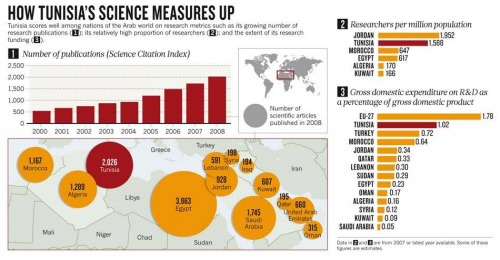
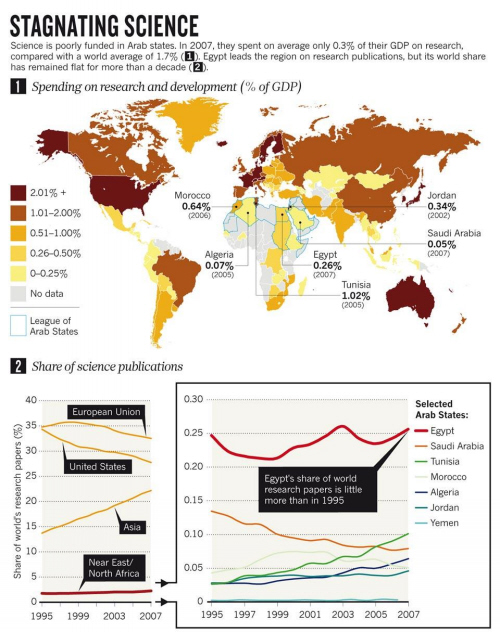
In summary, many Middle Eastern and North African nations are seriously underperforming in science education and research compared to the rest of the world. Egypt is one of the best of the Arab states, but in 2008 the entire nation published less than half of the papers that Harvard University did. Egypt was one of the first advanced human civilizations, and they were making amazing progress in shipbuilding, construction, medicine, and mathematics thousands of years ago (by the way, thanks a LOT for helping the Babylonians to discover Algebra and making the lives of middle school students miserable). What happened?
A lot of the blame, according to Egyptian-born chemist Ahmed Zewail, lies with the repressive dictatorships of the Middle East and North Africa. He accused Mubarak of “presiding over a long deterioration in Egypt’s education and research systems”. According to the Nature News article,
“Intake at the public universities — which offer students free tuition — has expanded vastly since the 1960s, in line with the country’s rapidly growing population. But budgets have remained flat, salaries have stagnated, and training of teachers and lecturers has been neglected…political patronage and nepotism are rife in senior university appointments. The suppression of human rights, and the poor conditions for science, have also led to a brain drain to the West..Egypt’s research has also been plagued by a lack of funding, with research spending amounting to just 0.2–0.3% of the country’s gross domestic product”
Here’s an example of brain drain – Ahmed Zewail (referenced above) is a brilliant scientist. He won the Nobel Prize in Chemistry in 1999… years after he left Egypt to work in the more research-friendly California.
Is it fair to blame the Mubarak regime for the current state of Egyptian science? Tarek Khalil, President of Nile University, believes so, saying “Mubarak wasn’t interested in science; he didn’t have the vision or the ability to understand what development takes.” Hassan Azzazy, a researcher at the American University in Cairo, agrees: ” The current outdated government simply lacks the mindset and vision to strategically support scientific research and lead an innovation-based economy that can compete globally”.
In Tunisia, there was little academic freedom. According to the Nature News article,
“Universities and researchers had little freedom to develop their own strategies, or even to choose who they worked with…Multiple permissions were required for almost everything, from leaving the country to meeting with foreign researchers”.
As the people of the Middle East and North Africa consider a new model for their scientific establishment, they don’t have to look very far to find a nation that values science, education, and individual rights. If you look closely at the second figure above, something stands out. It incorrectly reports that Egypt “leads the region” in research publications. While it may be true that Egyptian scientists have one of the highest publication rates of any Arab state, Arab states aren’t the only countries in “the region” that this article is discussing. To their credit, Nature printed a letter from David Borhani in their latest issue which partially corrected this oversight*.
Bohrani took the time to look up the comparable statistics for the country that Nature left out – Israel. According to his statistics, Israel had 14,493 published papers in 2008, much more than the 2,000 reported for Tunisia. Israel had 7,841 researchers per million people, much more than Jordan’s 1,952. Israel also invested 4.3% of GDP in research and development in 2009, which is not only higher than the Arab states these articles considered, but higher than any other nation on Earth.
What’s different between Israel and the rest of “the region”? Bohrani correctly points out that in 1948, when Great Britain abandoned it’s colonies in the Middle East, Israel and it’s neighbors started off on approximately the same footing. All had very little infrastructure in a harsh climate. Israel had several major disadvantages relative to it’s neighbors, not the least of which is that many of the surrounding countries have repeatedly tried to “drive the Jews into the sea” or “wipe Israel off the map”. Additionally, Israel is one of the most natural resource poor nations in the world, while many surrounding Arab states have some of the world’s largest petroleum reserves. Israel received large amounts of aid from the U.S. and Europe, which they invested in modernizing their country and educating their citizens. Many neighboring countries received large amounts of income as well – some from the U.S., some from the Soviet Union, and some from oil revenues – but for the most part, these monies were not invested in education and modernization. New York Times writer Thomas Freidman describes this phenomenon as some nations “tapping into their people’s potential” while others simply “tapped into their oil fields”.
Additionally, while Israel has a free and open democracy, many Arab states have repressive dictatorships that place no value on the rights or accomplishments of the individual. While there isn’t a perfect correlation between the type of government and the amount of research coming out of that nation (few would argue that China is as free and open as Canada, for example), the two seem to be related. A functional culture of academia requires freedom of inquiry and freedom of exchange. If the Israeli scientific and educational establishment were to offer support and cooperation to the emerging scientific establishments in nations undergoing revolution, it might go a long way towards reducing political tension in the region, as cooperation between American and Russian scientists reduced some Cold War tensions.
Some political pundits are warning us about how the power vacuum created by the fall of these dictators will give terrorist groups an opening. They correctly point out al-Qaeda’s second in command Ayman al-Zawahiri was originally a leader in Egypt’s Islamic Brotherhood, a group that is gaining influence in the post-Mubarak era.
However, other pundits such as Paul Cruikshank believes that when the people of the Arab states get a taste of freedom, they will no longer support terrorist groups. Another group competing for power in Egypt is led by Mohammed el-Baradei. The former head of the International Atomic Energy Agency is a lawyer, not a scientist, but he is a strong advocate for individual freedoms and limited government power. He also shared the 2005 Nobel Peace Prize. Let’s hope that his faction wins the coming elections.
* I suppose you could argue that not mentioning Israel is a misprint ( referencing “the region” instead of “Arab States”) and not an oversight because much of the focus of the article is on Arab states. However, the Egypt info-graphic has data for much of Africa, Europe, North America, South America, and Asia.