Andrew is a post-doctoral researcher in North Carolina focused on population and conservation genetics in hydrothermal vent communities.


David is a graduate student in Florida. He studies the ecology and conservation of sharks.


Amy is a graduate student in North Carolina studying local ecological knowledge within small scale fisheries.


Chuck is a graduate student in North Carolina focusing on apex predators and how they interact with fisheries.


Lyndell is a graduate student in North Carolina, studying the feeding ecology of cownose rays.


Iris is a graduate student in Washington studying habitat use and feeding habits of juvenile Pacific salmon and herring in Puget Sound.


Michael is a graduate student in Maryland investigating the visual systems of mantis shrimp.


Archives

Were 18 foot long thresher sharks responsible for closing a New York beach?

Earlier this week, several New York state beaches were closed due to shark sightings. Fox News’ Rick Leventhal, speaking as part of Bill Hemmer’s “America’s Newsroom” show, reported on this story, claiming that “some onlookers ID’ed them as thresher sharks, they’re estimated to be about  18 feet long”. A half-eaten seal also washed up on shore nearby.


To his credit, Mr. Leventhal  attempted to play down fears about these animals, saying that “Let’s not forget that sharks live in the ocean…as long as there’s food, they’re likely to keep hanging around”. However, I was immediately skeptical of the claim that a group of 18 foot long thresher sharks were swimming slowly just a few yards offshore. A cursory review of the known biology and ecology of thresher sharks will explain my skepticism.

Continue reading Were 18 foot long thresher sharks responsible for closing a New York beach?

State of the Field: Satellite tagging sharks

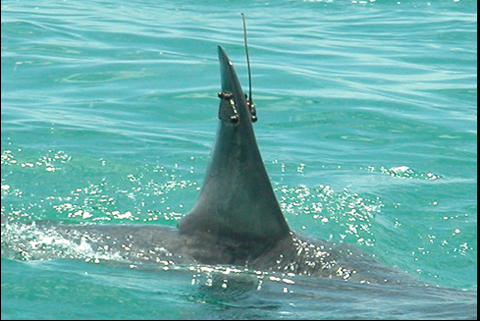
Modern shark researchers have access to a variety of high-tech tools. Acoustic tags with noises specific to each individual shark signal a receiver (or network of receivers) every time the shark passes nearby. Some tags have three-dimensional accelerometers, allowing researchers to study the small scale movement patterns and behaviors of sharks. Others, which are placed in the stomach, measure pH before, during, and after digestion. The most advanced technology on the market, however, is undoubtedly the satellite tag.

Image from SurfThereNow.com

Continue reading State of the Field: Satellite tagging sharks

Shark News Roundup: the ecology of fear, curious whale sharks, and saving the manta rays

The shark blog-o-sphere has been busy lately. Here are some of the headlines from the world of shark science and conservation.

Chuck from Ya Like Dags has a fantastic post explaining the ecology of fear and how it relates to sharks. As it turns out, predators can have a major impact on an ecosystem just by being there- prey change their behavior in ecologically significant ways because they want to avoid being eaten. If you’re looking for scientific reasons why sharks are important to the ocean or if you’re just looking for a cool ecology story, check it out!

Al Dove of the Georgia Aquarium explains that whale sharks are curious animals that will  sometimes swim over to check out humans. I’ve found that most sharks tend to avoid people, but he has a pretty convincing video.

Continue reading Shark News Roundup: the ecology of fear, curious whale sharks, and saving the manta rays