Andrew is a freelance marine biologist in North Carolina focused on population and conservation genetics in hydrothermal vent communities.


David is a graduate student in Florida. He studies the ecology and conservation of sharks.


Amy is a graduate student in North Carolina studying local ecological knowledge within small scale fisheries.


Chuck is a graduate student in North Carolina focusing on apex predators and how they interact with fisheries.


Lyndell is a graduate student in North Carolina, studying the feeding ecology of cownose rays.


Iris is a graduate student in Washington studying habitat use and feeding habits of juvenile Pacific salmon and herring in Puget Sound.


Michael is a graduate student in Maryland investigating the visual systems of mantis shrimp.


Archives

Guest Post: A review of the Field Guide for Sharks of the Genus Carcharhinus

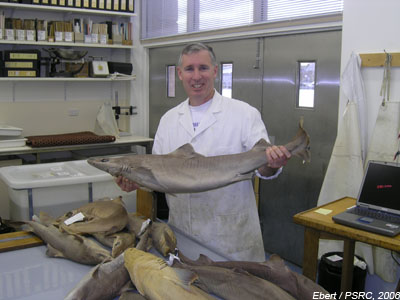
Dr. David Ebert is the Director of the Pacific Shark Research Center at Moss Landing Marine Laboratories. He is one of the world’s leading experts on shark taxonomy, and has described new species of sharks, skates, rays, and chimaeras. Dr. Ebert has written over 100 publications, five books, and dozens of IUCN Red List assessments. He generously agreed to review a new taxonomy guide, Field Guide for Sharks of the Genus Carcharhinus, for Southern Fried Science. He has provided a thorough list of citations backing up his points, but all opinions are his own. 
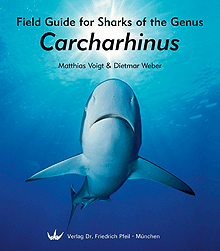
The shark genus Carcharhinus is one of the largest and perhaps most important genera of sharks, with many common and wide-ranging species. These sharks are mostly marine occurring from close inshore to the outer continental shelf and upper slope, but a few species inhabit estuaries and freshwater rivers and lakes. This group is by far one of the most important shark genera for fisheries globally, with various species being taken in commercial and sport fisheries, and in artisanal fisheries. Given the high profile and importance of this genus and the associated problems in identifying them to individual species in the field, an identification guide to the group would be most welcomed.

The book, “Field Guide for Sharks of the Genus Carcharhinus” by Matthias Voigt and Dietmar Weber, could have been that guide, with an exceptionally nice layout, beautiful illustrations, and tooth plates, but unfortunately the text does not stand up to the same high quality of the illustrations. The book cover is quite attractive and eye-catching, and upon initially thumbing through the illustrations and layout of the individual species accounts, I thought wow this looks to be an interesting and possibly useful guide to this shark group, even though I was unfamiliar with the authors, whom to be candid I had never heard of before.

Continue reading Guest Post: A review of the Field Guide for Sharks of the Genus Carcharhinus

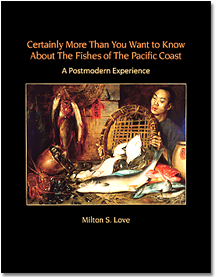
Just enough about “Certainly More Than You Want to Know About The Fishes of The Pacific Coast” to pique your curiosity

There is a website floating around the interwebs entitled “So you want to be a marine biologist?” that most future marine biologists who came of age in the early 21st century have encountered. The sage page of advice is followed up with “So you want to be a marine biologist, the revenge“. Reading through these two essays, one might come to the conclusion that their author, Dr. Milton Love of the University of California, Santa Barbara, should compose a voluminous tome to the fishes of the Pacific coast. Which is exactly what he’s done. Welcome to Certainly More Than You Want to Know About The Fishes of The Pacific Coast: a postmodern experience.

Despite it’s self-aware title, this book is far more than just an exhaustive guide to the fishes of the Pacific, though it certainly is that. The highly detailed taxonomic descriptions are rich with humor and insight into the ecology, behavior, and physiology of, if not each species, than each genus or species complex. Interspersed among the taxa are descriptions of prominent Pacific researchers, anecdotes from a lifetime of work on the water, stories by people who lived, worked, and fished these species, and the occasional poem, song, or limerick. Somehow, these disparate units manage to complement each other in a way that makes you want to read what is essential a taxonomy textbook cover-to-cover.

Continue reading Just enough about “Certainly More Than You Want to Know About The Fishes of The Pacific Coast” to pique your curiosity

Book review: Discoveries of the Census of Marine Life

The Census of Marine Life is undoubtedly one of the most amazing scientific collaborative efforts of all time. All told, thousands of scientists from more than 80 countries participated in the decade-long project. They discovered thousands of new species, published thousands of papers, created and perfected new research techniques, and added countless datapoints to important databases- many of which are free and accessible online.  The story of the COML is nothing short of incredible, and it is told wonderfully in the new book “Discoveries of the Census of Marine Life: Making Ocean Life Count.”

Continue reading Book review: Discoveries of the Census of Marine Life

Crude Rage – A Sea in Flames reviewed

In the year since the Deepwater Horizon sunk, killing 11 people and pumping untold millions of barrels of oil into the Gulf of Mexico, much has been revealed about the causes and effects of this disaster: the chain of events leading up to the explosion, the response (or lack of response) from BP and the US government, the impact of sealife and coastal fisheries. In his most recent book, A Sea in Flames, Carl Safina lays out the timeline of the disaster, the factors the lead to such an egregious lapse in safety, the role that several corporate and government entities played, and the anger. Above all else, this book is about the rage one man feels about a situation that is almost impossible to comprehend.

Continue reading Crude Rage — A Sea in Flames reviewed

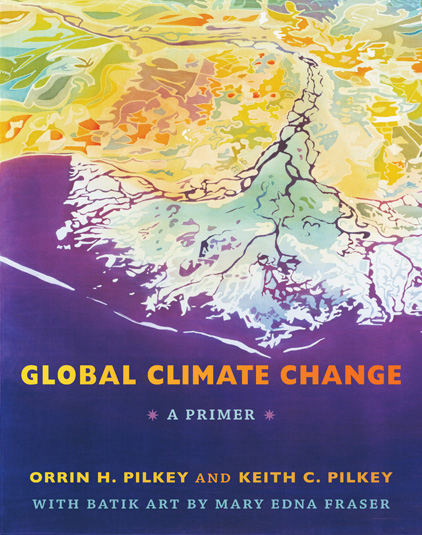
A primer for climate change

Sea level rise. Desertification. Ocean acidification. Climategate. Permafrost. Greenland ice sheet. Hockey stick. The language of global climate change can be overwhelming. Every year, as we learn more about the ways that human activity fundamentally alter global processes, the subject becomes even broader and more complicated. Fortunately, world renowned oceanographer Orrin Pilkey and his son, Keith Pilkey, have produced a comprehensive and readable primer on global climate change. The strength of Global Climate Change: A Primer can be broken into three sections – the content, the conflict, and the illustrations.

Continue reading A primer for climate change

Book Review: Demon Fish

Juliet Eilperin’s “Demon Fish: Travels Through the Hidden World of Sharks” hit bookshelves earlier this week. Juliet has written many great articles about shark science and conservation for the Washington Post, where she works as a science and environment reporter, and I was excited to read Demon Fish. It did not disappoint.

Continue reading Book Review: Demon Fish

Book Review: Saving the Oceans 101

Ted Danson (yes, that Ted Danson) isn’t your typical ocean activist. Though he is best known as the bartender on Cheers, he has been actively involved in marine conservation issues for more than 25 years. While living in California to work on Cheers, he took a walk on the beach with his daughters. When they came across a sign that read “water polluted, no swimming”, he didn’t know how to explain to his disappointed children what was wrong with the ocean. He decided to learn more, began to work with local scientists and conservationists, and eventually co-founded the American Oceans Campaign (one of the founding members of Oceana) Danson’s decades of knowledge of and passion for the oceans are clear in his new book, “Oceana: Our Endangered Oceans And What We Can Do to Save Them”.

Continue reading Book Review: Saving the Oceans 101

Book Review: Five Fundamentals for Fisheries

Daniel Pauly’s research over the last 20 has provided much of the foundational theory in modern fisheries management. In 5 Easy Pieces, Daniel Pauly presents his five most influential papers, with a concise history of both the intellectual and human motivations that led to each study. The papers that were included in this volume are: Primary Production required to Sustain Global Fisheries, Fishing Down Marine Food Webs, Systematic Distortion in World Fisheries Catch Trends, Towards Sustainability in Global Fisheries, and The Future of Fisheries.

Continue reading Book Review: Five Fundamentals for Fisheries

Book Review: A year at Lazy Point

I adored Song for the Blue Ocean. The first time I read it was a formative moment in my development as a young marine biologist and conservationist. When I picked up Eye of the Albatross and, later, Voyage of the Turtle, I expected that same magic, but could not find it. Safina’s subsequent books were not bad. Both were evocative, beautifully written, and stirring tributes to the natural world. But their stories felt too familiar, like listening to a contemporary symphony built around a Bach fugue or watching a remake of a classic movie. So I approached The View from Lazy Point with the same expectations, as yet another supplement to Song for the Blue Ocean. I was mistaken.

Continue reading Book Review: A year at Lazy Point

Lessons from the Death and Life of Monterey Bay

A few weeks ago, Mark Powell at Blogfish posted “Where are conservation success stories?” in which he asks if we have a bias against good news in conservation. Late last year we presented a series of conservation success stories from the IUCN. Whether because we choose to focus only on the doom-and-gloom news stories or because the natural world really is in pretty bad shape, success stories in conservation are few and far between. That is why The Death and Life of Monterey Bay, a new book by Stephen Palumbi and Carolyn Sotka, is so important. Palumbi is a working scientist and director of the Hopkins Marine Station in Monterey Bay and his work has been cited on this blog before. Carolyn Sotka is the project coordinator for COMPASS, an organization that connects scientist to policy makers and journalists.

In The Death and Life of Monterey Bay, Palumbi and Sotka present the history of Monterey Bay, from discovery, to exploitation, to collapse, and ultimately to rebirth. They weave the narratives of many important players, exploring the legacy of a dedicated conservationist who existed before the term was coined, the hunters, fishers, and canneries who found fortune and destruction, the writers and scientists who made Monterey Bay a literary icon, and the Bay itself, which survived by equal parts luck, tenacity, and foresight. The events in the book span hundreds of years, but we can still glean lessons from both the collapse and rebirth of Monterey Bay.

Continue reading Lessons from the Death and Life of Monterey Bay