Andrew is a freelance marine biologist in North Carolina focused on population and conservation genetics in hydrothermal vent communities.


David is a graduate student in Florida. He studies the ecology and conservation of sharks.


Amy is a graduate student in North Carolina studying local ecological knowledge within small scale fisheries.


Chuck is a graduate student in North Carolina focusing on apex predators and how they interact with fisheries.


Lyndell is a graduate student in North Carolina, studying the feeding ecology of cownose rays.


Iris is a graduate student in Washington studying habitat use and feeding habits of juvenile Pacific salmon and herring in Puget Sound.


Michael is a graduate student in Maryland investigating the visual systems of mantis shrimp.


Archives

Short update on the North Carolina Wildfire and Red Wolves

The wildfire that ignited in Dare County last week is still burning, as many coastal residents were reminded last night when the wind changed and brought smoke inland. Fortunately, the incident command is reporting that the fire is more than 50% contained, has not reached the town of Stumpy Point, and did not penetrate to deeply into the bombing range. The fire is not expected to spread much more. InciWeb has been provided the most up-to-date information thus far.

I checked in with representatives from the Alligator River National Wildlife Refuge and the North Carolina Nature Conservancy regarding the status of the last wild population of Red Wolves. While the fire is burning through a portion of their range, there is currently no cause for concern. One possible issue is that red wolves caught in the area may find themselves in the middle of thousands of acres of denuded forest with limited food and shelter. Fortunately, the Red Wolf range extends across five counties, of which the fire is only affecting a small portion, and the species is adapted to exploit fire dominated ecosystems.

The Outer Banks Ablaze

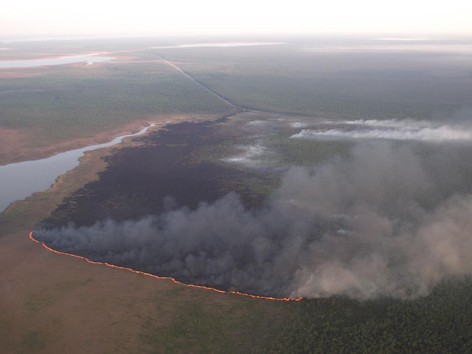
Early hours of the wildfire in Dare Country. Image NCFWS

In Beaufort, the first sign that something was amiss occurred on Sunday night. The air became thick with haze and smelled like of burning mulch. At first we thought it was just an overzealous barbecue somewhere down the road, but as we drove over the Morehead City highrise bridge, we discovered that the smoke was everywhere. This wasn’t an isolated grilling accident, trash burn, or house on fire, some thing was burning, something big. It could only be a forest fire, and, judging by the direction of the wind, it was blowing in from somewhere near the Outer Banks.

Continue reading The Outer Banks Ablaze