Andrew is a post-doctoral researcher in North Carolina focused on population and conservation genetics in hydrothermal vent communities.
David is a graduate student in Florida. He studies the ecology and conservation of sharks.
Amy is a graduate student in North Carolina studying local ecological knowledge within small scale fisheries.
Chuck is a graduate student in North Carolina focusing on apex predators and how they interact with fisheries.
Lyndell is a graduate student in North Carolina, studying the feeding ecology of cownose rays.
Iris is a graduate student in Washington studying habitat use and feeding habits of juvenile Pacific salmon and herring in Puget Sound.
Michael is a graduate student in Maryland investigating the visual systems of mantis shrimp.
|
By David Shiffman, on May 1st, 2013

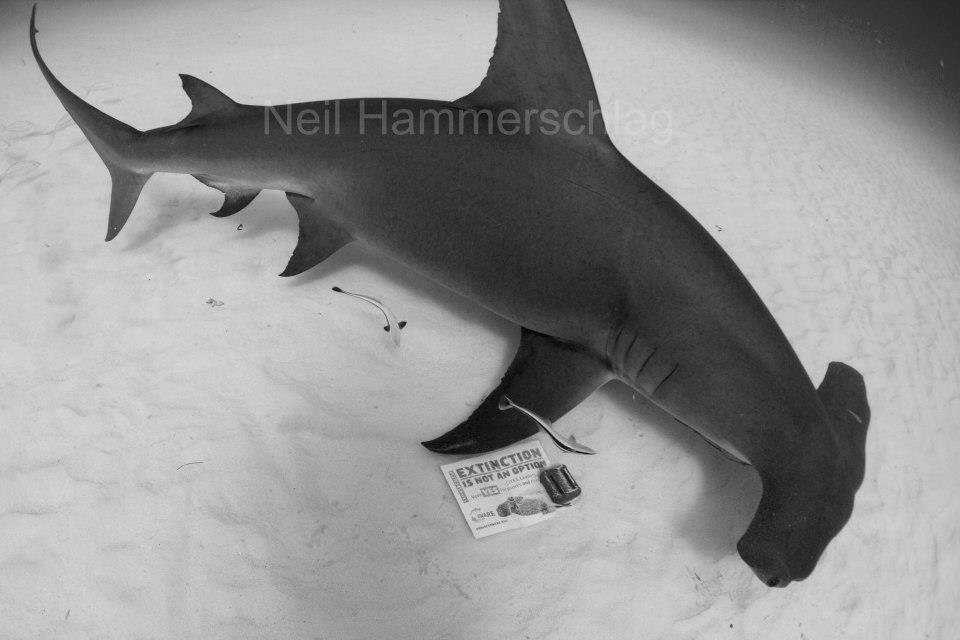
 A great hammerhead shark swims by a Project AWARE “Extinction is NOT an Option” sign, Bimini, Bahamas. Photo credit: Neil Hammerschlag
The Endangered Species Act is one of the strongest conservation laws on the planet, and to date, no shark has ever been given ESA protections. In recent weeks, however, the National Marine Fisheries Service has responded to a series of NGO petitions requesting ESA protections for two species of hammerhead sharks. NMFS proposes to list 2 “distinct” population segments” (DPS) of scalloped hammerhead sharks as endangered and 2 as threatened, with 2 DPS’s listed as “not warranted”. The response to the great hammerhead petition is not as developed (the petition itself is more recent), but notes that “the petitioned action may be warranted”.
I strongly believe that both of these species of hammerhead sharks need and qualify for Endangered Species Act protections. If you agree, I encourage you to submit an official public comment in support of listing both under the ESA following the instructions below. Failure to follow all instructions to the letter will result in your comment not being considered. Commenting on this blog post does not count as submitting a public comment, and neither does commenting on a Facebook post about this blog post. Online petitions will not be considered. This process is open to the public, but requires that we follow basic instructions.
To submit a public comment in support of great hammerhead ESA listings, click on the “comment now” button on this page and fill in the required information. To submit a public comment in support of scalloped hammerhead ESA listings, click on the “comment now” button on this page and fill in all the required information. You can also submit written comments via the mail to “Office of Protected Resources,NMFS, 1315 East-West Highway, Silver Spring, MD 20910 or by fax to 301-713-4060 attn: Maggie Miller. Please note that if you submit a comment by mail or fax, you need to include code NOAA-NMFS-2013-0046 for great hammerheads and code NOAA-NMFS-2011-0261 for scalloped hammerheads.
To help craft your public comment, I’ve written a list of 10 reasons why these sharks qualify for Endangered Species Act protections. Please do not just quote this post word-for-word, if you do then your comment will be considered a “form letter” and not an individual comment.
Continue reading 10 Reasons why Great and Scalloped Hammerhead Sharks Deserve Endangered Species Act Protections
By David Shiffman, on December 27th, 2012

While the rest of the scientific and management community and I are grateful for the passionate support of many shark conservation advocates, passion is no substitute for knowledge and accuracy. Some conservation issues are a matter of opinion and can (and should) be reasonably be discussed by people with different views, but many others are a matter of fact. Presented here, in no particular order, are 13 incorrect statements and arguments commonly made by well-intentioned but uninformed shark conservation advocates, along with the reality of the situation.
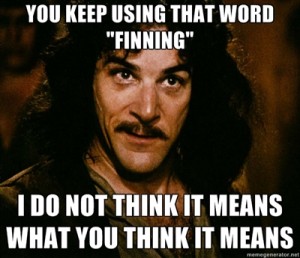
 From MemeGenerator.net
1) “Shark finning” is synonymous and interchangeable with “the global shark fin trade.” Shark finning is a specific fishing method. It is not the only way to catch sharks, and it is not the only way to provide shark fins for the global fin trade. Stopping shark finning is a worthy goal (that has largely been accomplished already *) because it is a wasteful and brutal fishing method that complicates management, but stopping shark finning does not stop the global shark fin trade. Many people calling for a ban on finning really seem to want no shark fishing and no fin trade of any kind (a viewpoint I disagree with, but regardless, proper terminology matters). For more on the difference between shark fishing and shark finning, see this post from June 2012.
2) 100 million sharks a year are killed for their fins. The origin of this number is still debated, but it was popularized by Sharkwater. While we will likely never know exactly how many sharks are “killed for their fins”, the best scientific estimate of the scope of the fin trade we have comes from a 2006 paper by Dr. Shelley Clarke. She found that the fins of between 26 and 73 million sharks end up in the fin trade each year, with a simulation average of 38 million. Dr. Clarke wrote an essay for SeaWeb on the misuse of her work, which is worth a read.
3) 1 in 3 species of sharks face extinction. This one is actually relatively close to accurate, and can be fixed with the addition of just two words. An IUCN Shark Specialist Group report found that 1 in 3 species of “open ocean” sharks are Threatened with extinction (Threatened means Vulnerable, Endangered or Critically Endangered according to IUCN Red List standards). 1 in 6 species of shark, skate, ray, or chimera are Threatened- while still a troubling number indicative of a very bad situation, it’s half as bad as claimed by many advocates. Also, please note that I included skates and rays, which are similarly threatened but often ignored by conservation advocates (with one notable exception from 2012).
Continue reading 13 wrong things about sharks that conservation advocates should stop saying in 2013 (and what they should say instead)
By David Shiffman, on July 13th, 2011

The Largetooth Sawfish (Pristis perotteti) is about to become the second elasmobranch protected by the Endangered Species Act, a welcome step in the conservation of these animals. In addition to the slow growth, low number of offspring, and relatively late maturity which characterizes most elasmobranchs, another biological feature contributes to sawfish being “among the most endangered fishes in the world,” according to Shark Advocates International President Sonja Fordham. It’s hard to imagine a biological structure that can get more thoroughly entangled in fishing nets than the “saw” on their rostrum, and bycatch is one of the leading causes of population decline in this group of animals. Additionally, the saw used to be a part of the souvenir trade.
Continue reading Largetooth sawfish to become second elasmobranch to receive Endangered Species Act protections
By David Shiffman, on March 31st, 2011

Earlier this month, a video of fishermen shooting a rifle at sharks appeared on YouTube and caused quite a stir. The video has since been removed, but not before shark conservation activists made copies (warning: the videos are extremely graphic and have inappropriate language). Apparently some computers can access the site with the videos and others can’t, if you can’t access the site and want a copy of the videos just let me know. All images in this post are screenshots from the video.
Continue reading Shark shooter identified, but has he broken any laws?
By WhySharksMatter and Southern Fried Scientist, on October 26th, 2010
  Earth is facing a biodiversity crisis so severe that many conservation scientists refer to it as a mass extinction event. The International Union for the Conservation of Nature (IUCN), a professional network of 11,000 volunteer scientists belonging to more than 1,000 government and NGO agencies in 160 countries, evaluates species worldwide and determines their risk of extinction. This Red List, which ranks species in increasing risk of extinction – Least Concern, Near Threatened, Conservation Dependent, Vulnerable, Endangered, Critically Endangered, Extinct in the Wild, and Extinct – is described as “the world’s most comprehensive information source on the global conservation status of plant and animal species”.
Statistics from the Red List are terrifying. One fifth of all evaluated vertebrate species are threatened with extinction, including 12% of birds, 21% of mammals, 30% of amphibians, and 26% of fish. On average, fifty species of amphibians, birds, and mammals move measurably closer to extinction each year. One fifth of the world’s plant species are in danger of extinction. Critical habitat-builders, including 33% of reef building coral species and 14% of seagrass species are in very big trouble.
Continue reading Back from the Brink: Victories in Conservation
By David Shiffman, on October 19th, 2010
Two of the strongest environmental laws in the world are the Endangered Species Act and the Marine Mammal Protection Act. Among many other statutes, these laws make it a Federal crime for anyone to harass endangered marine mammal species such as the West Indian manatee. By the accepted definitions of the word “harass”, this means that people cannot swim with and certainly cannot touch a manatee. However, at Crystal River National Wildlife Refuge in Florida, visitors can do both of these things- and it’s totally legal!
Continue reading Ethical debate: Can an endangered species be a business partner?
By Andrew David Thaler, on July 14th, 2010
By David Shiffman, on April 16th, 2010


Most marine conservationists and environmentally conscious citizens believe that fisheries bycatch is a major problem that needs to be solved soon. In most cases, they are correct, but an
interesting paper from Nature shows that bycatch can sometimes be good for certain species. Consider the case of the Great Skua.
 Image from BritishEcologicalSociety.org
The Great Skua is a large predatory seabird that lives in northern Europe. In the past, it has been known to feed on many smaller local seabird species, including the Leach’s Storm Petrel, the Northern Fulmar, the Northern Gannet, the Lesser Black-Backed Gull, and the Herring Gull. In the last few decades, Great Skua populations have increased tremendously.
Ordinarily, when the population of a predator increases, the populations of its prey decrease. This doesn’t seem to be the case among populations of the seabird species in northern Europe. How can this be?
The answer to this apparent ecological enigma has to do with fisheries bycatch. The oceans around northern Europe support many large-scale fisheries, such as the sandeel fishery. Like most large-scale fisheries, the sandeel fishery has a significant amount of bycatch (fish that were caught merely because they were swimming near the sandeel) associated with it. Since the fishermen only have a permit to sell sandeel, the bycatch species are dumped overboard…where they are devoured by Great Skua.
In other words, Great Skua have found a new steady source of food. Great Skua populations have increased without a decrease in the populations smaller seabirds that they ate in the past.
Modern sentiments, however, have turned against bycatch. Efforts to reduce bycatch in commercial fisheries are underway in many countries worldwide. What will this mean for the seabird communities of northern Europe?
Well, it’s possible (and for the purposes of this discussion, we’ll assume it will definitely happen) that without their new source of food (bycatch dumped over the side of fishing vessels), Great Skua will return to eating their previous prey- the smaller seabirds of northern Europe. Since there are many more Great Skua than there used to be, this would be very bad news for the smaller seabirds in the area, and could easily make several seabird species endangered.
The question for this week’s ethical debate is simple: Do you think that we should continue with efforts to reduce bycatch in Northern Europe even if it means that local seabird species will become endangered?
I should note that the authors of this paper stated that “it would not be appropriate to maintain current rates of discarding for the sake of seabirds”.
Votier SC, Furness RW, Bearhop S, Crane JE, Caldow RW, Catry P, Ensor K, Hamer KC, Hudson AV, Kalmbach E, Klomp NI, Pfeiffer S, Phillips RA, Prieto I, & Thompson DR (2004). Changes in fisheries discard rates and seabird communities. Nature, 427 (6976), 727-30 PMID: 14973483
~WhySharksMatter
By David Shiffman, on April 1st, 2010

 Sushi! Image from OpenClipArt.org
Bluefin tuna are some of the most endangered fish in the sea. Prized by the sushi industry for their delicious flavor, populations of bluefin have declined precipitously in recent decades.
They also may be the first species of fish to be driven to extinction by commercial fishing. Normally, when populations of fish get low, it isn’t profitable to fish for them anymore- thus they are not driven to extinction. However, a single bluefin tuna can sell for hundreds of thousands of dollars, so it is still profitable to fish for the last one.
Continue reading Might as well eat ‘em: A semi-serious April Fool’s Day ethical debate
By David Shiffman, on February 18th, 2010

 Image from OwlPages.com
This month’s Frontiers in Ecology and the Environment has a brief article about a new proposed conservation strategy that seems perfect for a Southern Fried Science ethical debate. Northern spotted owls (Strix occidentalis caurina) are one of the most famous endangered species in the United States. While solutions to the destruction of their habitat by logging have been debated for years, a new threat has been recently identified- encroachment on their limited habitat by another species of owl (the barred owl, Strix varia). Some conservationists now believe that we need to kill barred owls to protect spotted owls.
Continue reading Ethical debate: saving owls by killing owls?
|
|
Recent Comments