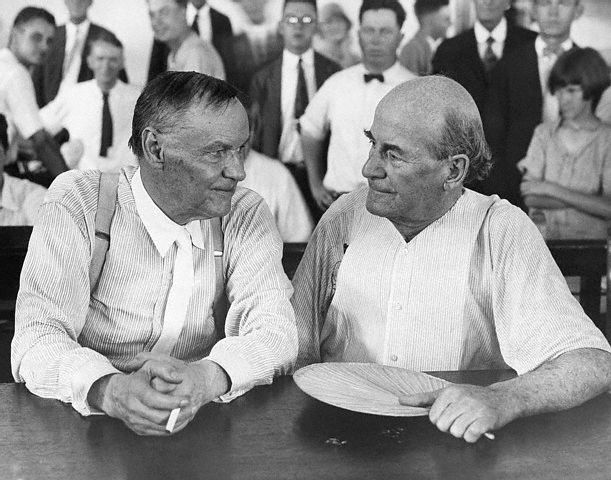
Over the last 2 weeks, I’ve taken to twitter to “live-tweet” the Scopes Monkey Trial, as it happens, 87 years after the event. Through the news reports of H.L. Mencken and several historical documents, I attempted to capture the atmosphere of 1925 Dayton, Tennessee, the tension of the trial, the exciting, and sometimes irreverent, nature of the proceedings.
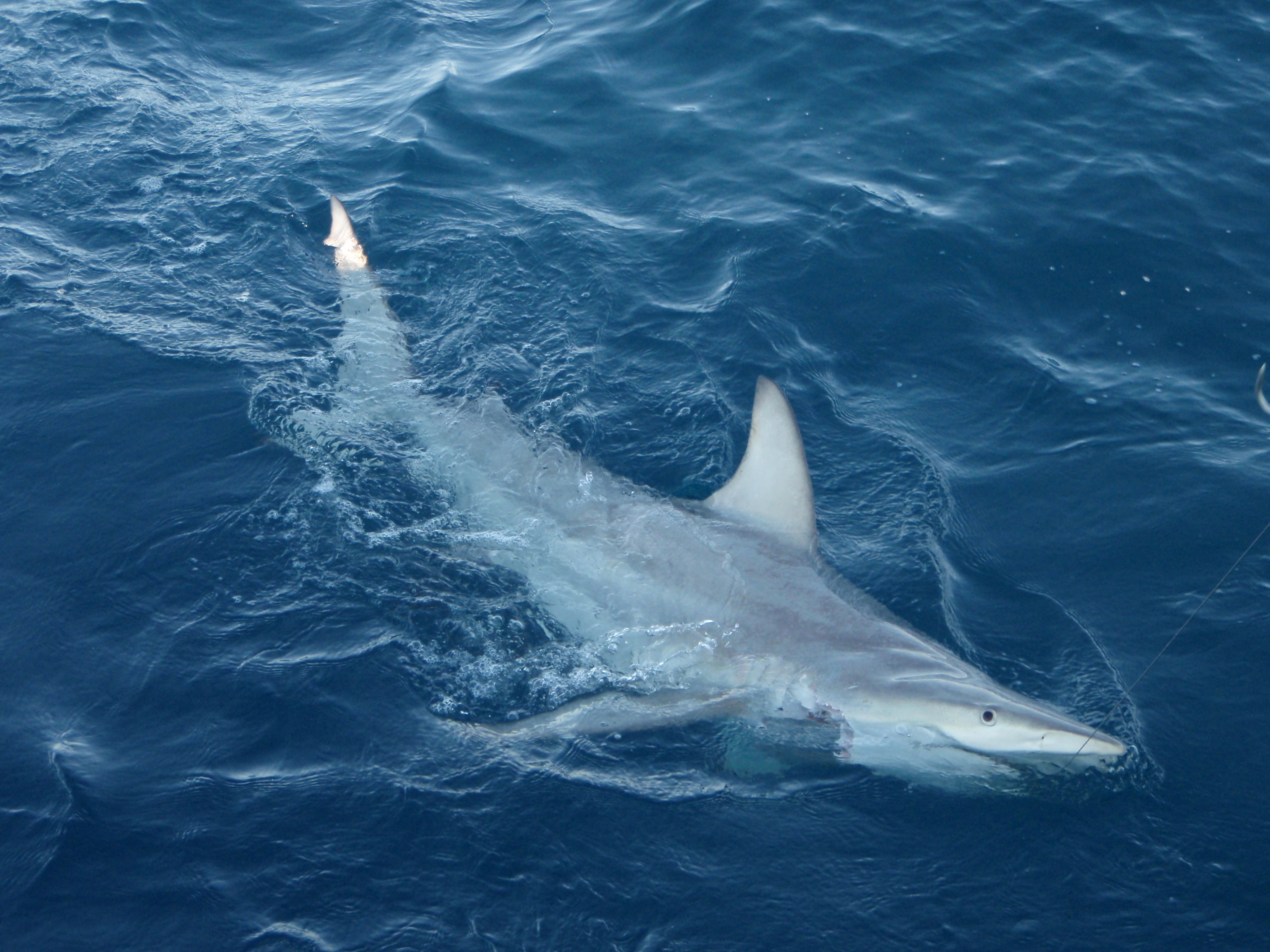
Photo credit: study author Pascal Geraghty, New South Wales Department of Primary Industry
Last week, a team of 10 Australian scientists announced that they had found the world’s first “shark hybrids”, offspring of individuals from two different shark species which had interbred. During a routine survey of Australian marine life, 57 sharks were found that physically resembled one species of shark, but had genetic markers inconsistent with that species. Subsequent genetic investigation revealed that these 57 animals were hybrids between common blacktip sharks (Carcharhinus limbatus) and Australian blacktip sharks (C. tilstoni).
Some of these hybrids were “F1″, meaning that one parents was a common blacktip and one was an Australian blacktip. Others were “B+”(backcrossed), which means that one parent was a common blacktip/Australian blacktip hybrid, and the other was a “purebreed” of one of those two species. According to the study’s lead author, Dr. Jess Morgan of the University of Queensland, ”our genetic marker tells us that these hybrids are ‘at least’ F1, and that these animals are reproductively viable and can produce an F2…the hybrids may be generations past F2 but the existing genetic markers can’t distinguish how many generations past the second cross have occurred.”
We see so many powerful designs in nature, yet when we design our own structure we tend to build rigid, fixed, industrial beasts. What designs in nature inspire you? How do we break away from a culture of hard edges and inflexible machines?
fish face a tradeoff of where to use their energy, much like the polluted fish in the Lorax by Dr. Suess
Overfishing is most often implicated as the cause of decreasing fish stocks and that makes a lot of logical sense if you’ve ever seen a large commercial trawler unload its catch. But there very well might be another force at work in the precipitous decline in fish stocks worldwide: pollution. The basic premise is that it takes resources to deal with pollutants that normally would be given to growth and reproduction. Through polluting the ocean, we have selected for the fish individuals that can most effectively divert those resources, inadvertently also selecting for smaller fish that reproduce less. That has huge implications for the fish’s population dynamics and potentially total fish stock. More details below the fold…
85 years ago today John Scopes was indicted for violating the Butler Law – a law that made it illegal to teach evolution in Tennessee. The Scopes Trial, engineered by several parties to bring attention to both Dayton, Tennessee and the controversial anti-evolution laws, left a lasting mark on America’s legal system and the public perception of science. It was the bombastic firebrand H. L. Menken, one of the architects of the trial, that summerised best the spirit of the Monkey Trail:
The way to deal with superstition is not to be polite to it, but to tackle it with all arms, and so rout it, cripple it, and make it forever infamous and ridiculous. Is it, perchance, cherished by persons who should know better? Then their folly should be brought out into the light of day, and exhibited there in all its hideousness until they flee from it, hiding their heads in shame.
This is the first entry in Crowdsourcing ConGen. This entry is meant to be half of an Introduction which lays out the framework for what conservation genetics is, its philosophical basis in population genetics, and why it’s a meaningful method of inquiry for conservation. This first section is meant to outline foundational concepts in population genetics. It is not meant to be a detailed summery of population genetics, but needs to be accurate and clear.
Longtime readers know that I get really excited by clear (or not so clear) cases of convergent evolution. Pound for pound, convergence is the most persuasive evidence for the truth of evolution out there; different lineages finding novel paths to the same solution. While I mostly talk about convergences in morphology, genetic convergence is often even more fascinating. Enter the bizarre case of the serpent and the platypus.
The title of this post is followed by a question mark. That is because what follows is not a statement of fact but a puzzle that I have been mulling over in my head since a photograph was published early last year. I do fervently hope the authors of the paper will forgive me for not citing the picture directly, the full citation can be found at the end of this post. I do this only because I want to lead off with a mystery.
Recent Comments