
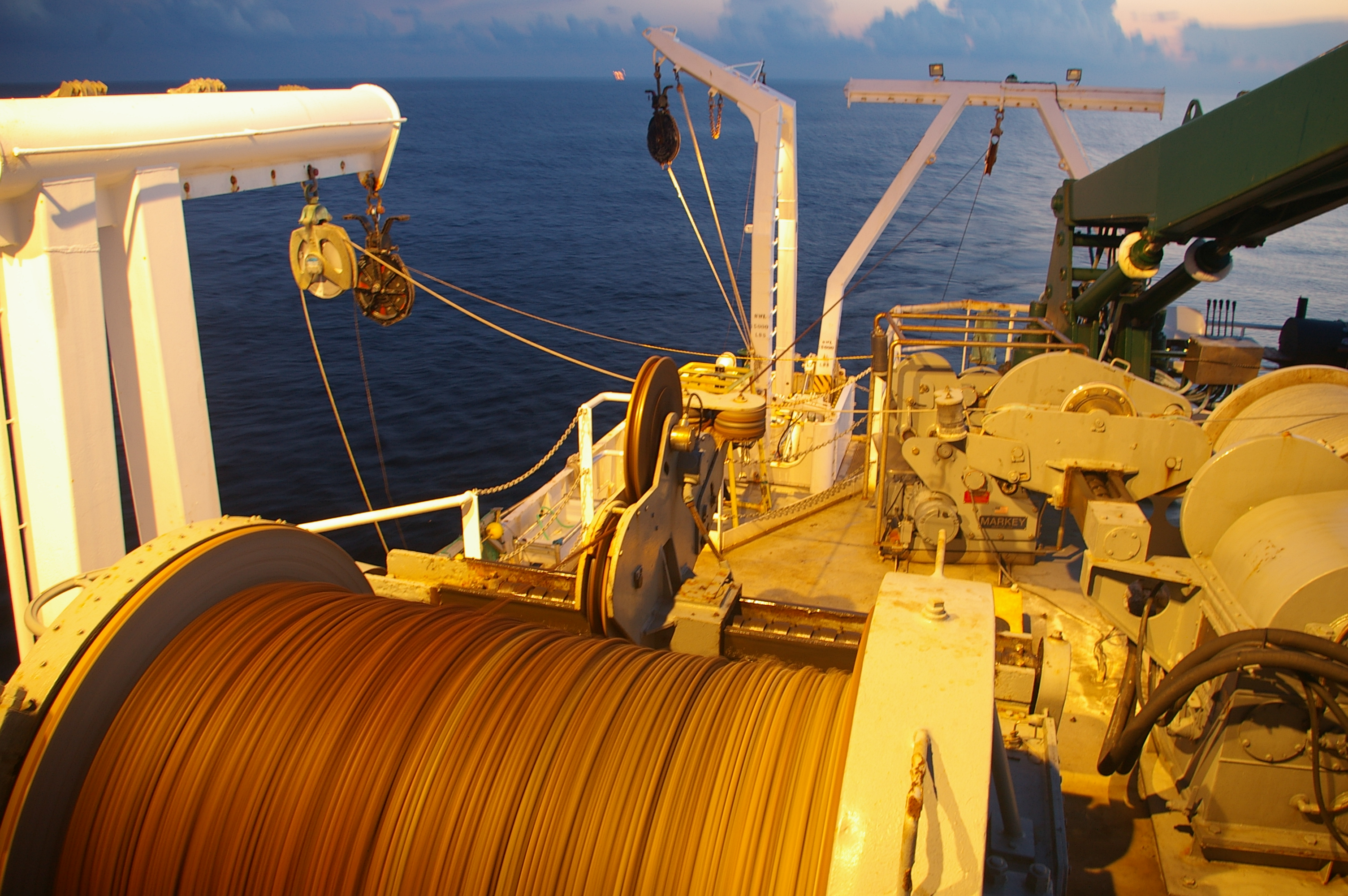
The A-frame shuddered as the box core, heavy with mud and reeking of sulfur, emerged from the water. We knew that it had found its mark 2300 meters below. Soft sediment from the seafloor oozed out the sides as I slid the safety pins into the spade arm. There was nothing visibly special about this mud. No ancient arthropods or primeval polychaetes crawled through this muck. It was a cubic meter of sticky, stinking glop. My first sample.
We were in the middle of the Gulf of Mexico, aboard the R/V Cape Hatteras. Our cruise objectives were to characterize the pelagic and benthic fauna associated with deep-sea methane seeps. For me, it was a ship of opportunity. In exchange for and extra set of hands to work the gear and process samples, I could add my own small research project to the cruise objectives. My goal was to collect sediment cores from multiple sites and survey the diversity of fungi associated with these methane seeps.
The 12 hour shifts rarely left me enough time to eat meals. Though I had never seen the equipment before we left port I became the acoustic tracking technician, out of necessity. Things consistently went wrong. Nets tore, gear broke, a misfired box core almost crushed my leg. Two hurricanes, one a category 5, hit the Gulf of Mexico while we were at sea. Work was exhausting and rest was brief, when existent. I loved every minute of it.
The end of that cruise was the high point of a 4 year project that began with unbridled optimism and early, exciting results, only to decay into drudgery, failure, desperation, and collapse. In the end, it would rise from the past for one small victory. In hindsight, so much of those four years seems painfully trivial, but this story is really about how much of a human being is poured into a scientific manuscript.
Read More “The importance of failure in graduate student training” »