Andrew is a post-doctoral researcher in North Carolina focused on population and conservation genetics in hydrothermal vent communities.


David is a graduate student in Florida. He studies the ecology and conservation of sharks.


Amy is a graduate student in North Carolina studying local ecological knowledge within small scale fisheries.


Chuck is a graduate student in North Carolina focusing on apex predators and how they interact with fisheries.


Lyndell is a graduate student in North Carolina, studying the feeding ecology of cownose rays.


Iris is a graduate student in Washington studying habitat use and feeding habits of juvenile Pacific salmon and herring in Puget Sound.


Michael is a graduate student in Maryland investigating the visual systems of mantis shrimp.


Archives

Return from the Cayman Abyss: cruise post-mortem and some thoughts on media coverage

AndrewThumbAt 7 AM EST on Monday, February 25, the ROV Isis rose from the depths of the Cayman Abyss, bringing to a close the 82nd cruise of the RRS James Cook. During JC82, we explored two recently discovered hydrothermal vents fields in the Cayman Trough: Von Damm, named for the late marine geochemist Karen Von Damm, and Beebe, named for the 20th century explorer William Beebe. By any measure, JC82 was a massive success. The samples and videos we’ll bring back will provide ecologists, geologists, and chemists with new insights into fundamental ocean systems for years. The images alone, some beautiful, some heart-breaking, have already inspired.

bacteriamatssmall

Eyeless shrimp, dancing anemones, and a garden of filamentous bacteria. I’m a pretty good writer, and I can’t even begin to describe how beautiful this is. Photo Credit: NERC

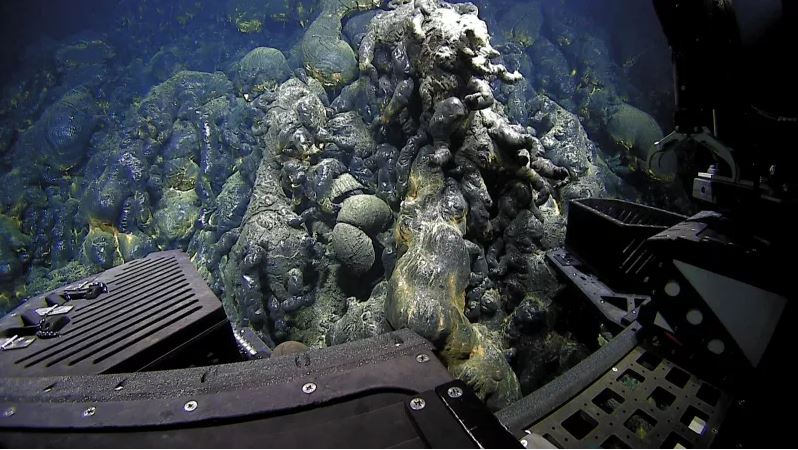
Since I last updated the blog on our adventures exploring the Cayman Trough, we’ve had a steady stream media coverage, most of which has been excellent, some of which has been… strange. It’s been fascinating watching the articles come out, seeing what different media outlets consider the story, and, most important to me, getting a chance to share our adventure with a wide audience. Now that the #DeepestVents cruise is officially over (and we’re in transit to yet another, equally exciting bolt on cruise to investigate submerged lava flows off the island of Montserrat), I thought it would be a good opportunity to reflect on the cruise, the story, and how the media shaped it.

Continue reading Return from the Cayman Abyss: cruise post-mortem and some thoughts on media coverage

This Week in the Deep

New and noteworthy publications in deep-sea science for the week of January 21, 2013.

Geobiology: Did life originate from a global chemical reactor?

Many decades of experimental and theoretical research on the origin of life have yielded important discoveries regarding the chemical and physical conditions under which organic compounds can be synthesized and polymerized. However, such conditions often seem mutually exclusive, because they are rarely encountered in a single environmental setting. As such, no convincing models explain how living cells formed from abiotic constituents. Here, we propose a new approach that considers the origin of life within the global context of the Hadean Earth. We review previous ideas and synthesize them in four central hypotheses: (i) Multiple microenvironments contributed to the building blocks of life, and these niches were not necessarily inhabitable by the first organisms; (ii) Mineral catalysts were the backbone of prebiotic reaction networks that led to modern metabolism; (iii) Multiple local and global transport processes were essential for linking reactions occurring in separate locations; (iv) Global diversity and local selection of reactants and products provided mechanisms for the generation of most of the diverse building blocks necessary for life. We conclude that no single environmental setting can offer enough chemical and physical diversity for life to originate. Instead, any plausible model for the origin of life must acknowledge the geological complexity and diversity of the Hadean Earth. Future research may therefore benefit from identifying further linkages between organic precursors, minerals, and fluids in various environmental contexts.

Continue reading This Week in the Deep

This Week in the Deep

New and noteworthy publications in deep-sea science for the week of January 14, 2013.

Continue reading This Week in the Deep

This Week in the Deep

New and noteworthy publications in deep-sea science for the week of January 7, 2013.

Deep Sea Research Part 1: Oceanographic Research Papers: Discovery of a new hydrothermal vent based on an underwater, high-resolution geophysical survey


A new hydrothermal vent site in the Southern Mariana Trough has been discovered using acoustic and magnetic surveys conducted by the Japan Agency for Marine–Earth Science and Technology’s (JAMSTEC) autonomous underwater vehicle (AUV) Urashima. The high-resolution magnetic survey, part of near-bottom geophysical mapping around a previously known hydrothermal vent site, the Pika site, during YK09-08 cruise in June-July 2009, found that a clear magnetization low extends ~500 m north from the Pika site. Acoustic signals, suggesting hydrothermal plumes, and 10 m-scale chimney-like topographic highs were detected within this low magnetization zone by a 120 kHz side-scan sonar and a 400 kHz multibeam echo sounder. In order to confirm the seafloor sources of the geophysical signals, seafloor observations were carried out using the deep-sea manned submersible Shinkai 6500 during the YK 10-10 cruise in August 2010. These discovered a new hydrothermal vent site (12°55.30′N, 143°38.89′E; at a depth of 2922 m), which we have named the Urashima site. This hydrothermal vent site covers an area of approximately 300 m x 300 m and consists of black and clear smoker chimneys, brownish-colored shimmering chimneys, and inactive chimneys. All of the fluids sampled from the Urashima and Pika sites have chlorinity greater than local ambient seawater, suggesting subseafloor phase separation or leaching from rocks in the hydrothermal reaction zone. End-member compositions of the Urashima and Pika fluids suggest that fluids from two different sources feed the two sites, even though are located on the same knoll and separated by only ~500 m. We demonstrate that investigations on hydrothermal vent sites located in close proximity to one another can provide important insights into subseafloor hydrothermal fluid flow, and also that, while such hydrothermal sites are difficult to detect by conventional plume survey methods, high-resolution underwater geophysical surveys provide an effective means.


Continue reading This Week in the Deep

An open letter to my newborn niece

Dear Tinsley,

Welcome to the world. I know it must feel like a very small world right now–just big enough to keep you safe and sheltered and loved–but trust me, as you keep growing, so will the world. Even after you stop growing, it will keep getting bigger. This big, old world that you have suddenly appeared in is huge and strange and beautiful and mysterious. There is more to discover in this world than all of us who have ever lived, working together, can ever know. Even before you can speak, you will think things and know things that no one has ever thought or known before. That is wonderful.

We are explorers. Not just your aunt and uncle, or your family, but all of us: this whole, gigantic group of people that call ourselves “humanity”. Today, there are over 7 billion of us and every last one, every person you will ever meet, can trace their heritage back, through thousands of millennia, to a small tribe of primates somewhere on the African savannah  We were explorers then, too. This tribe made its way across Europe and Asia. They sailed across the Pacific to Australia and a thousand tiny islands. They marched across the Bering Sea–land once connected Alaska to Russia–and traveled all the way down to the tip of South America. And, no matter how far they traveled, no matter how much they explored, the world just kept getting bigger.

We’re still exploring, today. We’ve built an enormous machine called the Large Hadron Collider–some say it’s the most complicated machine humanity has ever built—that allows us to explore the tiniest things in the universe: the sub-atomic particles that hold our world (and every world) together. We’ve even begun to explore beyond our own world. We have massive telescopes that allow us to explore distant galaxies. We’ve built probes that have left our own solar system. We have satellites orbiting Jupiter and Saturn. This summer, we landed a robot on Mars. It has already discovered that Mars was once more like our own world than we previously believed. We named that robot “Curiosity”.

Continue reading An open letter to my newborn niece

Return of the Science of Aquaman: Welcome to the Trench

Seriously, is no one else bothered by the fact that his trident has five points? Aquaman: The Trench. From DC Comics.

Seriously, is no one else bothered by the fact that his trident has five points? Aquaman: The Trench. From DC Comics.

After reducing Aquaman to a hypothermic, hyposmotic, constantly famished, case study in psychological trauma, I figure that I owe the king of Atlantis a second chance. After all, Aquaman was and still remains the most interesting hero in the DC universe. A generous fan sent me a copy of Aquaman Volume 1: The Trench, arguing that the New 52 version of everybody’s favorite aquatic hero is even more compelling than previous incarnations, with a stronger backstory, powers that make sense, and plenty of humor.

Last time I paid the hapless mariner a visit, many readers interpreted my incisive criticism of the science behind Aquaman as evidence that I had it out for our scale-clad hero. Since you all know that I’m going to take the misguided marine science in this volume to task, let’s start with all of the good stuff in this reimagination of DC’s oft-mocked champion.

The central conceit of New 52 Aquaman is that the comic book world has the same perception of Arthur Curry that we do–a hero with oddly specific and mostly useless powers that talks to fish. In addition, the citizens of the DC Universe believe that Atlantis is a fairy tale, so Aquaman’s kingly status is meaningless to the surface dwellers. The hybrid of a human father and Atlantean mother, Aquaman feels out of place in Atlantis and chooses to return to the surface with his wife, Mera. Comparing himself to his lighthouse-keeper father, he explains that even though he loves the sea, someone must protect the shore.

Continue reading Return of the Science of Aquaman: Welcome to the Trench

A selection of primary literature on the ecology of deep-sea hydrothermal vents in Manus Basin

Deep-sea mining is once again in the news. As Kevin Zelnio frustratingly points out on twitter, news articles often fail to mention the primary research that has been conducted at these sites or make more than a cursory statement concerning their ecology. This has the effect of marginalizing an entire ecosystem and makes it difficult for the public to grasp the richness and diversity of deep-sea hydrothermal vent communities, some of which may face commercial exploitation. Here is a selection of recent primary literature, with abstracts, on the ecology of deep-sea hydrothermal vents at the center of the mining debate, Manus Basin (you may recognize some of the authors).

Continue reading A selection of primary literature on the ecology of deep-sea hydrothermal vents in Manus Basin

VentBase – securing the conservation of deep-sea hydrothermal vent ecosystems

As a marine biologists just beginning my deep-sea education, conservation as a priority was an alien concept. The deep sea was the last true wilderness, distant and alien, impossibly difficult to access. We knew that exploitation was coming, companies had been exploring the potential of deep-sea mining for decades, but they always seemed to be generation away. Conservation was a question for my scientific descendants. For my peers and me, we still had a few good decades left in the golden age of exploration that began in the 1970’s with the first discovery of deep-sea hydrothermal vents. That age is about to end.

The reality of deep-sea exploitation is imminent. The first hydrothermal vent mining lease has been issued in the territorial waters of Papua New Guinea. The International Seabed Authority, which regulates seafloor extraction in international waters, has approved the first two mining exploration permits for seafloor massive sulfides in international waters. Manganese nodule extraction, once quashed by a global decline in metal prices, has recently reappeared. Crustal metal deposits are fast becoming a viable resource. The isolation of rare earth elements from the seafloor, a newcomer in deep-sea exploitation, could open up new, massive deposit for critical electronic components. All of these are likely to occur within the next few decades.

Continue reading VentBase – securing the conservation of deep-sea hydrothermal vent ecosystems

Updates from the Deep: New and Noteworthy in Hydrothermal Vent Research

From hairy-chested yeti crabs to the deepest known fields, hydrothermal vents have been enjoying a bit of science celebrity in the last few weeks. Beneath the headlines, there has been an eruption of vent-related research published in the scientific literature and some exciting new expeditions just left port.

The Discovery of New Deep-Sea Hydrothermal Vent Communities in the Southern Ocean and Implications for Biogeography

'Hoff' crabs in paradise. Image from ChEss Southern Ocean Consortium

'Hoff' crabs in paradise. Image from ChEss Southern Ocean Consortium

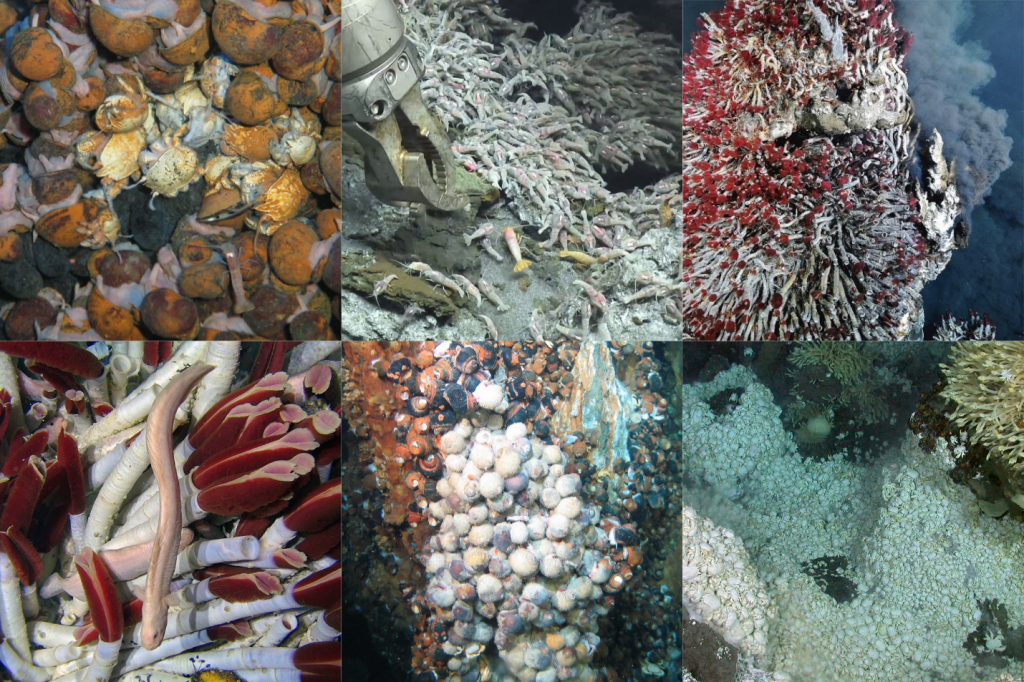
The exhaustive author list on this paper reads like a who’s who in hydrothermal vent biogeography. This is the paper that introduced “the Hoff” crab to the world, but the findings are far more significant. Hydrothermal vent systems are sorted into biogeographic provinces, with different regions supporting different communities. The iconic giant tube worms dominate the eastern Pacific, while the western Pacific (prominently featured in Deep Fried Sea) plays host to fist sized snails, and the Atlantic features shrimp as its dominant species. There are several missing gaps in our understanding of how these qualitatively different communities are connected – the Southern Ocean, the south Atlantic, the Indian Ocean, and the Cayman Trough, among others. Filling in these gaps in our knowledge can help us understand the history and evolution of hydrothermal vent ecosystems.

Continue reading Updates from the Deep: New and Noteworthy in Hydrothermal Vent Research

Rumors from the Abyss: visions of a future without deep sea conservation

Bathymetric map, click for GEBCO high resolution image

The deep benthos is simultaneously the largest and least explored ecosystem on the planet. Covering nearly 60% of the Earth’s surface, it supports an almost unimaginable reservoir of biodiversity, rivaling all terrestrial habitats combined. Its microbial and metabolic diversity have revolutionized our view of how life is sustained, not once, but twice (first with the discovery of chemoautotrophic organisms at hydrothermal vents, and again with the discovery of cognate communities at methane cold-seeps). In spite of these major discoveries, the deep benthos is essentially invisible. Only a select few will ever witness it first hand, while for the rest, it will remain a dark and unfathomable abyss.

This places the deep benthos in a precarious position. Human activities that influence the deep sea go unnoticed. Without a thorough understanding of its ecology, it is impossible to assess the damage caused by anthropogenic impacts. Although recent and ongoing studies have shed light on many species and communities, the deep benthos remains largely unexplored. Two studies, both released this week, reveal simultaneously how little we know about the deep benthos and how human impacts, even unintentional ones, could shape this ecosystem.

Continue reading Rumors from the Abyss: visions of a future without deep sea conservation