Skip to content

Southern Fried Science

Over 15 years of ocean science and conservation online

  • Home
  • About SFS
  • Authors
  • Support SFS

Tag: lipids

Beneath the Broken Ice: Playing with Mud

Posted on April 18, 2012April 18, 2012 By Guest Writer
Science

Megumi Shimizu is a graduate student aboard the RVIB Nathaniel B. Palmer to collect sediment samples near Antarctic Peninsula as a part of the LARISSA project. She is interested in microorganisms and biogeochemistry of marine sediments; how the metabolism of microorganisms interact with the surrounding environment and the chemical components in sediments. See her first update here.


Are you playing with mud on the research vessel?

Some people on the ship joked when they saw me processing my sediment core. Yes, I’m playing with mud in Antarctica. Sampling sediments can tell us a lot, not only what happened across geologic time scales, but also what kind of organisms are living in the sediment, microbiology, and the geochemical conditions. We are serious about collecting mud and playing with mud.
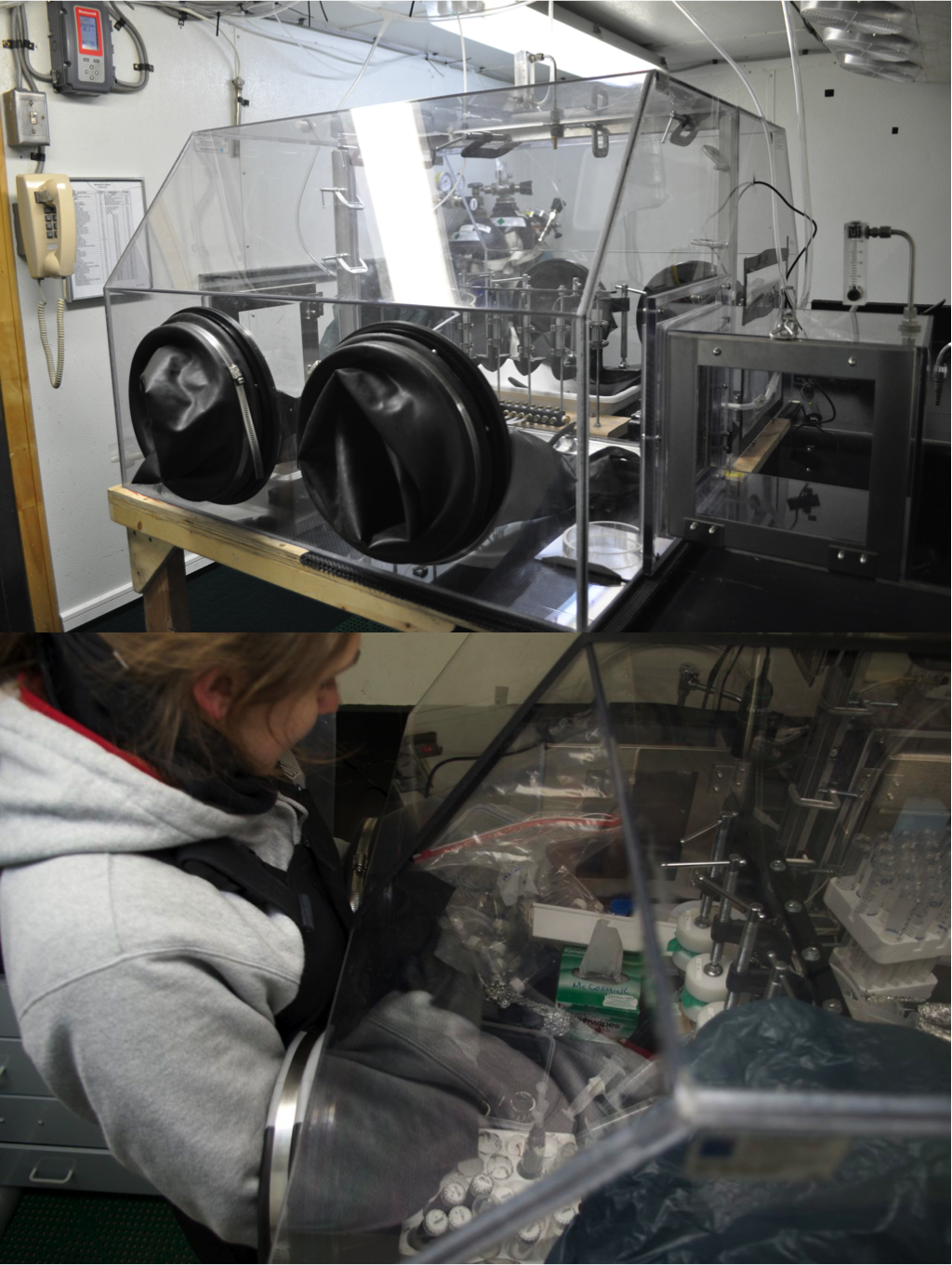
upper panel: the entire view of glove box, lower panel: Liz Bucceri working on sediment sample processing in glove box. Photo by Megumi Shimizu

Nathaniel B. Palmer has three pieces of equipment to collect sediment; the megacore, kasten core, and jumbo piston core. The length you can reach below seafloor is different, 40cm, 1.5 to 6m and 24m respectively. Megacore is more suitable for biological studies since it preserves the sediment-water interface better than kasten core and jumbo piston core. Geological studies prefer Kasten core and jumbo piston core so that they can get older data from the sediment.

For my microbial lipid biomarker study, I’m taking samples from the megacore and kasten core. Along with microbial lipid and DNA, our team is collecting sediment and porewater (the water in pore spaces of sediments) to analyze geochemical properties of sediments, such as methane, sulfate, sulfide, and dissolved inorganic carbon. To maintain the condition of the sediments as close as the real environment, the sediment cores are processed under the condition of cold (~0C degree) and anoxic (no oxygen). How to make that condition? We have a special room called “The Little Antarctica”, on the ship, which is a big refrigerator containing glove box. A glove box is the transparent container with two pairs of gloves. The inside of the box is kept practically anoxic (less than 1% of oxygen. Atmospheric oxygen is ~20%).
Read More “Beneath the Broken Ice: Playing with Mud” »

Beneath the Broken Ice: Megumi Shimizu on the 2012 LARISSA Campaign to the Antarctic Peninsula

Posted on March 12, 2012 By Guest Writer 1 Comment on Beneath the Broken Ice: Megumi Shimizu on the 2012 LARISSA Campaign to the Antarctic Peninsula
Science

Megumi Shimizu is a graduate student studying microorganisms in marine sediment. She is currently on board the RVIB Nathaniel B. Palmer exploring seafloor communities in a once ice-covered region beneath the Larsen Ice Shelf. Over the next month, she will be updating us from the field.


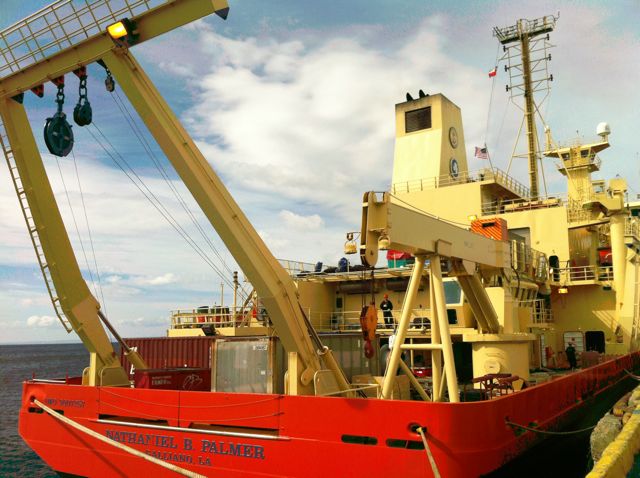
The RVIB Nathaniel B. Palmer. photo by Megumi Shimizu

I’m a PhD student interested in microorganisms and biogeochemistry of marine sediments; how the metabolisms of microorganisms interacting with the surrounding environment, the chemical components in sediments. Microorganisms in subseafloor are universally important because of its large biomass. It is said 50% of prokaryotes are living under the seafloor. This biomass makes large carbon and nutrients reservoir, which are important in biogeochemical cycle. For example, microorganisms play the role of organic carbon decomposition in sediments, as a result, carbon dioxide and methane are produced. In contrast, carbon dioxide and methane are also consumed by microorganisms called chemolithotrophs and methanotrophs in sediments. Therefore, understanding microorganisms in sediments; who they are, what are they doing, is important to reveal the details of global biogeochemical cycle and accurate estimate of budgets (amount of elements converted to different forms of chemicals for example, amount of carbon dioxide converted into organic carbon by carbon fixation). In addition, how microbial community response to environmental changes such as climate warming is also important in terms of the influence of global elemental cycles.

Read More “Beneath the Broken Ice: Megumi Shimizu on the 2012 LARISSA Campaign to the Antarctic Peninsula” »

Popular Posts

The story of the pride flag made from NASA imagery: Bluesky's most-liked imageThe story of the pride flag made from NASA imagery: Bluesky's most-liked imageSeptember 27, 2024David Shiffman
"Why Sustainable Seafood Matters" is now available for preorder! Here's what it's about, and why I decided to write it."Why Sustainable Seafood Matters" is now available for preorder! Here's what it's about, and why I decided to write it.June 8, 2026David Shiffman
I just told 850 shark scientists a hard truth: We’re not communicating shark conservation correctly.I just told 850 shark scientists a hard truth: We’re not communicating shark conservation correctly.June 1, 2026David Shiffman
What Ocean Ramsey does is not shark science or conservation: some brief thoughts on "the Shark Whisperer" documentaryWhat Ocean Ramsey does is not shark science or conservation: some brief thoughts on "the Shark Whisperer" documentaryJuly 2, 2025David Shiffman
Deep-sea Mining, Domestic Cats, Star Trek, and Ocean Exploration: Andrew's mid-year podcast round-up.Deep-sea Mining, Domestic Cats, Star Trek, and Ocean Exploration: Andrew's mid-year podcast round-up.June 6, 2026Andrew Thaler
Shark of Darkness: Wrath of Submarine is a fake documentaryShark of Darkness: Wrath of Submarine is a fake documentaryAugust 10, 2014Michelle Jewell
Why ocean science is still one of the worst-funded scientific fields worldwideWhy ocean science is still one of the worst-funded scientific fields worldwideJune 3, 2026Chris Parsons
That's not a blobfish: Deep Sea Social Media is Flooded by AI SlopThat's not a blobfish: Deep Sea Social Media is Flooded by AI SlopDecember 19, 2025Andrew Thaler
What is a Sand Shark?What is a Sand Shark?November 12, 2017Chuck Bangley
Here's how to join my IMCC8 symposium, "Ocean Science Communication: What's New and What's Next?"Here's how to join my IMCC8 symposium, "Ocean Science Communication: What's New and What's Next?"April 22, 2026David Shiffman
Subscribe to our RSS Feed for updates whenever new articles are published.

We recommend Feedly for RSS management. It's like Google Reader, except it still exists.

Southern Fried Science

  • Home
  • About SFS
  • Authors
  • Support SFS


If you enjoy Southern Fried Science, consider contributing to our Patreon campaign.

Copyright © 2026 Southern Fried Science.

Theme: Oceanly Premium by ScriptsTown