Transcript available below.
Tag: marine mammals
Uncategorized
Cuttings (short and sweet): Follow Louise Chavarie, an Arctic aquatic ecologist, on twitter! A squid-skin inspired invisibility cloak. From Nature News research updates. Underwater noise pollution disturbs fish, too. From CBC News. NOAA publishes list of global fisheries and their risks to marine mammals. By John Cannon, for MongaBay Antarctic ice melting faster than thought. By … Read More “Invisible squid and fish with glowing eye spikes: Thursday Afternoon Dredging, April 5th, 2018” »
Uncategorized
Cuttings (short and sweet): Follow shark and ray biologist Jeremy Vaudo on twitter! Science may have a reason why whales get so big. By Carrie Arnold, for National Geographic. Paleo profile: The fish from China. By Brian Switek, for Scientific American. Mass stranding in Australia claims 130 whales. Video, for the Guardian. Spoils (long reads and … Read More “Giant whales and collapsing cod stocks: Thursday Afternoon Dredging, March 29th, 2018” »
Blogging, Conservation
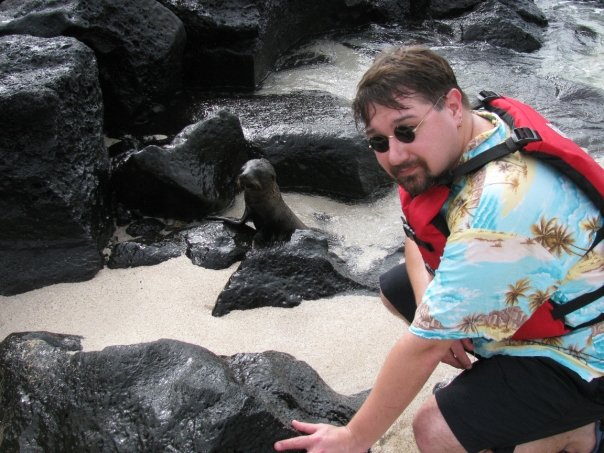 Dr. Chris Parsons has been involved in whale and dolphin research for over two decades and has been involved in research projects in every continent except Antarctica. Dr. Parsons is an Associate Professor at George Mason University as well as the undergraduate coordinator for their environmental science program. He’s a member of the scientific committee of the International Whaling Commission (IWC), has been involved in organizing the International Marine Conservation Congress (IMCC) (the world’s largest academic marine conservation conference) and is currently the Conference Chair and a Governor of the Society for Conservation Biology. In addition, Dr. Parsons has published over 100 scientific papers and book chapters and has written a textbook on marine mammal biology & conservation.
At a recent conference of marine scientists I attended, one of the speakers announced, albeit tongue in cheek, that they “hated dolphins”. This prompted a round of applause and cheers from the largely marine biologist audience, much to the chagrin of the marine mammal researchers in the audience (there were several, and almost all of these were involved in marine mammal conservation).That sort of attitude unfortunately is common in the marine biology community. There seems to be a misapprehension that dolphin researchers get all the glamour, glory and funding, and to paraphrase Yoda, this leads to hate, and hate leads to suffering.
I’ve been studying dolphins (mostly in conservation-focused research) for over 20 years, and admittedly it has led to some rather nice trips on boats, sometimes in warm tropical locations. But it has also been 20 years with marine biologist colleagues constantly commenting that dolphin research is not “real marine biology” – even to the extent of having a reviewer say that, in response to a manuscript. Within the marine mammal science professional societies this has led to the rather unfortunate situation where: (a) marine mammalogists keep themselves to themselves with their own journals and conferences and not mixing with many other streams of marine biology; (b) there is such a fear of being seen as “not a real scientist” that within the marine mammal science community there is frequently a stigma against doing any applied, or interdisciplinary, or non-pure science research, including research that is conservation-oriented. This is at a time when such research is drastically needed, with so many cetacean species being endangered. In fact, a study on cetacean science literature determined that about half of the studies could be important to conservation, but unfortunately much of the information lies locked within the ivory tower, and the relatively few ivory towers of marine mammalogists at that.
Science

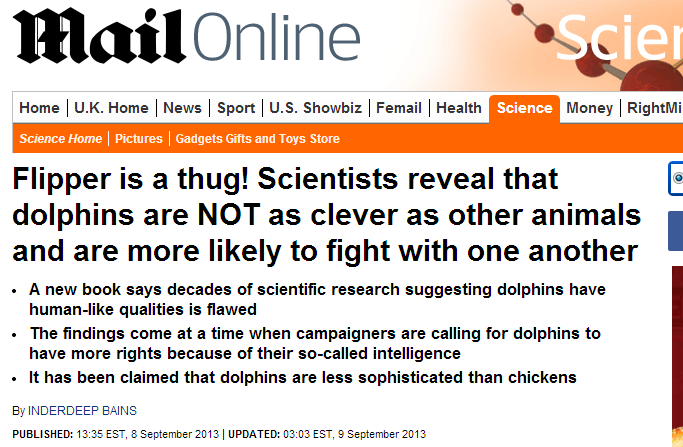
Earlier this week, the Daily Mail ran an article which claimed that dolphins are not as intelligent as is commonly believed. The crux of this provocative argument comes from an interview with Dr. Justin Gregg, a research associate with the dolphin communication project who studies social cognition.
According to the Daily Mail article, Justin Gregg said, “Dolphins are fascinating in their own right, but in terms of intelligence they are nowhere near as special as they have been portrayed…they are less sophisticated than chickens.” In an editorial that was likely the source of the Daily Mail article, the Sunday Times claims that he said “Not only are dolphins dimmer than the average chicken, says Justin Gregg, a zoologist, but they are also capable of gang rape and acts of violence. So don’t be taken in by those winning smiles.”
Unsurprisingly, this article has ruffled some feathers in the marine mammal researcher community.
Science
On World Oceans Day, I asked the online marine science and conservation community to tweet their favorite facts about the ocean using the hashtag #OceanFacts . Dozens of people joined the discussion, and more than 300 #OceanFacts were contributed. These tweets cover a variety of topics, from marine invertebrates, fish, sharks, and marine mammals to facts about the ocean itself and conservation policy. The discussion also inspired a great deal of humorous posts, including an entire spinoff #OceanFibs hashtag. Some of my favorite #OceanFacts tweets are saved in the Storify below.
Science
This 2011 Beneath the Waves Film Festival entry comes from Paul Hillman at NOAA. What Do Marine Mammals Eat? is part of the Microworlds series, which focuses on NOAA scientists interacting with public school students.
Science
Keith Rittmaster discusses Bonehenge. For more on Bonehenge, check out http://bonehenge.org/ Read our previous posts about the project: Visiting Bonehenge and Bonehenge – Community action in science outreach
Science
The following is a repost from the old Southern Fried Science WordPress blog. The original can be found here.

If a 33.5 foot Sperm Whale (Physeter macrocephalus) stranded on your beach, what would you do with it? Leave it to rot? Drag it out to sea? Blow it up? Keith Rittmaster of the North Carolina Maritime Museum decided to do one better.
This blog has never been known for heaping praise on marine mammals, but these creatures are the exception. Sperm whales are extremely strange animals. There are some fantastic online resources available that do a great job covering basic sperm whale biology, so I’d like to skip the intro and talk about some sperm whale features I find fascinating.
Read More “Bonehenge – Community action in science outreach” »
Science
This time they’ve gone too far. In this economy, it’s hard enough to find employment as a marine scientist. Marine mammals are taking our jobs!