If interested citizens want to get involved in conservation and management policy, it’s absolutely vital to use proper terminology. The policy world can be full of confusing jargon, but there are few ways to discredit yourself in the eyes of decision makers as quickly as using a critical term incorrectly. In fact, it isn’t uncommon for a decision maker’s response to a petition or public comment to consist entirely of correcting inaccurate terminology, if a response is issued at all. There are well over 100 acronyms and terms that I’ve seen regularly used, but in the interest of brevity, I’ve selected what I believe to be the 15 most important terms that I’ve seen people repeatedly use incorrectly.
For each term, I’ve provided a definition from a scientific paper or technical report whenever possible. I have also provided some additional explanation in my own words, and some assistance from familiar memes. Whenever possible, I’ve linked to blog posts, articles, or websites that provide even more information. Most of these terms are broadly applicable to fisheries management policy, but some are specific to shark fisheries. It is not my intention with this post to strongly advocate for or against any specific policy (I do plenty of that with other posts), but to make sure everyone is speaking the same language.
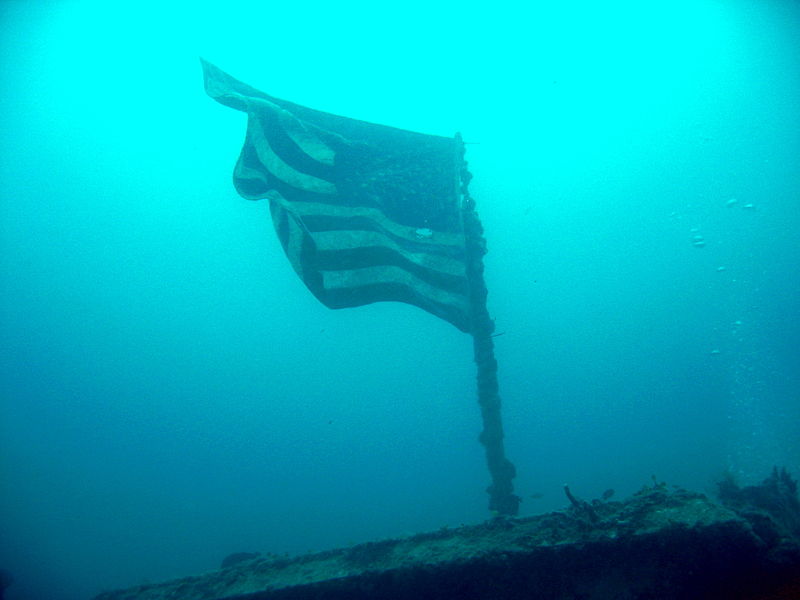
U.S. flag on the wreck of the Speigel Grove. Photo by Scott Hughes, via Wikimedia Commons
On Tuesday, after what seems like an eternity of campaigning, millions of Americans will head to the polls to vote for our next President. Voters will consider numerous important issues, such as the economy, national security, and the endorsement of Lindsay Lohan. Recent polling indicates that Americans are split, and the election is expected to be very close. On an issue near and dear to my heart, the conservation of the ocean and marine life, one candidate is by far the best choice. I endorse President Barack Obama for re-election.
Kristine Stump is a PhD candidate in Marine Biology and Fisheries at the University of Miami’s Rosenstiel School of Marine and Atmospheric Science (RSMAS). Her dissertation focuses on the effects of anthropogenic nursery habitat loss on juvenile lemon sharks in Bimini, Bahamas. She was the Principal Investigator of the Bimini Biological Field Station (BBFS, or Sharklab) from 2008 – 2011 while collecting field data for her degree and has been heavily involved in the process of establishing a Marine Protected Area in Bimini. Kristine has an M.A. in Marine Policy from RSMAS, and prior to entering the doctoral program, she spent five years working in Washington, DC at Ocean.US – the National Office for Integrated and Sustained Ocean Observations (now the NOAA IOOS Program). In addition, she has worked for the Census of Marine Life program office at the Consortium for Ocean Leadership in Washington, DC.
There is an apex predator roaming the seas. For hundreds of thousands of years, this beast has hunted in the waters of the world’s oceans. Relentless is it in its search along the shorelines for that which satisfies its primal urges. Its numbers ever on the rise, the destruction in its path knows no bounds. And now, in 2012, it wants to dominate the sea more than ever before: it wants glass-bottom bungalows. It needs yacht dockage at its vacation home. It craves manicured fairways. IT MUST HAVE AN INFINITY POOL!
If you haven’t already guessed, the apex predator here is man. Throughout history, the environment has shaped man, but now more than ever, man is shaping the environment. In the current era of environmental awareness, however, we have learned that there are limits to the anthropogenic changes ecosystems can withstand while still maintaining ecosystem function. Luckily, we have learned to implement mitigation strategies to offset, to some degree, the negative effects of human expansion.
In this week’s edition of Shark Science Monday, Grant Galland from the Scripps Institution of Oceanography discusses marine protected areas and sharks.
If you have a question for Grant, please leave it as a comment below and I’ll make sure he sees it.
Although marine fish face many threats, one of the greatest is large-scale modern commercial fishing. Technology makes it all too easy for so-called “factory ships” to remove enormous numbers of fish from the oceans, sometimes with devastating effects on the populations of those fish and their habitat.
Marine conservationists have proposed a variety of policies to protect fish populations around the world. Of these, the concept of the marine protected area (MPA) is arguably the most popular. Though technically a marine protected area is any area of the ocean where human activities are restricted in some way, the best known version is an area where fishing is banned with the goal of letting exploited fish stocks recover.
Recent Comments