Andrew is a post-doctoral researcher in North Carolina focused on population and conservation genetics in hydrothermal vent communities.
David is a graduate student in Florida. He studies the ecology and conservation of sharks.
Amy is a graduate student in North Carolina studying local ecological knowledge within small scale fisheries.
Chuck is a graduate student in North Carolina focusing on apex predators and how they interact with fisheries.
Lyndell is a graduate student in North Carolina, studying the feeding ecology of cownose rays.
Iris is a graduate student in Washington studying habitat use and feeding habits of juvenile Pacific salmon and herring in Puget Sound.
Michael is a graduate student in Maryland investigating the visual systems of mantis shrimp.
|
By Andrew David Thaler, on January 5th, 2013
New and noteworthy publications in deep-sea science for the week of December 31st, 2012.
PLoS One: How Deep-Sea Wood Falls Sustain Chemosynthetic Life
Large organic food falls to the deep sea – such as whale carcasses and wood logs – are known to serve as stepping stones for the dispersal of highly adapted chemosynthetic organisms inhabiting hot vents and cold seeps. Here we investigated the biogeochemical and microbiological processes leading to the development of sulfidic niches by deploying wood colonization experiments at a depth of 1690 m in the Eastern Mediterranean for one year. Wood-boring bivalves of the genus Xylophaga played a key role in the degradation of the wood logs, facilitating the development of anoxic zones and anaerobic microbial processes such as sulfate reduction. Fauna and bacteria associated with the wood included types reported from other deep-sea habitats including chemosynthetic ecosystems, confirming the potential role of large organic food falls as biodiversity hot spots and stepping stones for vent and seep communities. Specific bacterial communities developed on and around the wood falls within one year and were distinct from freshly submerged wood and background sediments. These included sulfate-reducing and cellulolytic bacterial taxa, which are likely to play an important role in the utilization of wood by chemosynthetic life and other deep-sea animals
Continue reading This Week in the Deep
By Andrew David Thaler, on October 16th, 2012

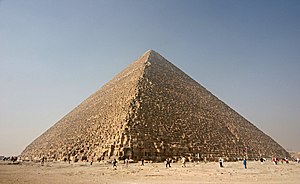
 Great Pyramid of Giza. Photo by Nina Aldin Thune.
Pharaoh Khufu must be rolling in his monumental grave. Since its construction in 2560 BC, the Great Pyramid of Giza stood as the largest man-made pyramid ever built*. For 3800 years, it held the title of the tallest man-made structure of any kind. It wasn’t until the Industrial Revolution that our buildings began dwarfing this wonder of the ancient world. Even still, the Great Pyramid is massive, with a volume of 2,580,000 cubic meters. But there is another pyramid, more massive than Giza, and it wasn’t built to entomb a mighty king. It’s not a monument of any kind. The largest (by volume) pyramid in the world resides in Alberta, Canada and it’s made entirely of sulfur.
Wait, what?
Continue reading Alberta, Canada is the proud owner of the largest man-made pyramid on the planet
By Andrew David Thaler, on August 7th, 2012
Deep-sea mining is once again in the news. As Kevin Zelnio frustratingly points out on twitter, news articles often fail to mention the primary research that has been conducted at these sites or make more than a cursory statement concerning their ecology. This has the effect of marginalizing an entire ecosystem and makes it difficult for the public to grasp the richness and diversity of deep-sea hydrothermal vent communities, some of which may face commercial exploitation. Here is a selection of recent primary literature, with abstracts, on the ecology of deep-sea hydrothermal vents at the center of the mining debate, Manus Basin (you may recognize some of the authors).
Continue reading A selection of primary literature on the ecology of deep-sea hydrothermal vents in Manus Basin
By Andrew David Thaler, on April 16th, 2012
As a marine biologists just beginning my deep-sea education, conservation as a priority was an alien concept. The deep sea was the last true wilderness, distant and alien, impossibly difficult to access. We knew that exploitation was coming, companies had been exploring the potential of deep-sea mining for decades, but they always seemed to be generation away. Conservation was a question for my scientific descendants. For my peers and me, we still had a few good decades left in the golden age of exploration that began in the 1970’s with the first discovery of deep-sea hydrothermal vents. That age is about to end.
The reality of deep-sea exploitation is imminent. The first hydrothermal vent mining lease has been issued in the territorial waters of Papua New Guinea. The International Seabed Authority, which regulates seafloor extraction in international waters, has approved the first two mining exploration permits for seafloor massive sulfides in international waters. Manganese nodule extraction, once quashed by a global decline in metal prices, has recently reappeared. Crustal metal deposits are fast becoming a viable resource. The isolation of rare earth elements from the seafloor, a newcomer in deep-sea exploitation, could open up new, massive deposit for critical electronic components. All of these are likely to occur within the next few decades.
Continue reading VentBase – securing the conservation of deep-sea hydrothermal vent ecosystems
By Andrew David Thaler, on December 13th, 2011

 The shimmering insides of a vent chimney
In Jules Verne’s 20,000 Leagues Under the Sea*, the iconic Captain Nemo announced that “in the depths of the ocean, there are mines of zinc, iron, silver and gold that would be quite easy to exploit” while predicting that the abundance of marine resources could satisfy human need. If the pace of development for deep-sea mining projects and the estimated value of deep-sea ores is any indicator, it seems as though our misanthropic mariner was wrong on both counts.
In The abundance of seafloor massive sulfide deposits, an international team of geologists attempts to quantify the total available copper and zinc contained in deep-sea massive sulfide mounds. Seafloor massive sulfide mounds are a byproduct of the processes that create deep-sea hydrothermal vents. As super-heated sea water emerges from the vent, it deposits heavy metals and other elements and minerals along the walls of the vent. Over thousands of years, an active vent field can build up a huge mound of metal and mineral rich ore – a massive sulfide mound. In addition to copper and zinc, these mounds can contain gold and silver. Generally, the ore is of much higher quality than its terrestrial counterpart. Over the last few decades, many exploration companies were eyeing these deposits, but it’s only recently that technological developments and economic incentives have aligned to permit potentially profitable deep-sea mining.
Continue reading Mining the Deep Sea: what’s it worth?
By Andrew David Thaler, on July 6th, 2011

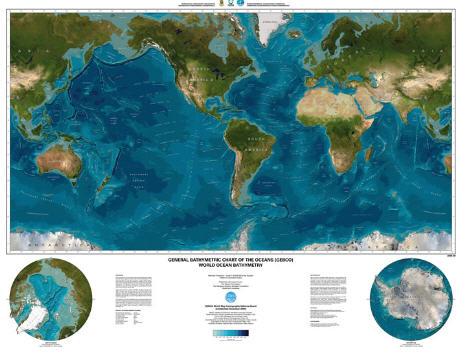
 Bathymetric map, click for GEBCO high resolution image
The deep benthos is simultaneously the largest and least explored ecosystem on the planet. Covering nearly 60% of the Earth’s surface, it supports an almost unimaginable reservoir of biodiversity, rivaling all terrestrial habitats combined. Its microbial and metabolic diversity have revolutionized our view of how life is sustained, not once, but twice (first with the discovery of chemoautotrophic organisms at hydrothermal vents, and again with the discovery of cognate communities at methane cold-seeps). In spite of these major discoveries, the deep benthos is essentially invisible. Only a select few will ever witness it first hand, while for the rest, it will remain a dark and unfathomable abyss.
This places the deep benthos in a precarious position. Human activities that influence the deep sea go unnoticed. Without a thorough understanding of its ecology, it is impossible to assess the damage caused by anthropogenic impacts. Although recent and ongoing studies have shed light on many species and communities, the deep benthos remains largely unexplored. Two studies, both released this week, reveal simultaneously how little we know about the deep benthos and how human impacts, even unintentional ones, could shape this ecosystem.
Continue reading Rumors from the Abyss: visions of a future without deep sea conservation
|
|
Recent Comments