
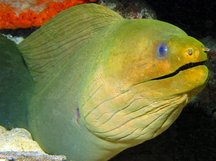
Since they are typically observed hiding in dark crevices while opening and closing their mouths in an apparently menacing gesture, it isn’t surprising that moray eels get a bad reputation. The fact that their sharp teeth face backward (causing severe damage to anyone trying to pull their hand out of a moray’s mouth) doesn’t help this reputation, and neither does the recent discovery that morays have a second set of “Alien”-like jaws that drags prey deep into their mouth and throat. The truth isn’t quite so simple. Most people know very little about these amazing animals.
The green moray (pictured above) is the most famous member of this group, but there are more than 200 species in the family Muraenidae. Green morays are not even really green (a yellow mucus deposited on a dark body creates the illusion of green skin). Snyder’s morays are less than a foot long when full grown, while giant slender morays can reach lengths of over 10 feet. Morays live in an impressive variety of habitats, including temperate and tropical seas, depths of several hundred meters, and even freshwater.