Andrew is a post-doctoral researcher in North Carolina focused on population and conservation genetics in hydrothermal vent communities.


David is a graduate student in Florida. He studies the ecology and conservation of sharks.


Amy is a graduate student in North Carolina studying local ecological knowledge within small scale fisheries.


Chuck is a graduate student in North Carolina focusing on apex predators and how they interact with fisheries.


Lyndell is a graduate student in North Carolina, studying the feeding ecology of cownose rays.


Iris is a graduate student in Washington studying habitat use and feeding habits of juvenile Pacific salmon and herring in Puget Sound.


Michael is a graduate student in Maryland investigating the visual systems of mantis shrimp.


Archives

15 important shark conservation and management terms explained with memes

davesquare

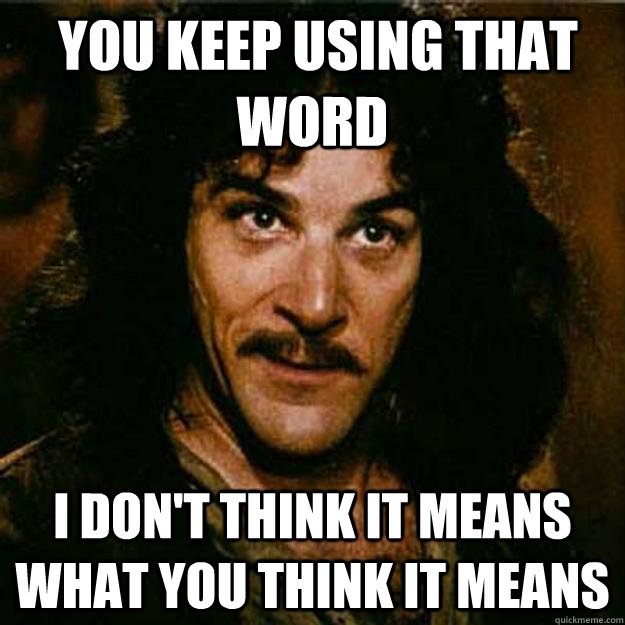
inigo-montoya-you-keep-using-that-word-i-dont-think-it-means-what-you-th-3b4b2920-sz625x625-animateIf interested citizens want to get involved in conservation and management policy, it’s absolutely vital to use proper terminology. The policy world can be full of confusing jargon, but there are few ways to discredit yourself in the eyes of decision makers as quickly as using a critical term incorrectly. In fact, it isn’t uncommon for a decision maker’s response to a petition or public comment to consist entirely of correcting  inaccurate terminology, if a response is issued at all. There are well over 100 acronyms and terms that I’ve seen regularly used, but in the interest of brevity, I’ve selected what I believe to be the 15 most important terms that I’ve seen people repeatedly use incorrectly.

For each term, I’ve provided a definition from a scientific paper or technical report whenever possible.  I have also  provided some additional explanation in my own words, and some assistance from familiar memes. Whenever possible, I’ve linked to blog posts, articles, or websites that provide even more information. Most of these terms are broadly applicable to fisheries management policy, but some are specific to shark fisheries. It is not my intention with this post to strongly advocate for or against any specific policy (I do plenty of that with other posts), but to make sure everyone is speaking the same language.

Continue reading 15 important shark conservation and management terms explained with memes

Pseudoscience Redux: Maximum (un)Sustainable Yield

This post was originally published on September 8, 2010 as a part of our first Week of Ocean Pseudoscience. Enjoy!


In 1954 and 1957 Gordon and Schaefer respectively described the idea of maximum sustainable yield (MSY) – that is, the amount of fish that could be taken by commercial fishing operations to maximize reproduction by the system year after year. Since then, it has been heralded as the mathematical panacea to fisheries management.

Gordon and Schaefer also described the maximum economic yield which threw price relations into the mix.  It describes the point at which the fishers will make the most money, accounting for revenue and their expenses. Note in the graph below the fold that the maximum economic yield (MEY) is below the MSY in terms of effort. Gordon and Schaefer imagined a private manager or government overseer that could calculate the MEY and regulate fisher behavior in order to meet it. The idea was meant to be win-win for the fishers and the fish.

Continue reading Pseudoscience Redux: Maximum (un)Sustainable Yield

Maximum (un)Sustainable Yield

This post was chosen as an Editor's Selection for ResearchBlogging.orgIn 1954 and 1957 Gordon and Schaefer respectively described the idea of maximum sustainable yield (MSY) – that is, the amount of fish that could be taken by commercial fishing operations to maximize reproduction by the system year after year. Since then, it has been heralded as the mathematical panacea to fisheries management.

Gordon and Schaefer also described the maximum economic yield which threw price relations into the mix.  It describes the point at which the fishers will make the most money, accounting for revenue and their expenses. Note in the graph below the fold that the maximum economic yield (MEY) is below the MSY in terms of effort. Gordon and Schaefer imagined a private manager or government overseer that could calculate the MEY and regulate fisher behavior in order to meet it. The idea was meant to be win-win for the fishers and the fish.

Continue reading Maximum (un)Sustainable Yield