Andrew is a post-doctoral researcher in North Carolina focused on population and conservation genetics in hydrothermal vent communities.
David is a graduate student in Florida. He studies the ecology and conservation of sharks.
Amy is a graduate student in North Carolina studying local ecological knowledge within small scale fisheries.
Chuck is a graduate student in North Carolina focusing on apex predators and how they interact with fisheries.
Lyndell is a graduate student in North Carolina, studying the feeding ecology of cownose rays.
Iris is a graduate student in Washington studying habitat use and feeding habits of juvenile Pacific salmon and herring in Puget Sound.
Michael is a graduate student in Maryland investigating the visual systems of mantis shrimp.
|
By David Shiffman, on November 2nd, 2012

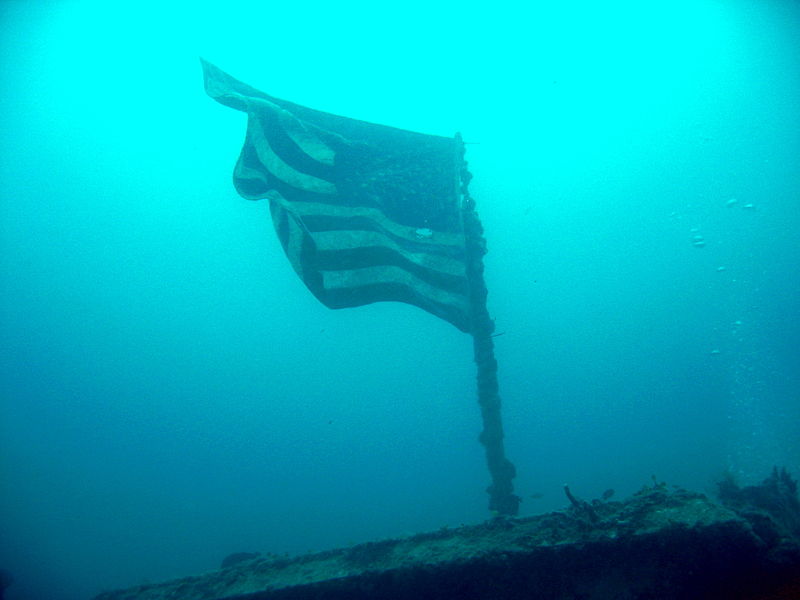
 U.S. flag on the wreck of the Speigel Grove. Photo by Scott Hughes, via Wikimedia Commons
On Tuesday, after what seems like an eternity of campaigning, millions of Americans will head to the polls to vote for our next President. Voters will consider numerous important issues, such as the economy, national security, and the endorsement of Lindsay Lohan. Recent polling indicates that Americans are split, and the election is expected to be very close. On an issue near and dear to my heart, the conservation of the ocean and marine life, one candidate is by far the best choice. I endorse President Barack Obama for re-election.
After promising to “restore science to its rightful place” in his 2009 inauguration speech, there are indeed many successes in conservation and science that President Obama can boast of. He has invested unprecedented amounts of Federal money in alternative energy sources, which, despite the bankruptcy of a few companies, will help reduce greenhouse gas emissions and combat climate change and ocean acidification- as will increased fuel efficiency standards. Early action resulted in conservation of wilderness rivers and trails, and Federal Everglades restoration funding has increased. Restrictions on stem cell research were greatly reduced, and mercury pollution was restricted by the EPA. Race to the top programs have improved science and math education in several states.
On ocean issues, the Obama administration has been a leader domestically and internationally. For the first time, the United States has a National Ocean Policy, which aims to reduce conflicts between different ocean stakeholders. President Obama signed both the Shark Conservation Act and the Billfish Conservation Act, which, despite being imperfect, are strong legal tools to protect charismatic and ecologically important top predators- and numerous other successes in improving the management of U.S. shark fisheries are detailed here. The Obama administration has aggressively pursued fisheries conservation internationally, at CITES, regional fisheries management organization meetings, and the Convention on Migratory Species.
Continue reading Presidential Endorsement: On ocean conservation issues, the choice is clear. Obama 2012
By Morgan Gopnik, on January 12th, 2012
Earlier today, the National Ocean Council released a new Implementation Plan for the National Policy for the Stewardship of the Ocean, Our Coasts, and the Great Lakes. We asked our colleague Morgan Gopnik, formerly a senior advisor to the U.S. Commission on Ocean Policy, to summarize this new plan.
Today marks a momentous and long-awaited milestone for true ocean policy geeks: at noon the National Ocean Council released a draft Implementation Plan for the National Policy for the Stewardship of the Ocean, Our Coasts, and the Great Lakes! If this announcement makes you yawn, you are not alone. But wait! This new Plan could be truly significant for anyone who cares about ocean ecosystems and resources or coastal communities. Let me explain.
As most readers of Southern Fried Science probably know, the last decade has produced many depressing stories about declines in ocean health: overharvested fish stocks, waning biodiversity, “dead zones,” invasive species, oil spills, etc. It has also produced a number of studies and high-level Commission reports suggesting solutions to these problems, most notably the U.S. Commission on Ocean Policy’s “Ocean Blueprint for the 21st Century,” released in September 2004. (Full disclosure: I served as Senior Advisor to the Commission.) The Blueprint provided lots of recommendations (212 in all) about controlling pollution, managing fisheries, protecting shorelines, and addressing other specific problems. But its major theme and most significant contribution was to emphasize the need to fundamentally change our approach to ocean management and governance.
Continue reading U.S. Ocean Policy Takes a (Small) Step Forward
|
|
Recent Comments