Transcript below.
Tag: North Carolina
Uncategorized
Yesterday the Trump Administration unveiled its proposed budget for fiscal year 2020. This budget contains steep cuts research, education, and social services in order to fund the construction of the border wall. Chief among the cuts is an unprecedented reduction in funding for NOAA, which functionally disbands several core research programs within Ocean Services. From A Budget for a Better America:
“The Budget also proposes to eliminate funding for several lower priority NOAA grant and education programs, including Sea Grant, Coastal Zone Management Grants, and the Pacific Coastal Salmon Recovery Fund.”
A Budget for a Better America, page 21
Rumblings on the hill suggest that Secretary of Commerce Wilbur Ross plans to unveil his own plan to drastically reduce the budget of the National Oceanic and Atmospheric Administration and permanently hamstring NOAA in furtherance of the Administration’s goal to find funding to construct a wall on the US southern border.
These cuts include zeroing out the budget for the following agencies and programs:
- NOAA SeaGrant
- NOAA Coastal Zone Management Program
- National Centers for Coastal Ocean Science (NCCOS)
- Pacific Salmon Restoration Program
- Potentially at least one fisheries laboratory
These cuts would be catastrophic America’s Coastal Communities and Economies, especially in places like North Carolina, Maryland, and Louisiana.
Read More “Trump’s 2020 Budget will be a Disaster for America’s Coastal Economies” »
Weekly Salvage
Foghorn (a call to action)
- After a decade spent expanding marine protection throughout the US EEZ, the federal government is going to war on healthy oceans: The Trump Administration’s New Attack on Marine Monuments.
- Want to work for COMPASS in DC? One of the nation’s preeminent science communications institutions is hiring, and trust me, DC needs you.
- If fleeing to Canada is more your style (David (¬_¬) ), Ocean Watch is hiring a manager to plan, manage and execute the Coastal Ocean Health Initiative.
Flotsam (what we’re obsessed with right now)
- Gulper Eels are amazing. Amazing.
- This is an amazing series of visualizations from the Guardian. Seven endangered species that could (almost) fit in a single train carriage.
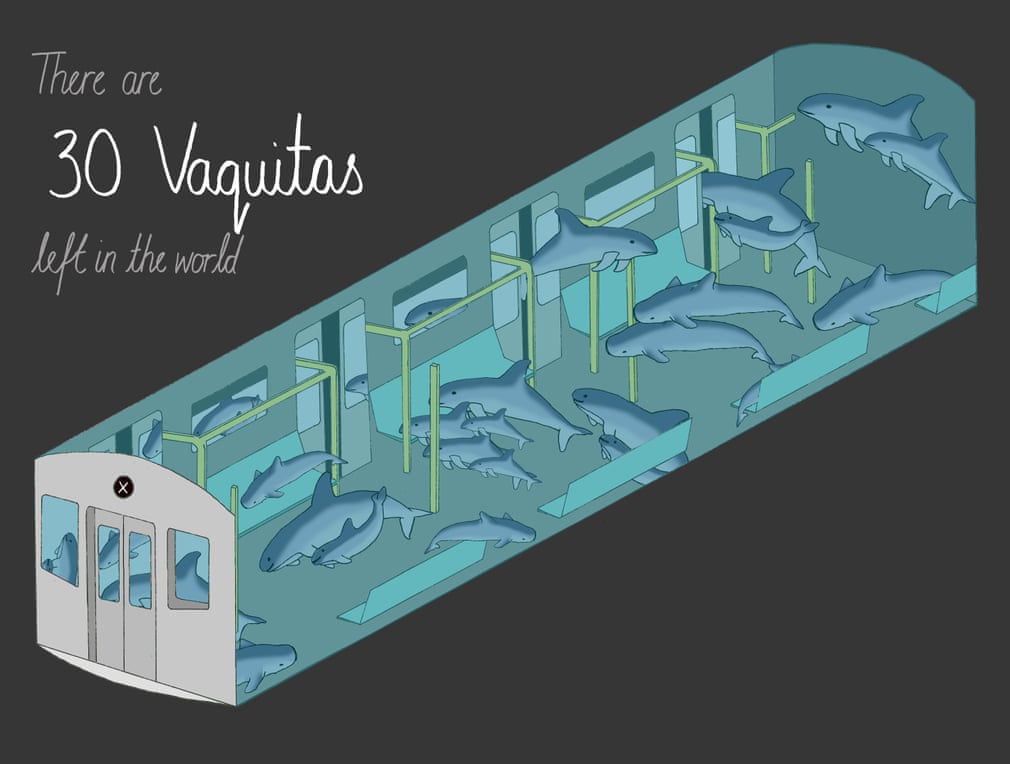
Illustration: Mona Chalabi
- There are sextants on the International Space Station and I can’t stop thinking about it.
Climate change
Marine environments are typically considered more open than those on land when it comes to animal movement. On land, the range of a species can be limited by geographic features like mountain ranges, canyons, rivers, and anything else that might get in the way. In the ocean, however, actively swimming animals like, say, large sharks have few physical barriers and may instead be restricted by their own environmental preferences. This is why in unusually warm summers you might see tropical fishes in southern New England. Because of this, one of the anticipated consequences of warming ocean temperatures is shifting distributions of mobile and highly migratory species. Basically, changes in temperature are likely to allow marine animals to move into places they haven’t before, and if those temperature changes become consistent, these species might make regular visits or even just start staying there.
This kind of change is already happening and has been documented across a variety of marine species. Now, findings from a new paper in Scientific Reports by me and co-authors from the North Carolina Division of Marine Fisheries, Simon Fraser University, and East Carolina University show an apex predator may be joining the northward shift.
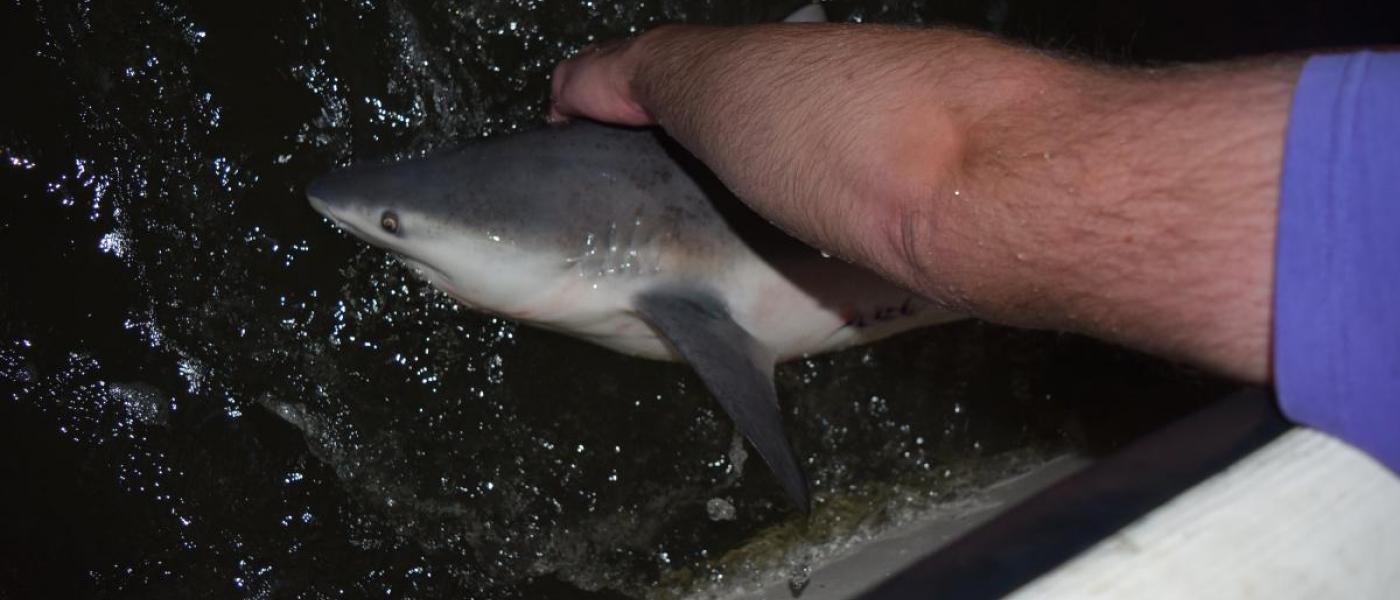
Read More “Is a Changing Environment Bringing Baby Bull Sharks to North Carolina?” »
Uncategorized
On January 1, 2016, the Southern Fried Science central server began uploading blog posts apparently circa 2041. Due to a related corruption of the contemporary database, we are, at this time, unable to remove these Field Notes from the Future or prevent the uploading of additional posts. Please enjoy this glimpse into the ocean future while we attempt to rectify the situation.
I’ve been posting very sporadically due to spending the past month or so compiling all the data from the Marine Species Distribution Survey’s Cape Lookout leg. This was an exciting part of the survey for me because it brought me back to the waters I worked in while earning my PhD, so it a lot of ways it was like coming home. I happily took the lead on the apex predator portion of the survey so that’s mostly what I’ll be recapping first, but future posts will have more details on the trap, core, and genetic surveys.
Of course a lot has changed since then. For one thing, the ocean was two meters shallower, though parts of Beaufort and Morehead City used to flood at high tide even back in 2015. The biggest change may be the collapse and migration of many of North Carolina’s barrier islands, especially after Hurricane Monty rolled through ten years ago. In my mind I still picture Cape Lookout, now an island sitting by itself southeast of the Down East Banks, as part of a chain of barrier islands that once outlined all the North Carolina sounds. Core and Shackleford Banks are still on the map, but as shallow subsurface shoals that have a nasty habit of grounding whatever daring (or foolish) freighters still land cargo in Morehead City. They do draw in a lot of fish though, and still act as a sort of sill that allows Back and Core Sounds to function pretty much as shallow lagoons. If rumors of coral growth on some of the banks are true, it’s possible that the shoals could become fixed in place again.
Uncategorized
I know, I know, we’ve been talking politics too much around here, but I couldn’t sit on this one. Earlier this week, the NC House overturned Governor Bev Perdue’s veto of a bill to allow natural gas exploration (hydraulic fracturing, or, colloquially, “fracking”) in North Carolina. The only problem, the veto wasn’t overruled. The News and … Read More “North Carolina Speaker of the House, Thom Tillis, Celebrates Independence Day by saying “Frack You” to Democracy” »
Conservation, Science
The Division of Coastal Management shall be the only State agency authorized to develop rates of sea-level rise and shall do so only at the request of the Commission. These rates shall only be determined using historical data, and these data shall be limited to the time period following the year 1900. Rates of sea-level rise may be extrapolated linearly to estimate future rates of rise but shall not include scenarios of accelerated rates of sea-level rise.
source (emphasis mine)
This is the text of the notorious, anti-science, anti-coastal community bill that was originally floated in the North Carolina state senate. A revised version of that bill is now under review, with new language that now mandates that:
The Commission and the Division of Coastal Management may collaborate with other State agencies, boards, commissions, other public entities, or institutions when defining sea-level rise or developing rates of sea-level rise. These rates shall be determined using statistically significant, peer-reviewed historical data generated using generally accepted scientific and statistical techniques. Historic rates of sea-level rise may be extrapolated to estimate future rates of rise but shall not include scenarios of accelerated rates of sea-level rise unless such rates are from statistically significant, peer-reviewed data and are consistent with historic trends.
source (emphasis mine)
While this new language is almost certainly an improvement over the old bill, which was heavily supported by a lobbying group for coastal developers and heavily opposed by organizations that actually care what happens to the Carolina coastline and its historic communities, it is still problematic. By problematic, I mean wrong. And by wrong I mean that by refusing to allow accelerated estimates of sea level rise, it explicitly ignores all the best available science and contradicts 130 millenia of historic precedent.
Science
 News broke yesterday that NC-20, a lobbying group for coastal development that, among other things, thinks property owners should be allowed to dump chemical waste directly into our watersheds, is sponsoring legislation that would outlaw outlaw sea level rise. Ignoring the fact that you can’t actually sue the ocean, what they’re actually promoting is a law that would prevent the state from using any sea surface model that extrapolates future ocean trends using anything but a linear regression. Essentially, they’re making it illegal for the state to anticipate future changes to the coastline, plan and prepare for potential flooding, or restrict development on transient barrier islands.
Conservation
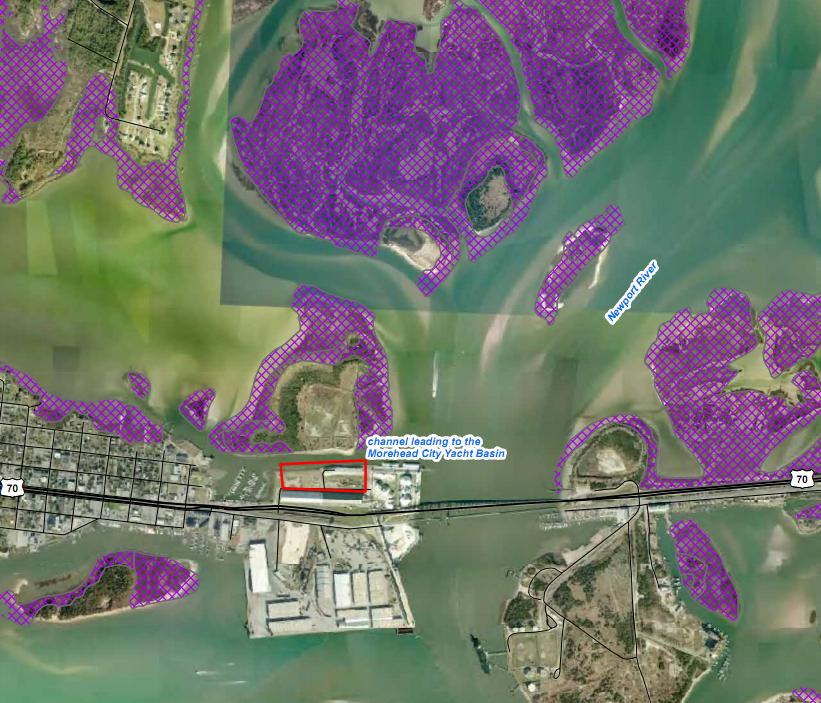
The news caught us by surprise. PCS Phospate, a division of Potash Corp. and one of the largest suppliers of fertilizer in the world is planing to build a Sulfur processing plant in Morehead City. Seemingly overnight, it had grown from a few rumors to an announcement that the final permitting and funding process was already underway. Initial planning began almost a year ago, and an environmental assessment was produce in in December 2010, but at no point during this year of closed door meetings was there ever a public review. The first official notice occurred when an adjacent landowner was informed of the expansion.
Uncategorized
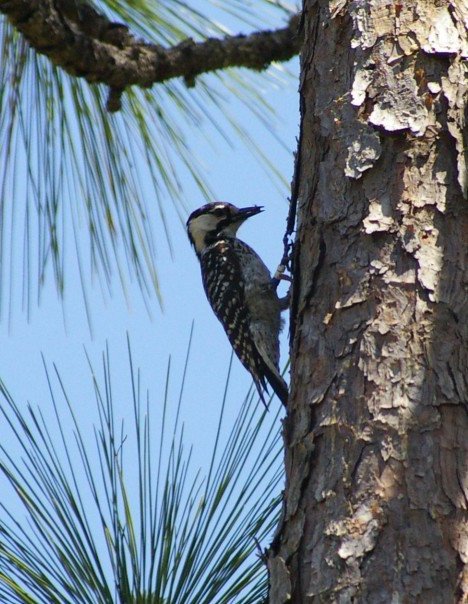
The wet, temperate understory of a longleaf pine savanna, is not the first place one would thing to search for some of nature’s most fearsome predators. These maritime ecosystems stretch down the Atlantic seaboard, from southern Virginia to northern Georgia, but are most common in North and South Carolina. Boomerang-shaped bays, called Carolina bays, formed behind ancient sand dunes, provide the foundation for these biodiversity rich regions. More than 50 endangered species are native to the Carolina lonfleaf pine savannas, including the Cape Fear Threetoothed land snail and the iconic Red-cockaded Woodpecker, but among the most evocative inhabitants of these pocosin wild-lands are the many-jawed monsters of the the understory – the Venus Flytrap.
Read More “Biodiversity Wednesday: Flesh eaters of the Savanna” »