Transcript below.
Read More “Space whales. Space. Whales. SPAAAAACE WHAAAAALES! Weekly Salvage: October 21, 2019” »
Over 15 years of ocean science and conservation online

Foghorn (A Call to Action!)
Flotsam (what we’re obsessed with right now)
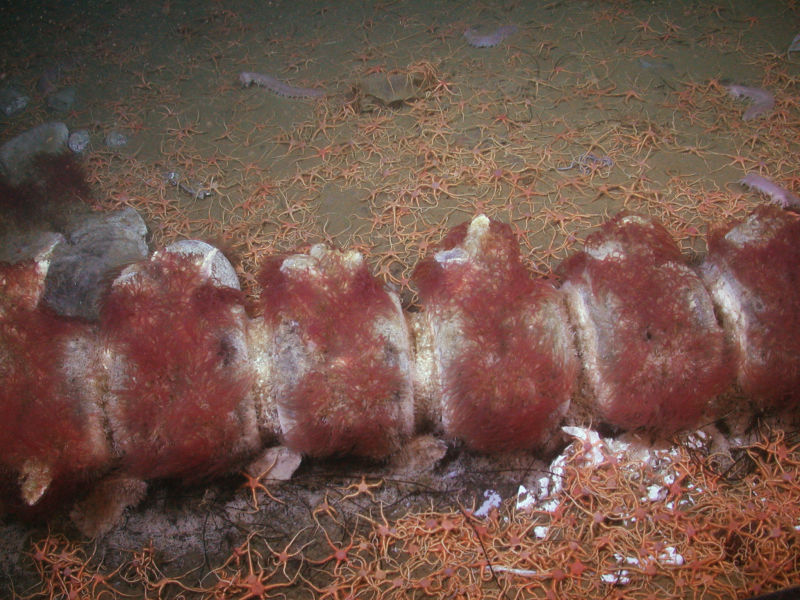
Photo: 2006 MBARI
Fog Horn (A Call to Action)
Flotsam (what we’re obsessed with right now)
Jetsam (what we’re enjoying from around the web)
Bringing you the best of marine science and conservation from the last week.
Flotsam (what we’re obsessed with right now)
Jetsam (what we’re enjoying from around the web)
Earlier this week, Fox News commentator and all-around terrific guy* Erick Erickson, while discussing a recent Pew Study that revealed that women were the sole breadwinners in 40% of US households that contain children, had this to say:
“I’m so used to liberals telling conservatives that they’re anti-science. But liberals who defend this and say it is not a bad thing are very anti-science. When you look at biology—when you look at the natural world—the roles of a male and a female in society and in other animals, the male typically is the dominant role. The female, it’s not antithesis, or it’s not competing, it’s a complementary role.”

I’m not sure where Erickson got his science education from, but it’s pretty clear he should have spent a little more time shopping around on the free market, because he sure is wrong. How wrong? I managed to assemble this list of 10 marine species with dwarf, parasitic, or otherwise reduced males (including an entire female-only class) while waiting for my toast**. So have a seat and let me show you how much weirder and more wonderful the world is than Erickson’s Disney-esque misinterpretation of biology.
1. Anglerfish
The deep-sea Anglerfish is among the most common examples of parasitic males in the marine world. Anglerfish comprise a variety of taxa in the order Lophiiformes. Almost all (females) possess a specialized appendage that acts as a lure to attract unwary prey. Life in the deep sea is rough–even though it is the largest and most diverse ecosystem on Earth, biomass is fairly low–so finding a mate is a struggle for these slow swimming fishes. The solution: carry your partner with you.
Male anglerfish are tiny, often less than 5% the size of the female, but they possess powerful olfactory receptors, allowing them to seek out females. Once a mate is located, the male anglerfish latches on to her abdomen, fuses his circulatory system with hers, and is then slowly digested until there’s nothing left but a sac of gonads surrounded by basic life-supporting tissues. Female anglerfish are not monogamous, either. At any given time she could be covered by a half-dozen parasitic males. Kinky.
 Cryptozoology, the study of animals whose existence is unproven, lies just south of the boundary between science and pseudoscience. Unlike most psuedoscientific movements, which require adherents to suspend disbelief and ignore the realities of physics, chemistry, medicine, and, well, reality, the foundational principals of cryptozoology – that there are remnant populations of thought-to-be-extinct species and that there are still large, charismatic animals that have not yet been discovered – are grounded in ecology. In deep-sea biology, we discover new species all of the time, some of which are far more fantastical than humans can imagine. Some times, we even discover once extinct species. So it is not much of a leap to go from exploratory zoology to cryptozoology.

 I tend to avoid the creationist blogs. Every time I get sucked into that vortex of pseudoscience, I find the exact same debunked claims that were bunk when I was 12. There are better bloggers out there who have the energy and patience to systematically dissect the same tired old rubbish day after day, but I’m not one of them.
This claim, however, is special. There’s nothing new in the rhetoric behind it, it’s just another “how could this commensalism/symbiosis/mutualism evolve? It must be magic!” mantra. And the analysis isn’t terribly sophisticated, anyone could do the basic googling to find out why every argument in it is either wrong or deceptive. What’s special is that it’s about one of my favorite critters, Osedax – the bone eating worm.
Read More “Bone-eating worms and contorted creationist thinking” »
It’s been a long time since we’ve reposted this video. Even Osedax needs some love.
Hundred-leven to 1, Polyandry like Crazy!
~Southern Fried Scientist
Lyrics below the jump: