
Andrew is a post-doctoral researcher in North Carolina focused on population and conservation genetics in hydrothermal vent communities.


David is a graduate student in Florida. He studies the ecology and conservation of sharks.


Amy is a graduate student in North Carolina studying local ecological knowledge within small scale fisheries.


Chuck is a graduate student in North Carolina focusing on apex predators and how they interact with fisheries.


Lyndell is a graduate student in North Carolina, studying the feeding ecology of cownose rays.


Iris is a graduate student in Washington studying habitat use and feeding habits of juvenile Pacific salmon and herring in Puget Sound.


Michael is a graduate student in Maryland investigating the visual systems of mantis shrimp.


Archives

Get marine conservation into the national political conversation with Americans Elect!

In response to the partisan gridlock in Washington DC, a group called Americans Elect hopes to “open up the political process”. This organization, founded by heavy hitters from both parties, is using the internet to allow anyone registered to vote in the United States, regardless of political affiliation, to nominate candidates for President of the United States. An online convention in June, which every registered Americans Elect user can participate in, will determine the nominee. who will be on official ballots in every state alongside Barack Obama and the Republican nominee (probably Romney but we’ll see).

Additionally, any registered Americans Elect user can propose a question. The top questions, as voted on by all other Americans Elect users, will have to be answered by any potential candidate. These top questions, and the Americans Elect candidates’ responses to them, will undoubtedly attract national media coverage. Presently, most of the top questions are about the economy and foreign policy. None focus on the oceans.

I have submitted a series of marine conservation questions, and I need your help to get them enough votes to earn them “top question” status and get marine conservation into the national political conversation! If you are registered to vote in the United States, please consider registering for Americans Elect and voting for these questions.

Continue reading Get marine conservation into the national political conversation with Americans Elect!

State of the Field: Policy is not just for policymakers anymore

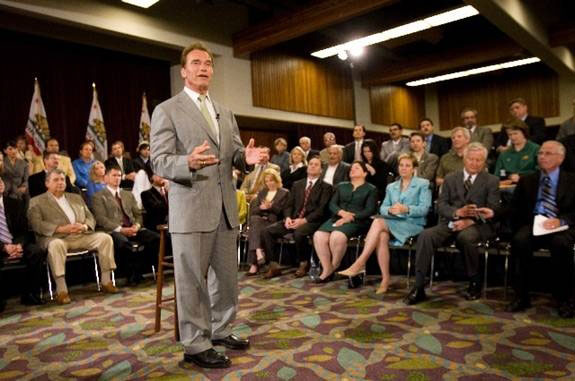
Even the Governator believes in public participation, thanks cdcr.ca.gov

Continuing this series’ recent theme of ways to make policy work, let’s consider a broader view of what policy is and therefore who gets to create policy. It’s not just the elected officials with legislation in their job description. For one, those people are accountable to the people who elected them. Second, formal written policy is not the only kind that is effective – informal rules, community traditions, and other forms of policy are often best. Plus, these types of policy offer the general public a change to be involved in creation and implementation.

There is a large literature on the value of participation in policymaking, especially in fisheries (Silver and Campbell 2005). Here I will focus on three particularly important aspects of participation to management at the scale of an estuary, where I work: a) additional knowledge creation, b) community buy-in, and c) tighter feedback loops. These are important for relatively large-scale systems with several communities and many variables that could affect management. Continue reading State of the Field: Policy is not just for policymakers anymore

Welcome three new blogs to our network!

As Science Online kicks into high gear, I’d like to give a shout out to the three new blogs that have joined the Gam this week!

First up is the long-awaited People, Policy, Planet by Lyndell. The blogs focuses on environmental policy, science research, and ecology. Read her introductory posts Politics and Policy.

Next up we’ve got Neuromancy, written by Craig Bertram. It’s about neuroscience, psychology, and science in general. Check out his extensive and exceptional research blogging posts here.

And finally, we’re pleased to introduce The Birds, the Bees, and Feeding the World, a group blog written by current and former PhD students Rebecca Nesbit, Emma Wright, Trish Wells, and Nichola Hawkins. They discuss all science related to our survival on this planet.

Head on over to theses three exceptional blogs and give them warm southern fried welcome!