Andrew is a post-doctoral researcher in North Carolina focused on population and conservation genetics in hydrothermal vent communities.


David is a graduate student in Florida. He studies the ecology and conservation of sharks.


Amy is a graduate student in North Carolina studying local ecological knowledge within small scale fisheries.


Chuck is a graduate student in North Carolina focusing on apex predators and how they interact with fisheries.


Lyndell is a graduate student in North Carolina, studying the feeding ecology of cownose rays.


Iris is a graduate student in Washington studying habitat use and feeding habits of juvenile Pacific salmon and herring in Puget Sound.


Michael is a graduate student in Maryland investigating the visual systems of mantis shrimp.


Archives

ScienceOnline Oceans update: Registration information and costs

davesquare

sciooceansI have exciting news about ScienceOnline Oceans to share! General registration will start in a little over two weeks. As this is a little different from traditional scientific conferences, I’d like to explain the process in some detail.

Registration 

Registration will take place in four stages.

1) Session moderators and workshop leaders. If your proposal for a session or workshop at ScienceOnline Oceans has been accepted (more information on that soon), a spot is automatically reserved for you, and registration will be a separate process. Please DO NOT register through the regular process.

2) Open registration. Open registration will take place on Wednesday, May 8th. To accommodate people in different time zones, there will be two registration times: 9:00 a.m. EST and 2:00 P.M. EST. There are 50 available spots during each timeslot, and they are first come, first served. In the past, ScienceOnline open registration spots have filled up in as little as 5 minutes, so please be sure to be prompt!

3) Lottery. The remaining spots will be filled by lottery. If you do not get a spot during open registration, sign up for the lottery and we’ll get back to you soon to let you know if you got a spot! Please note that the lottery is for the opportunity to register, not for a free spot.

4) Waitlist. There is also a waitlist for those who don’t get a spot during open registration or the lottery. As additional spots become available due to cancellations, people will be accepted off the waitlist.

Costs

Continue reading ScienceOnline Oceans update: Registration information and costs

ScienceOnline Oceans: The planning wiki is now open, and other important updates.

davesquare

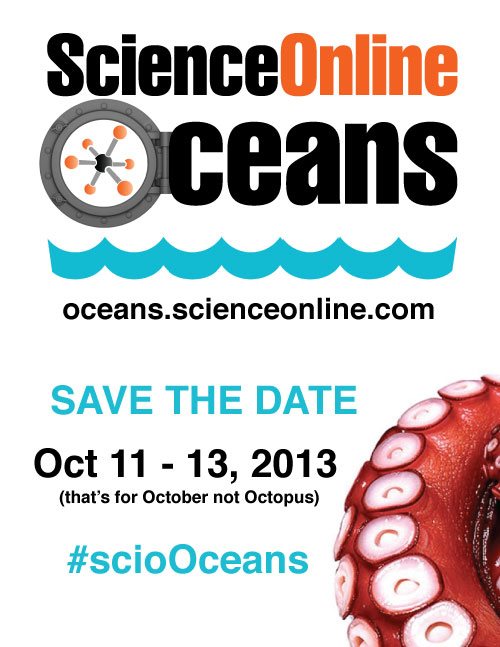
sciooceansI have a few important updates to share about ScienceOnline Oceans! For those of you who haven’t yet heard, ScienceOnline Oceans is a conference (affiliated with the NC-based ScienceOnline) that will explore how marine scientists and conservationists can use the internet for collaboration, education and outreach. The meeting will take place October 11-13th at the University of Miami (Miami, FL), and will include an expert panel discussion on current ocean conservation issues, a day of conference-style programming, and a day of field trips allowing attendees to explore south Florida’s marine environment. Scientists who want to learn more about collaboration and outreach applications of the internet are welcome, as are science communicators who want to learn more about ocean issues.

1) The Planning Wiki is now online, and will be until April 1st! If you have an idea for a session, now is the time to submit it!  For those of you new to the ScienceOnline community, theplanning wiki can be thought of as similar to a traditional conference submission page, but there are three important differences:1) everyone can see what everyone else has submitted, 2) anyone can add to what anyone else has written (including questions, suggestions, etc.), and 3) the person who proposes a session can, but does not have to, actually run that session- you can simply suggest a topic that you’d like to see discussed and ask people to volunteer to run it (and you can also volunteer to help run sessions that others have suggested).

We are offering four kinds of sessions at ScienceOnline Oceans. Skills workshops (taught by a hands-on leader to help people learn a skill), panel discussions (3-4 experts on a topic sharing their expertise, possibly including time for audience questions at the end), directed discussions (led by 1 or 2 discussions leaders, primarily consisting of the audience asking questions of the discussion leaders), and facilitated conversations (unconference-style discussions, essentially discussions between audience members facilitated by 1 or 2 moderators, which can be a follow-up to a panel discussion or directed discussion). Here is the link to the planning wiki.

Continue reading ScienceOnline Oceans: The planning wiki is now open, and other important updates.

Introducing ScienceOnline: Oceans!

I am thrilled to officially announce Science Online: Oceans, which will take place in Miami this October! ScienceOnline: Oceans is affiliated with the North Carolina based ScienceOnline organization and meeting, and we hope to incorporate much of what makes those meetings so special, but there is one key difference that regular ScienceOnline attendees should be aware of. ScienceOnline: Oceans will focus exclusively on ocean science and conservation (and, of course, how these topics relate to the internet and social media).

scio_oceans

Who can attend? Anyone! Any interested scientist, journalist, student, blogger, communicator, activist, or member of the public is welcome.  Due to logistical limits, we will have to cap total attendance at 200 (previously it was 150), including organizers, presenters, and attendees. Registration will open in March, stay tuned!

Continue reading Introducing ScienceOnline: Oceans!
