Transcript available below.
Tag: sea ice
Weekly Salvage
Foghorn (A Call to Action!)
- Melissa Márquez is fundraising to participate in a women-in-science leadership retreat that culminates in a 2.5 week trip to Antarctica. Help her out! Or back her Patreon!
- The scandal-plagued, utterly ineffective, Scott Pruitt is out, just days after an American patriot told him exactly how she felt about him in a restaurant. Good.
Flotsam (what we’re obsessed with right now)
- Investing in indigenous communities is most efficient way to protect forests, report finds. This should surprise no one but it often does.
- Explore the deep waters around Kiribati with OpenExplorer!
The Levee (A featured project that emerged from Oceandotcomm)
- Virtual Reality Preserves Disappearing Land: Coastal communities are capturing their cultures and landscapes in virtual reality before sea level rise steals them for good.
- Where Did the Oil Go In the Gulf of Mexico? a storymap.
Uncategorized
Cuttings (short and sweet): Follow Katelyn Heman, a marine conservation biologist working at the Georgia Aquarium, on twitter! What this walking fish can teach us about evolution. By Sarah Gibbens, for National Geographic Fish forego sleep thanks to this molecule in their brain. From Nature’s Animal Behavior news. Microplastics pollute even the most remote parts of … Read More “Walking fish and microbe warfare: Thursday Afternoon Dredging, February 15, 2018” »
Blogging
Year-in-review news roundups are one of my favorite parts of December. I really enjoy remembering all of the interesting and inspiring things that happened over the past year, especially after a rough year like this one. I especially enjoy “top science news of the year” roundups, and I was pleased to see marine science stories make the cut on many of them. For your “but why is this considered a top story but that isn’t” debating pleasure, here are the marine science news stories that made top science news stories of the year listicles!
Science
anecdote
noun.
1. a short account of a particular incident or event, especiallyof an interesting or amusing nature.
2. a short, obscure historical or biographical account.
Climate Change
noun.
A change of climate which is attributed directly or indirectly to human activity that alters the composition of the global atmosphere and which is in addition to natural climate variability observed over comparable time periods.
Climate change is real and human activity is the cause. The theory that we are fundamentally altering our planet’s climate is supported by overwhelming evidence. Prominent global warming skeptics have, in the face of such evidence, acknowledged that climate change is happening, and that humans are the cause.
And still climate change denial continues to persist.
In the last decade, we have passed a threshold where the reality of climate change is no longer a hypothesis buried in bar graphs or something to be assessed by minute changes in careful measurements, but an observable phenomenon. Rather than anticipating the effects of human impacts on the climate, we must now live them. Thanks to a well-organized and well-funded climate denial industry, we missed our chance to change course. If the last decade was the hurricane warning, than this decade is landfall.
Read More “Climate Change Anecdotes Volume 1: Sea Ice and Nuclear Reactors” »
Science
We traveled to Cape Lookout Bight aboard the R/V Susan Hudson to sample sediment and test our homemade ROV. Along the way, we asked the research team to talk about their favorite marine ecosystems. httpv://www.youtube.com/watch?v=_vpX4XGNjf8 Let us know what your favorite marine ecosystems are in the comments below.
Uncategorized
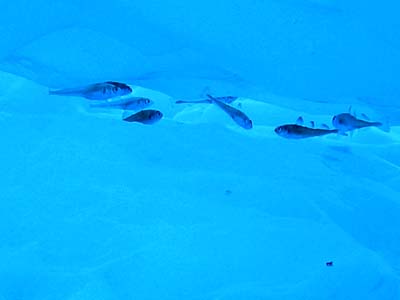
 A few years back I attended a mid-field season gathering of researchers working on International Polar Year projects. We were lucky enough to have collected the marine biologists, recently returned from a short cruise out of Barrow, AK with the mission to describe the biota living on the underside of the sea ice that is so critical to terrestrial Arctic ecology. It was absolutely stunning to me to realize that there is a whole ecosystem associated with the bottom of the ice, an ephemeral, threatened resource.
Depending on the time of year, sea ice covers 3-7% of the planet, making this relatively unexplored ecosystem fairly important to global biogeochemical processes. The algae trapped in and under sea ice, for example, accounts for 25% of the Arctic’s and 20% of the Antarctic’s primary productivity. This productivity trickles up the food web to the more well-known ice dwellers, such as polar bears and seals.