Andrew is a post-doctoral researcher in North Carolina focused on population and conservation genetics in hydrothermal vent communities.


David is a graduate student in Florida. He studies the ecology and conservation of sharks.


Amy is a graduate student in North Carolina studying local ecological knowledge within small scale fisheries.


Chuck is a graduate student in North Carolina focusing on apex predators and how they interact with fisheries.


Lyndell is a graduate student in North Carolina, studying the feeding ecology of cownose rays.


Iris is a graduate student in Washington studying habitat use and feeding habits of juvenile Pacific salmon and herring in Puget Sound.


Michael is a graduate student in Maryland investigating the visual systems of mantis shrimp.


Archives

America’s lust for gigantic breasts leads to impotence: the population genetics of captive-reared turkeys

Gobble? image from http://www.public-domain-image.com

Gobble? image from http://www.public-domain-image.com

The noble turkey, a centerpiece of the American Thanksgiving supper. It looms large from its prominent position on the dining room table. The master of ceremonies – or, in my case, the guy who keeps slicing himself open with various sharp objects yet is inexplicably the one people call on when there’s knife-work needs doing – draws a set of fine, honed knives, set aside for this particular task, and carves, delicately yet firmly, into the hefty white meat of the turkey’s breast. Sure, some favor the dark, rich meat around the legs, but this white meat, soaked in gravy and topped with cranberry sauce or stuffing, that is what we crave.

“We give thanks,” the benediction may begin, “to Charles Darwin, for determining the underlying mechanism by which a theropod may, over the course of 65 million years, through a process of gradual change by means of the retention of beneficial traits through successive generations, evolve into this delicious, delicious bird.” And then, perhaps, that surly teenager, the one determined to point out the social inequalities inherent in the holiday and the colonialist attitudes which led to the wholesale extermination of America’s native peoples – every family has at least one – will chime in to quip “you know, evolution didn’t shape the turkey. The modern Thanksgiving turkey is the product of an extensive selective breeding program that began in the 1940′s. Commercial turkeys can’t even reproduce naturally, they have to be artificially inseminated.” At which point the older members of your family may blush and/or faint at such an unseemly turn of phrase.

Continue reading America’s lust for gigantic breasts leads to impotence: the population genetics of captive-reared turkeys

In sexual selection and thermoregulation, bigger is better, at least for fiddler crabs

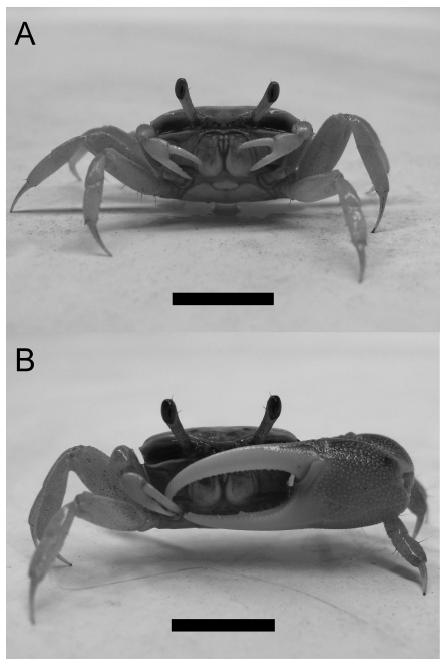
Sexual dimorphism in fiddler crabs. Female (A) and male (B) Uca panacea. Scale bars indicate 1 cm. From Darnell and Munguia 2011

Imagine yourself a fiddler crab. For this exercise, imagine yourself a male fiddler crab. Are you with me? Great. Check out your right claw, it’s a sleek, slender machine, perfect for picking through the sand as you sift out bacteria and other microorganisms for food. It also makes a handy shovel for digging nice deep burrows to protect you from harsh conditions. Now check out your left claw. Wow! This thing is massive. If you possess a particularly vivid mind and have place your ego within the carapace of Uca panacea, your giant claw is more than a quarter of your body weight. This comically mis-proportioned appendage is why those pesky bipeds call you and your cousins “Fiddler Crabs”.

See that female fiddler crab at the perimeter of your territory? Yes, she is checking you out. That giant claw of yours is primarily used to attract mates, signalling to interested parties that your are fit and fecund. You even have a special dance, unique to each fiddler crab species, to announce your vitality. And if some other, lesser-clawed, male tries to move in to your territory, why, you’re equipped with a serious piece of hardware to drive off that interloper.

Continue reading In sexual selection and thermoregulation, bigger is better, at least for fiddler crabs

Bed Bugs: better bitten than smitten

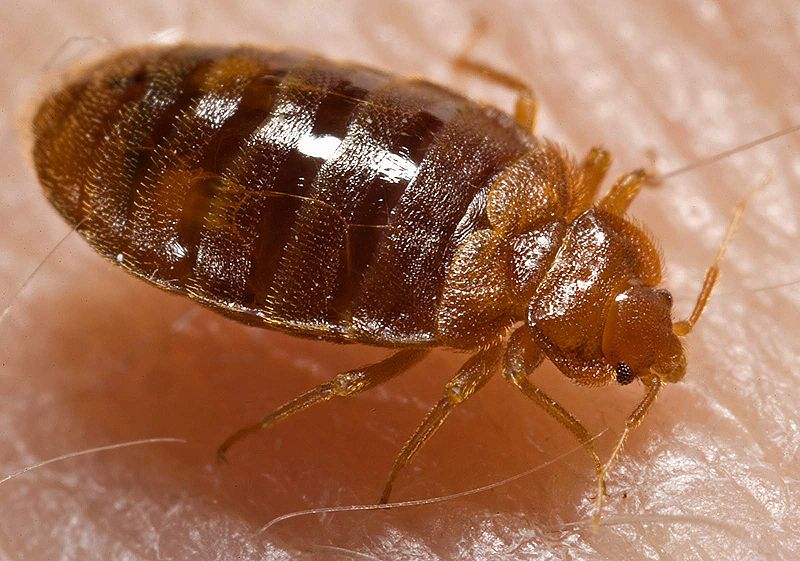
Common bed bug Cimex lectularius

Bed bugs, the nasty nocturnal nursery rhyme nightmares than are making a comeback throughout the northeastern United States. Infestations, previously relegated to the status of urban legend in much of the developed world, are on the rise due to a combination of more frequent travel, pesticide resistance, and the end of the ‘better living through chemistry” era when DDT was a perfectly acceptable thing to spray into your baby’s crib. They’re mean, nasty blood suckers that have risen over the summer to become the scourge of hotel managers everywhere. Except, they’re really pretty harmless. Most people don’t even have a reaction to the bite, they are shockingly poor vectors for disease, and, when you get past the blood sucking, they’re rather cute as far as bugs go. There is one rather disagreeable feature about these critters, and it’s the reason we should all be thankful that we’re only bitten by them.

Traumatic Insemination.
Continue reading Bed Bugs: better bitten than smitten

Non-Monophyly within Syngnathidae

ResearchBlogging.org

Objective 1: Develop the least publicly accessible title for a blog post about seadragons, mate selection, and evolution

Objective 1 Status: complete

Objective 2: Draw in whatever readers push passed the unwieldy title with an unconventional narrative structure.

Objective 2 Status: complete

Objective 3: Hook the reader with a fascinating, though brief, background on seahorses, seadragons, and pipefish.

Continue reading Non-Monophyly within Syngnathidae