
Andrew is a post-doctoral researcher in North Carolina focused on population and conservation genetics in hydrothermal vent communities.


David is a graduate student in Florida. He studies the ecology and conservation of sharks.


Amy is a graduate student in North Carolina studying local ecological knowledge within small scale fisheries.


Chuck is a graduate student in North Carolina focusing on apex predators and how they interact with fisheries.


Lyndell is a graduate student in North Carolina, studying the feeding ecology of cownose rays.


Iris is a graduate student in Washington studying habitat use and feeding habits of juvenile Pacific salmon and herring in Puget Sound.


Michael is a graduate student in Maryland investigating the visual systems of mantis shrimp.


Archives

U.S. government: shark fin bans “significantly undermine conservation and management of Federal shark fisheries”

davesquare

Photo Credit: Jessica King, Marine Photobank

Photo Credit: Jessica King, Marine Photobank

I’ve written in the past about why shark fin bans might not be the best tool for the conservation and management of sharks. Though specific details vary, these so-called “blanket bans” typically make it illegal for anyone to buy, sell, or possess shark fins regardless of the source *. Additionally, to date most of these fin bans have taken place in a few U.S. states and Canadian towns. If the goal of these state-level fin bans is to reduce the supply of fins to the global market, proponents should consider that  according to TRAFFIC, more than 95% of the supply of shark products comes from countries outside of the U.S. and Canada.  Even if every U.S. state passed a fin ban, it would have a negligible  direct impact on global supply. Additionally, the United States has some of the most sustainably managed shark fisheries in the world (hammerhead sharks and a few others are an exception). We want other countries to emulate out management practices, not to remove our management practices from the global marketplace.

If the goal of these local fin bans is to reduce global demand, proponents should consider that the overwhelming majority of the demand for shark fin soup is in China and Southeast Asia, where passing such bans will pose a significant challenge. Some proponents of fin bans say (after the negligible impact on supply and demand is pointed out) that fin bans help with  ”raising awareness of the problem of overfishing of sharks”. While these fin bans do result in (relatively) positive media coverage for shark conservation, “raising awareness” is not the publicly stated goal of these bans. If your goal is to educate people about a problem, educate people about the problem.

Instead of inflexible and ineffective fin bans that penalize fishermen who have adopted best practices * without impacting the global market, I’ve advocated for a science-based approach to sustainable shark management following the 10 basic principles in line with what has been laid out in the United Nations Fisheries and Aquaculture Organization’s International Plan of Action for Sharks and IUCN Shark Specialist Group guidance. These principles include banning finning of sharks by requiring that carcasses be landed whole (recall that finning is a specific fishing practice not synonymous with the fin trade), using science-based quotas to manage the fisheries of sharks whose populations can support a fishery, and restricting the harvest of species whose populations cannot.

Recently, the United States National Marine Fisheries Service (which, once again, manages some of the most sustainable shark fisheries on Earth) has started to officially speak out against state level fin bans.

Continue reading U.S. government: shark fin bans “significantly undermine conservation and management of Federal shark fisheries”

15 important shark conservation and management terms explained with memes

davesquare

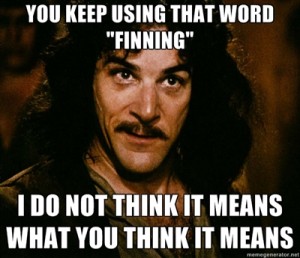
inigo-montoya-you-keep-using-that-word-i-dont-think-it-means-what-you-th-3b4b2920-sz625x625-animateIf interested citizens want to get involved in conservation and management policy, it’s absolutely vital to use proper terminology. The policy world can be full of confusing jargon, but there are few ways to discredit yourself in the eyes of decision makers as quickly as using a critical term incorrectly. In fact, it isn’t uncommon for a decision maker’s response to a petition or public comment to consist entirely of correcting  inaccurate terminology, if a response is issued at all. There are well over 100 acronyms and terms that I’ve seen regularly used, but in the interest of brevity, I’ve selected what I believe to be the 15 most important terms that I’ve seen people repeatedly use incorrectly.

For each term, I’ve provided a definition from a scientific paper or technical report whenever possible.  I have also  provided some additional explanation in my own words, and some assistance from familiar memes. Whenever possible, I’ve linked to blog posts, articles, or websites that provide even more information. Most of these terms are broadly applicable to fisheries management policy, but some are specific to shark fisheries. It is not my intention with this post to strongly advocate for or against any specific policy (I do plenty of that with other posts), but to make sure everyone is speaking the same language.

Continue reading 15 important shark conservation and management terms explained with memes

13 wrong things about sharks that conservation advocates should stop saying in 2013 (and what they should say instead)

davesquare

While the rest of the scientific and management community and I are grateful for the passionate support of many shark conservation advocates, passion is no substitute for knowledge and accuracy.  Some conservation issues are a matter of opinion and can (and should) be reasonably be discussed by people with different views, but many others are a matter of fact. Presented here, in no particular order, are 13  incorrect statements and arguments commonly made by well-intentioned but uninformed shark conservation advocates, along with the reality of the situation.

From MemeGenerator.net

From MemeGenerator.net

1) “Shark finning” is synonymous and interchangeable with “the global shark fin trade.” Shark finning is a specific fishing method. It is not the only way to catch sharks, and it is not the only way to provide shark fins for the global fin trade. Stopping shark finning is a worthy goal (that has largely been accomplished already *) because it is a wasteful and brutal fishing method that complicates management, but stopping shark finning does not stop the global shark fin trade. Many people calling for a ban on finning really seem to want no shark fishing and no fin trade of any kind (a viewpoint I disagree with, but regardless, proper terminology matters). For more on the difference between shark fishing and shark finning, see this post from June 2012.

2) 100 million sharks a year are killed for their fins. The origin of this number is still debated, but it was popularized by Sharkwater. While we will likely never know exactly how many sharks are “killed for their fins”, the best scientific estimate of the scope of the fin trade we have comes from a 2006 paper by Dr. Shelley Clarke. She found that the fins of between 26 and 73 million sharks end up in the fin trade each year, with a simulation average of 38 million.  Dr. Clarke wrote an essay for SeaWeb on the misuse of her work, which is worth a read.

3) 1 in 3 species of sharks face extinction. This one is actually relatively close to accurate, and can be fixed with the addition of just two words. An IUCN Shark Specialist Group report found that 1 in 3 species of “open ocean” sharks are Threatened with extinction (Threatened means Vulnerable, Endangered or Critically Endangered according to IUCN Red List standards). 1 in 6 species of shark, skate, ray, or chimera are Threatened- while still a troubling number indicative of a very bad situation, it’s half as bad as claimed by many advocates. Also, please note that I included skates and rays, which are similarly threatened but often ignored by conservation advocates (with one notable exception from 2012).

Continue reading 13 wrong things about sharks that conservation advocates should stop saying in 2013 (and what they should say instead)

What shark finning means (and doesn’t mean): a primer and quiz

Shark finning, one of the most wasteful, unsustainable, and inhumane methods of gathering food in the history of human civilization, has rightly become a hot topic in the marine conservation movement. However, there is a great deal of confusion among activists concerning this problem and the best way to solve it. Those of you who follow me on twitter have seen me point out numerous recent anti-finning “awareness campaigns” which feature photographs of sharks that have not actually been finned.

Shark finning does not mean removing the fins from a shark. This is really important and seems to be a source of some confusion- not every shark fin for sale in markets is the result of shark finning! Shark finning means removing the fins from a shark while still on the fishing vessel and dumping the rest of the shark overboard. This is a problem because its wasteful (less than 10% of the weight of a shark is used), because its easy to quickly overfish a population even from a small boat (fins don’t take up a lot of space on board), and because its almost impossible for managers to know how many of each species were harvested. As stated above, this practice is also shockingly inhumane, as the sharks are often still alive when they are dumped overboard.

Continue reading What shark finning means (and doesn’t mean): a primer and quiz

Shark fin bans: A storify of this week’s twitter discussion

Earlier this week, I asked my twitter followers what they thought about shark fin bans, which prompted a long and stimulating discussion. What follows is my first attempt at “Storify”, shared in the hopes that the discussion can continue here.

As I’ve said before, I’m not a big supporter of shark fin bans because they don’t allow for sustainable, well-managed fisheries to supply the market. Additionally, they promote the common (and false) belief that shark fin soup is the only major problem facing sharks, and don’t address many of the other important issues associated with shark conservation.

Instead, I favor a comprehensive approach to shark management, including requiring that sharks be landed with fins attached (i.e. a ban on “finning” but the fins can still be used if the shark is landed whole), special protections for threatened and endangered species, science-based fisheries quotas for species that can sustain fishing, time/area closures or gear restrictions when necessary, and  careful monitoring (including requiring that all fishing nations report the species composition of their catch).

Check out the great discussion if you missed it, and let me know what you think of this important issue in the comments of this post.

Continue reading Shark fin bans: A storify of this week’s twitter discussion

Bad news for whale sharks: The world’s largest fish are being killed for bait and billboards

WhySharksMatter and a whale shark at the Georgia Aquarium

The world’s largest shark eats only plankton, couldn’t bite a human if it wanted to, and is one of the few sharks that could be reasonably described as beautiful. Globally, SCUBA divers pay an estimated $50 million each year for the chance to swim with these incredible fish. Their long migrations through international waters makes international cooperation necessary to protect them, which is particularly important because the 30 years it can take for these animals to reach reproductive maturity means that populations will take a long time to recover if they are overexploited. They’re listed by the IUCN Shark Specialist Group as Vulnerable globally. Between their charismatic nature, their inability to harm humans, and their value to ecotourism, it should be easy to convince governments to protect whale sharks *, making two recent reports all the more shocking.

Continue reading Bad news for whale sharks: The world’s largest fish are being killed for bait and billboards

The top 10 shark conservation stories of 2011

Caribbean reef shark, Bimini. Photo credit: David Shiffman

2011 was a relatively good year for sharks and rays. Presented below, in no particular order, are ten important shark conservation stories from the past year.

1. Shark sanctuaries. The world gained several new shark sanctuaries, areas where shark fishing is banned, in 2011. Nations creating new shark sanctuaries include Honduras (~92,000 square miles), the Bahamas (~240,000 square miles), Marshall Islands/Guam/Palau (a regional partnership protecting almost 2 million square miles). Numerous concerns about enforcing rules in these huge areas, as well as concerns about potential loopholes in the policies, exist among conservation scientists.

2. Fin bans. These laws ban the possession, trade, or sale of shark fins within the boundaries of a city, state/territory, or country. In 2011, Hawaii’s first-in-the-US fin ban took effect, and a few other US states (California, Washington, and Oregon) passed similar laws. There is an ongoing debate in the shark conservation community about whether blanket bans on finning are better than promoting best practices (i.e. more sustainable shark fishing techniques). Additionally, some are concerned that we aren’t focusing enough on other threats to sharks like bycatch and habitat destruction.

Continue reading The top 10 shark conservation stories of 2011

Pseudoscience Redux: Shark Fin propaganda

This post was originally published on September 9, 2010 as a part of our first Week of Ocean Pseudoscience. Enjoy!


Last weekend, longtime SFS reader Suzy sent me an interesting question. Suzy is Asian, and though she is a committed conservationist, several members of her family regularly eat shark fin soup. One relative just sent her a copy of a news article entitled “Shark Fin Soup: Eat it without guilt” (available here). Suzy asked me if the information in this article is correct, and how she should respond to her family members.

Though it is a few years old, I had never seen this article, and it’s a little shocking. I don’t know if I’ve ever seen a better example of distorting or ignoring science to promote a political agenda outside of Fox News. In short, Suzy, most of the information in here is either false or intentionally misleading.

Continue reading Pseudoscience Redux: Shark Fin propaganda

Hooray for California, but there’s still much work to be done to save sharks


Photo credit: Jessica King, Marine Photobank

Earlier today,  the California legislature voted to approve AB 376,  the excitingly titled “act to add section 2021 to the Fish and Game Code,  relating to sharks”. The ocean conservation community is happy,  and we should be. The bill and its backing from Hollywood stars have generated substantial media coverage of the plight of sharks,  and,  if signed into law by the Governor and properly enforced,  it could well save a lot of sharks. However,  fin bans aren’t the perfect solution to the shark conservation crisis,  and we still have a lot of work to do to protect sharks and closely related species around the world.

Continue reading Hooray for California, but there’s still much work to be done to save sharks

Shark Science Monday: Claudia Li discusses Shark Truth’s ‘no shark fin soup’ wedding contests

In this week’s edition of Shark Science Monday, Claudia Li of Shark Truth discusses the Happy Hearts Love Sharks wedding contest, which aims to reduce the consumption of shark fin soup at wedding banquets.

If you have a question for Claudia, leave it as a comment below and I’ll make sure she gets it.