Transcript provided below.
Are we finally going to lead with deep-sea mining? We’re going to lead with deep-sea mining. Welcome to the Weekly Salvage.
Over 15 years of ocean science and conservation online
Transcript provided below.
Are we finally going to lead with deep-sea mining? We’re going to lead with deep-sea mining. Welcome to the Weekly Salvage.
This is an update and repost of our seminal article on the science of Aquaman, revised and expanded.
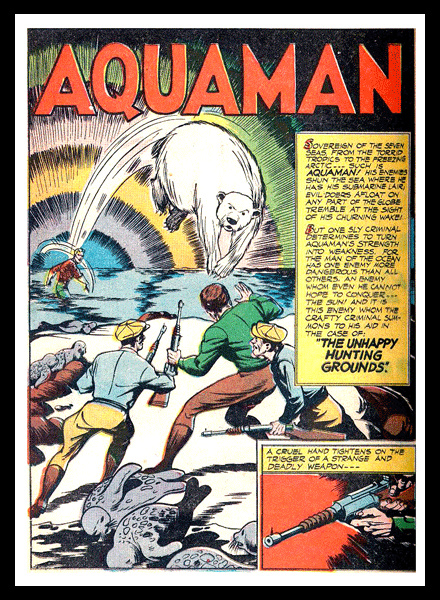
Aquaman may not be everybody’s favorite superhero, but since his creation in 1941, he has been among DC’s most enduring icons. During the Golden Age of comics, he held his own against Superman, Batman, and Wonder Woman. Silver Age Aquaman was a founding member and eventually leader of the Justice League. His powers, tied to the ocean, forced writers to create a compelling, complex hero with explicit limitations. In the early days, when Superman’s strength was practically infinite, and Batman’s brilliance was unmatched, Aquaman had to become more than just a superhero, he had to be a person.
If Superman existed to show us how high the human spirit could fly, and Batman to show us the darkness within even our most noble, Aquaman is here to show us the world that triumphs in our absence. The ocean is not ours, and no matter how great our technology, we will never master it as we have mastered land. Aquaman has. Through this lonely ocean wanderer, we can experience a world that we can never truly command. In many ways, Aquaman was stronger than the Man of Steel and darker than the Dark Knight. He knew loneliness that the orphan and the alien exile never could.
Even though Aquaman had to fight harder, endure the jokes of other, less interesting heroes, and find relevance in an ecosystem hostile to the humans that had to empathize with him, Aquaman was never forced to confront the truly horrifying consequences of life in the ocean.
The penetrating cold
Aquaman is, for all intents and purposes, a marine mammal. With the exception of a healthy mane in later incarnations, he is effectively hairless. As a human, we would expect his internal body temperature to hover around 99°F, or about 37°C. Even at its warmest points, the surface temperature of the ocean around the equator is only about 80°F/27°C. At the poles, ocean temperature can actually drop a few degrees below freezing. In the deep sea, ambient temperature levels out around 2 to 4°C. The ocean is cold, and water is a much better thermal conductor than air. Warm blooded species have evolved many different systems to manage these gradients, including countercurrent heat exchangers, insulating fur, and heavy layers of blubber. This is what a marine mammal that can handle cold waters look like:
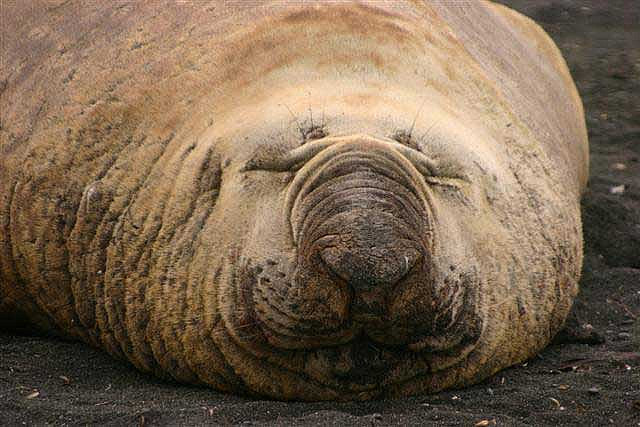
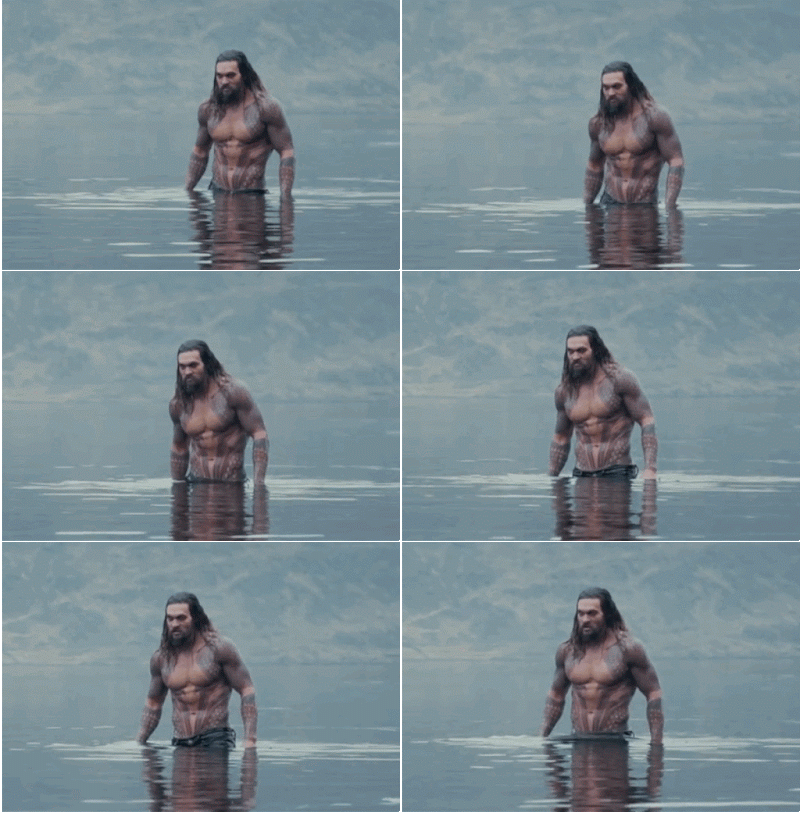
Aquaman is not just a human, he is an atypically uninsulated human. If the man has more than 2% body fat, I’d be shocked. In contrast, warm-water bottlenose dolphins have at least 18 to 20% body fat. Anyone who SCUBA dives knows that, even with a 12 millimeter neoprene wet suit, after a few hours in 80°F water, you get cold. Aquaman, lacking any visible insulation, should have slipped into hypothermia sometime early in More Fun Comics #73. He is built for the beach rather than the frigid deep.
Read More “The horrifying physiological and psychological consequences of being Aquaman” »
Flotsam (what we’re obsessed with right now)

 Today marks the first Tsukiji fish market tuna auction of 2013, and, as in the previous two years, the first fish sold broke all previous records. In 2011, the record breaking tuna sold for $396,000. Last year, we tipped the scales at $736,000. Early this morning, the record breaking bluefin tuna blew the previous records out of the water, fetching a whopping $1,800,000 at the auction block, making this 488-lb tuna the most expensive fish ever purchased.
Over the next few weeks, I’m certain that we’ll see this number presented as an argument against bluefin tuna fishing, as an example of an industry out-of-control, and as a symbol of how ruthlessly we’ll hunt the last few members of a species to put on our dinner plates. These issues are reflected in the tuna market, but I want to urge caution in drawing too many conclusions from this record breaking number.


Food is a tricky. For some people, food choice is an essential component of cultural heritage and national identity. For others, food choice is a statement of philosophical or moral principles. For many, being able to reject food is an unobtainable luxury. One thing is certain: food is so central to the human experience that when we question our food choices, when we are forced (or force others) to change them, when we discover that the choices we make are not what we think they are, it is impossible to separate our food ethics from our social structure. Which is why seemingly trivial revelations–bugs in your coffee, meat made slime, or a fish by any other name–often result in major outrage and structural changes. Eating is simultaneously a deeply personal experience and one in which, for much of the developed world, we are completely detached from the source.
How much of the world’s food supply is locked up in a few crops – corn, wheat, rice (for example) – and even fewer livestock – cows, pigs, chickens? Of the major commercial food production industries, only fish, and even then, only some fish, are still hunted. In a very real sense, fish are the last wild food. That may be changing. In Four Fish: The Future of the Last Wild Food, published last year, Paul Greenberg highlights the ways in which commercial fishing is becoming less like hunting and more like agriculture, with a few, often farm raised species, dominating the market.
Greenberg, a native of Long Island Sound who fished there since the 1970’s, documents the changes in four major fisheries – salmon, sea bass, cod, and tuna – and the changing attitudes of the (mostly) men who catch them. He travels to Alaska to meet with First Nation salmon fishermen, to Greece to visit groundbreaking aquaculture facilities, he charters a tuna boat to experience the fight first hand, and across the world he talks to those of whom fishing matters most, including himself. At times, the book becomes autobiographical, focusing on Greenberg’s personal journey – but this is a book about fish and fishermen, and he is, if only recreationally, a fisher.
Seriously, what the fuck? A proposal to protect the Atlantic bluefin tuna prized in sushi was rejected at a UN wildlife meeting today. The decision was reached after Japan, Canada and scores of poor nations opposed the measure on the grounds that banning exports of the fish would devastate fishing economies. Monaco introduced the proposal … Read More “Bluefin tuna fails to make UN’s list of protected fish” »