Andrew is a post-doctoral researcher in North Carolina focused on population and conservation genetics in hydrothermal vent communities.


David is a graduate student in Florida. He studies the ecology and conservation of sharks.


Amy is a graduate student in North Carolina studying local ecological knowledge within small scale fisheries.


Chuck is a graduate student in North Carolina focusing on apex predators and how they interact with fisheries.


Lyndell is a graduate student in North Carolina, studying the feeding ecology of cownose rays.


Iris is a graduate student in Washington studying habitat use and feeding habits of juvenile Pacific salmon and herring in Puget Sound.


Michael is a graduate student in Maryland investigating the visual systems of mantis shrimp.


Archives

America’s lust for gigantic breasts leads to impotence: the population genetics of captive-reared turkeys

Gobble? image from http://www.public-domain-image.com

Gobble? image from http://www.public-domain-image.com

The noble turkey, a centerpiece of the American Thanksgiving supper. It looms large from its prominent position on the dining room table. The master of ceremonies – or, in my case, the guy who keeps slicing himself open with various sharp objects yet is inexplicably the one people call on when there’s knife-work needs doing – draws a set of fine, honed knives, set aside for this particular task, and carves, delicately yet firmly, into the hefty white meat of the turkey’s breast. Sure, some favor the dark, rich meat around the legs, but this white meat, soaked in gravy and topped with cranberry sauce or stuffing, that is what we crave.

“We give thanks,” the benediction may begin, “to Charles Darwin, for determining the underlying mechanism by which a theropod may, over the course of 65 million years, through a process of gradual change by means of the retention of beneficial traits through successive generations, evolve into this delicious, delicious bird.” And then, perhaps, that surly teenager, the one determined to point out the social inequalities inherent in the holiday and the colonialist attitudes which led to the wholesale extermination of America’s native peoples – every family has at least one – will chime in to quip “you know, evolution didn’t shape the turkey. The modern Thanksgiving turkey is the product of an extensive selective breeding program that began in the 1940′s. Commercial turkeys can’t even reproduce naturally, they have to be artificially inseminated.” At which point the older members of your family may blush and/or faint at such an unseemly turn of phrase.

Continue reading America’s lust for gigantic breasts leads to impotence: the population genetics of captive-reared turkeys

Biodiversity Wednesday: South Carolina’s Santee Cooper Lake System

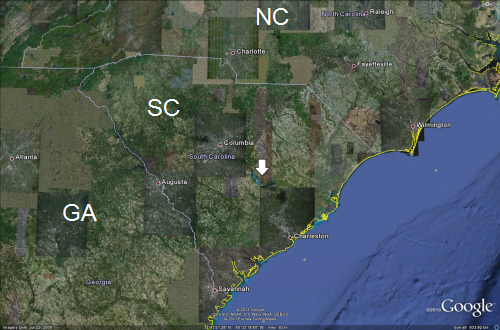
As part of our Biodiversity Wednesday series, we’ve discussed amazing ecosystems all over the world. This week’s post will focus on an area a little closer to home (at least a little closer to my home). The Santee Cooper lake system, home to unique fish and a fascinating history, is less than an hour from Charleston. If you’ve ever driven on I-95 through South Carolina, you’ve gone right over it.

The Santee-Cooper system is marked with a white arrow. Image created with Google Earth

Continue reading Biodiversity Wednesday: South Carolina’s Santee Cooper Lake System