Skip to content

Southern Fried Science

Over 15 years of ocean science and conservation online

  • Home
  • About SFS
  • Authors
  • Support SFS

Tag: climate change

The horrifying physiological and psychological consequences of being Aquaman

Posted on July 18, 2012December 27, 2012 By Andrew Thaler 20 Comments on The horrifying physiological and psychological consequences of being Aquaman
Popular Culture
Aquaman. DC Comics.
Aquaman. DC Comics. A rational response to seal poaching is to lob a polar bear at the aggressors.

Aquaman may not be everybody’s favorite superhero, but since his creation in 1941, he has been among DC’s most enduring icons. During the Golden Age of comic books, he held his own against Superman, Batman, and Wonder Woman. Silver Age Aquaman was a founding member of the Justice League. His powers, tied to the ocean, forced writers to create a compelling, complex hero with explicit limitations. In the early days, when Superman’s strength was practically infinite, and Batman’s brilliance was unmatched, Aquaman had to become more than just a superhero, he had to be a person.

If Superman existed to show us how high the human spirit could fly, and Batman to show us the darkness within even our most noble, Aquaman is here to show us the world that triumphs in our absence. The ocean is not ours, and no matter how great our technology, we will never master it as we have mastered land, but Aquaman has. Through this lonely ocean wanderer, we can experience a world that we can never truly command. In many ways, Aquaman was stronger than the Man of Steel and darker than the Dark Knight. He knew loneliness that the orphan and the alien exile never could.

Roll on, thou deep and dark blue Ocean – roll!
Ten thousand fleets sweep over thee in vain;
Man marks the earth with ruin – his control
Stops with the shore; — upon the watery plain
The wrecks are all thy deed, not does remain
A shadow of man’s ravage, save his own,
When for a moment, like a drop of rain,
He sinks into thy depths with bubbling groan,
Without a grave, unknell’d, uncoffin’d, and unknown.

Byron

Even though Aquaman had to fight harder, endure the jokes of other, less limited heroes, and find relevance in an ecosystem hostile to the humans that had to empathize with him, Aquaman was never forced to confront the truly horrifying consequences of life in the ocean.

Read More “The horrifying physiological and psychological consequences of being Aquaman” »

#SciFund Returns – A Climate for Castrators?

Posted on May 9, 2012 By Andrew Thaler 2 Comments on #SciFund Returns – A Climate for Castrators?
Science

#SciFund, a month long initiative to raise funds for a variety of scientific research projects, is once again upon us. Project leaders post a project description and an appeal for funds, and members of the public are invited to make small donations to projects that they deem worthy. Donations come with rewards such as access to … Read More “#SciFund Returns – A Climate for Castrators?” »

#SciFund Returns: Coping with stress: Coral reefs in Kiribati

Posted on May 4, 2012May 3, 2012 By Andrew Thaler
Science

#SciFund, a month long initiative to raise funds for a variety of scientific research projects, is once again upon us. Project leaders post a project description and an appeal for funds, and members of the public are invited to make small donations to projects that they deem worthy. Donations come with rewards such as access to … Read More “#SciFund Returns: Coping with stress: Coral reefs in Kiribati” »

Beneath the Broken Ice: Playing with Mud

Posted on April 18, 2012April 18, 2012 By Guest Writer
Science

Megumi Shimizu is a graduate student aboard the RVIB Nathaniel B. Palmer to collect sediment samples near Antarctic Peninsula as a part of the LARISSA project. She is interested in microorganisms and biogeochemistry of marine sediments; how the metabolism of microorganisms interact with the surrounding environment and the chemical components in sediments. See her first update here.


Are you playing with mud on the research vessel?

Some people on the ship joked when they saw me processing my sediment core. Yes, I’m playing with mud in Antarctica. Sampling sediments can tell us a lot, not only what happened across geologic time scales, but also what kind of organisms are living in the sediment, microbiology, and the geochemical conditions. We are serious about collecting mud and playing with mud.

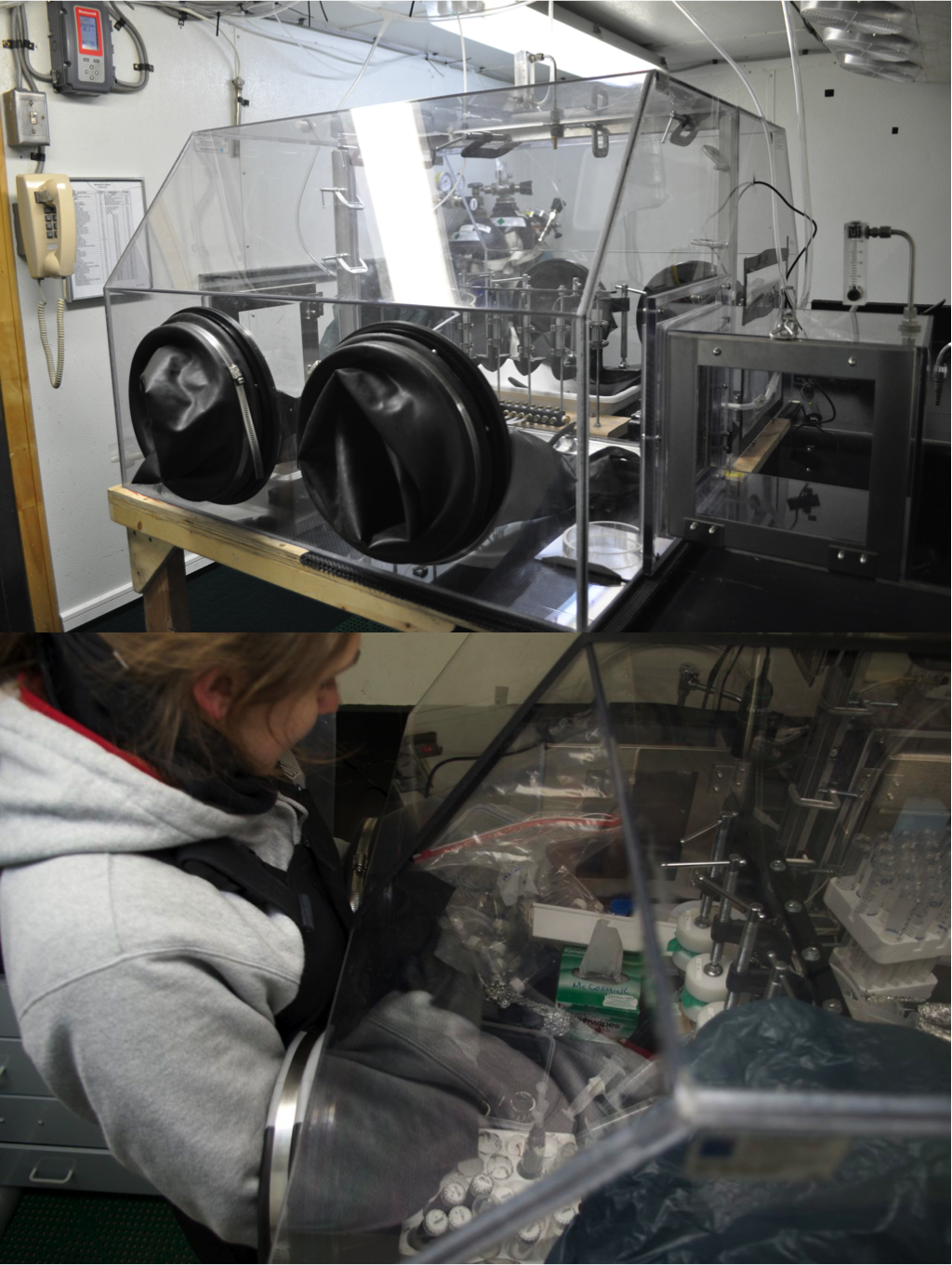
upper panel: the entire view of glove box, lower panel: Liz Bucceri working on sediment sample processing in glove box. Photo by Megumi Shimizu

Nathaniel B. Palmer has three pieces of equipment to collect sediment; the megacore, kasten core, and jumbo piston core. The length you can reach below seafloor is different, 40cm, 1.5 to 6m and 24m respectively. Megacore is more suitable for biological studies since it preserves the sediment-water interface better than kasten core and jumbo piston core. Geological studies prefer Kasten core and jumbo piston core so that they can get older data from the sediment.

For my microbial lipid biomarker study, I’m taking samples from the megacore and kasten core. Along with microbial lipid and DNA, our team is collecting sediment and porewater (the water in pore spaces of sediments) to analyze geochemical properties of sediments, such as methane, sulfate, sulfide, and dissolved inorganic carbon. To maintain the condition of the sediments as close as the real environment, the sediment cores are processed under the condition of cold (~0C degree) and anoxic (no oxygen). How to make that condition? We have a special room called “The Little Antarctica”, on the ship, which is a big refrigerator containing glove box. A glove box is the transparent container with two pairs of gloves. The inside of the box is kept practically anoxic (less than 1% of oxygen. Atmospheric oxygen is ~20%).

Read More “Beneath the Broken Ice: Playing with Mud” »

Beneath the Broken Ice: Megumi Shimizu on the 2012 LARISSA Campaign to the Antarctic Peninsula

Posted on March 12, 2012 By Guest Writer 1 Comment on Beneath the Broken Ice: Megumi Shimizu on the 2012 LARISSA Campaign to the Antarctic Peninsula
Science

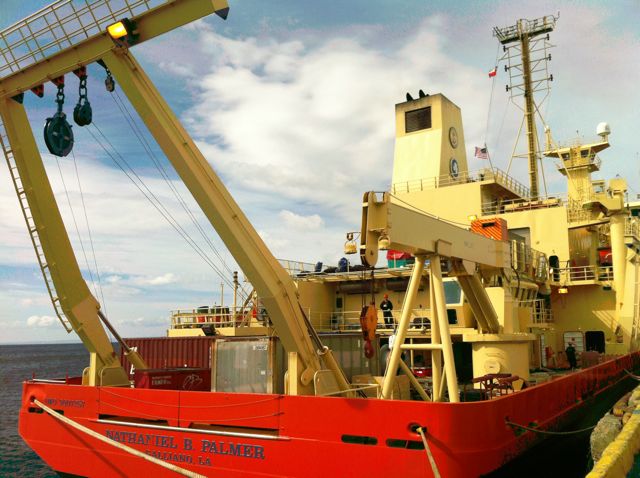
Megumi Shimizu is a graduate student studying microorganisms in marine sediment. She is currently on board the RVIB Nathaniel B. Palmer exploring seafloor communities in a once ice-covered region beneath the Larsen Ice Shelf. Over the next month, she will be updating us from the field.


The RVIB Nathaniel B. Palmer. photo by Megumi Shimizu

I’m a PhD student interested in microorganisms and biogeochemistry of marine sediments; how the metabolisms of microorganisms interacting with the surrounding environment, the chemical components in sediments. Microorganisms in subseafloor are universally important because of its large biomass. It is said 50% of prokaryotes are living under the seafloor. This biomass makes large carbon and nutrients reservoir, which are important in biogeochemical cycle. For example, microorganisms play the role of organic carbon decomposition in sediments, as a result, carbon dioxide and methane are produced. In contrast, carbon dioxide and methane are also consumed by microorganisms called chemolithotrophs and methanotrophs in sediments. Therefore, understanding microorganisms in sediments; who they are, what are they doing, is important to reveal the details of global biogeochemical cycle and accurate estimate of budgets (amount of elements converted to different forms of chemicals for example, amount of carbon dioxide converted into organic carbon by carbon fixation). In addition, how microbial community response to environmental changes such as climate warming is also important in terms of the influence of global elemental cycles.

Read More “Beneath the Broken Ice: Megumi Shimizu on the 2012 LARISSA Campaign to the Antarctic Peninsula” »

What hybrid sharks mean (and don’t mean) for climate change and evolution: fact-checking the media coverage

Posted on January 6, 2012January 6, 2012 By David Shiffman 37 Comments on What hybrid sharks mean (and don’t mean) for climate change and evolution: fact-checking the media coverage
Conservation, Science

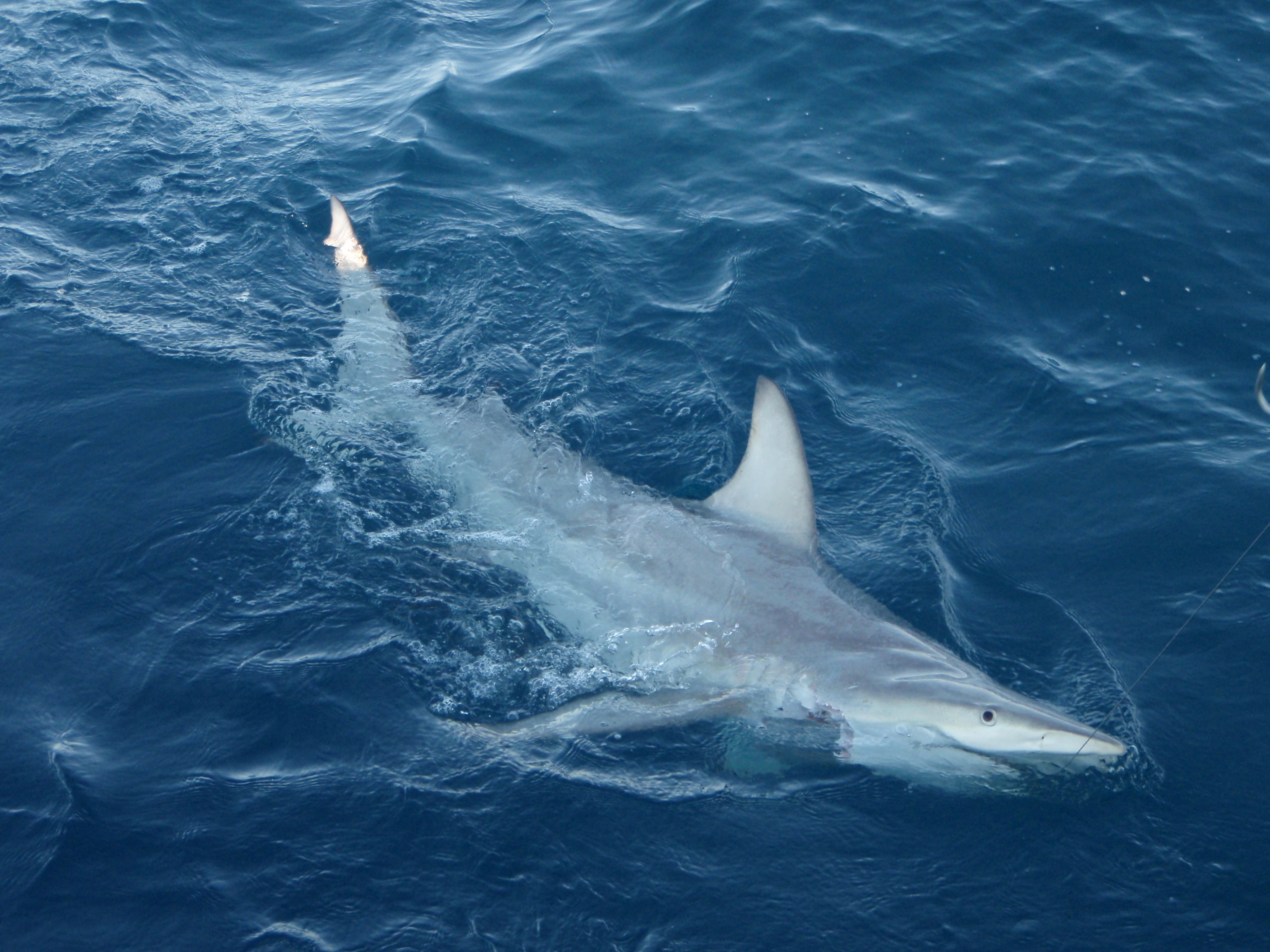
Photo credit: study author Pascal Geraghty, New South Wales Department of Primary Industry

Last week, a team of 10 Australian scientists announced that they had found the world’s first “shark hybrids”, offspring of individuals from two different shark species which had interbred. During a routine survey of Australian marine life, 57 sharks were found that physically resembled one species of shark, but had genetic markers inconsistent with that species. Subsequent genetic investigation revealed that these 57 animals were hybrids between common blacktip sharks (Carcharhinus limbatus) and Australian blacktip sharks (C. tilstoni).

Some of these hybrids were “F1″, meaning that one parents was a common blacktip and one was an Australian blacktip. Others were “B+”(backcrossed), which means that one parent was a common blacktip/Australian blacktip hybrid, and the other was a “purebreed” of one of those two species. According to the study’s lead author, Dr. Jess Morgan of the University of Queensland, “our genetic marker tells us that these hybrids are ‘at least’ F1, and that these animals are reproductively viable and can produce an F2…the hybrids may be generations past F2 but the existing genetic markers can’t distinguish how many generations past the second cross have occurred.”

Read More “What hybrid sharks mean (and don’t mean) for climate change and evolution: fact-checking the media coverage” »

#SciFund Challenge: Culture of Climate Change in French Polynesia

Posted on November 9, 2011December 9, 2011 By Andrew Thaler 1 Comment on #SciFund Challenge: Culture of Climate Change in French Polynesia
Science

#SciFund is a month-and-a-half long initiative to raise funds for a variety of scientific research projects. Project leaders post a project description and an appeal for funds, and members of the public are invited to make small donations to projects that they deem worthy. Donations come with rewards such as access to project logs, images from … Read More “#SciFund Challenge: Culture of Climate Change in French Polynesia” »

Climate change deniers continue to be wrong, science words with friends, and support science in the classroom

Posted on October 21, 2011October 21, 2011 By Andrew Thaler 4 Comments on Climate change deniers continue to be wrong, science words with friends, and support science in the classroom
Science

The bliggityblogsphere has been abuzz with recent finding by the Berkeley Earth Project that independently confirm that global climate change is real. From the BBC:

The Earth’s surface really is getting warmer, a new analysis by a US scientific group set up in the wake of the “Climategate” affair has concluded.

The Berkeley Earth Project has used new methods and some new data, but finds the same warming trend seen by groups such as the UK Met Office and Nasa.

source

Phil Plait, the Bad Astronomer, has a nice, in depth write-up, that provides some caveats missing from most of the press releases: New independent climate study confirms global warming is real.

Read More “Climate change deniers continue to be wrong, science words with friends, and support science in the classroom” »

10 misrepresentations about climate change

Posted on October 3, 2011October 2, 2011 By David Shiffman 146 Comments on 10 misrepresentations about climate change
Science

Few scientific fields generate as much controversy as climate change. Misunderstandings, misrepresentations, and outright lies are common. While environmentalists rightly criticize anti-global warming activists for not being truthful, neither side is innocent. Presented here are five common misrepresentations from both sides and the truth about those issues.

Read More “10 misrepresentations about climate change” »

Welcome to a Week of Ocean Pseudoscience!

Posted on October 3, 2011October 3, 2011 By Andrew Thaler 3 Comments on Welcome to a Week of Ocean Pseudoscience!
Uncategorized

Few things have inspired the human imagination quite like the ocean. The vast, mysterious deep is the stuff of poets, artists, explorers, and scientists. A natural result of this seemingly endless, unfathomable world-beneath-the-waves is the emergence of a broad and persistent ocean mythology, ranging from tales of sea monsters, to near magical healing powers, to … Read More “Welcome to a Week of Ocean Pseudoscience!” »

Posts pagination

Previous 1 … 10 11 12 Next

Popular Posts

Shark scientists want their research to help save threatened species, but don’t know how. Our new paper can help.Shark scientists want their research to help save threatened species, but don’t know how. Our new paper can help.December 1, 2025David Shiffman
Norway and Cook Islands put their deep-sea mining plans on pause.Norway and Cook Islands put their deep-sea mining plans on pause.December 3, 2025Andrew Thaler
What Ocean Ramsey does is not shark science or conservation: some brief thoughts on "the Shark Whisperer" documentaryWhat Ocean Ramsey does is not shark science or conservation: some brief thoughts on "the Shark Whisperer" documentaryJuly 2, 2025David Shiffman
What we know we don't know: impacts of deep-sea mining on whales, dolphins, sharks, turtles, and other migratory species.What we know we don't know: impacts of deep-sea mining on whales, dolphins, sharks, turtles, and other migratory species.November 20, 2025Andrew Thaler
2025: My year in writing, public speaking, and media interviews2025: My year in writing, public speaking, and media interviewsDecember 3, 2025David Shiffman
The Trouble with Teacup PigsThe Trouble with Teacup PigsOctober 14, 2012Andrew Thaler
Urea and Shark OsmoregulationUrea and Shark OsmoregulationNovember 15, 2010David Shiffman
How tiny satellites are tracking marine wildlifeDecember 1, 2025Andrew Thaler
Shark of Darkness: Wrath of Submarine is a fake documentaryShark of Darkness: Wrath of Submarine is a fake documentaryAugust 10, 2014Michelle Jewell
Quick Tips for Graduate Student Life - Write a Book ReviewJanuary 23, 2014Andrew Thaler
Subscribe to our RSS Feed for updates whenever new articles are published.

We recommend Feedly for RSS management. It's like Google Reader, except it still exists.

Southern Fried Science

  • Home
  • About SFS
  • Authors
  • Support SFS


If you enjoy Southern Fried Science, consider contributing to our Patreon campaign.

Copyright © 2025 Southern Fried Science.

Theme: Oceanly Premium by ScriptsTown