 I recently unveiled a new tier of Patreon rewards: 3D printed shark and ray models!For $17 per month, you will get a monthly 3D printed educational model of different shark or ray parts in the mail, and you’ll be supporting my efforts to provide these models to schools for free.
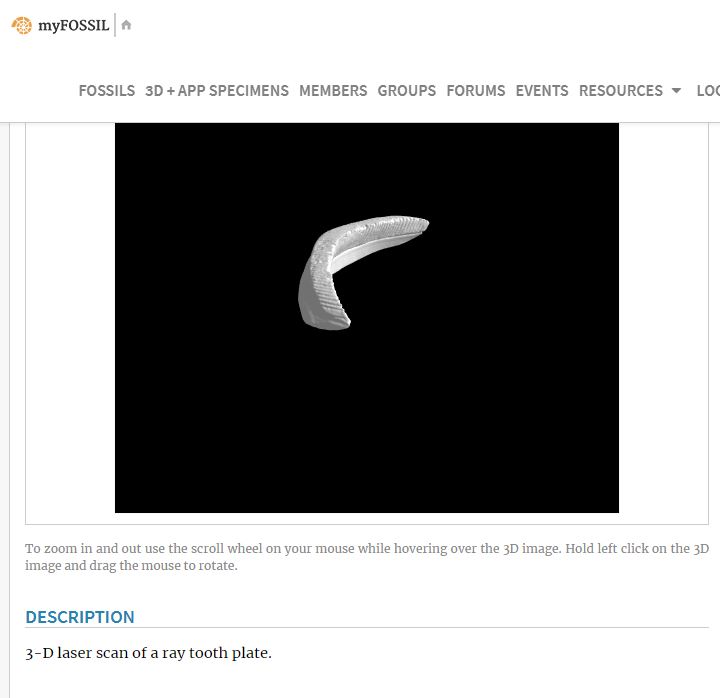
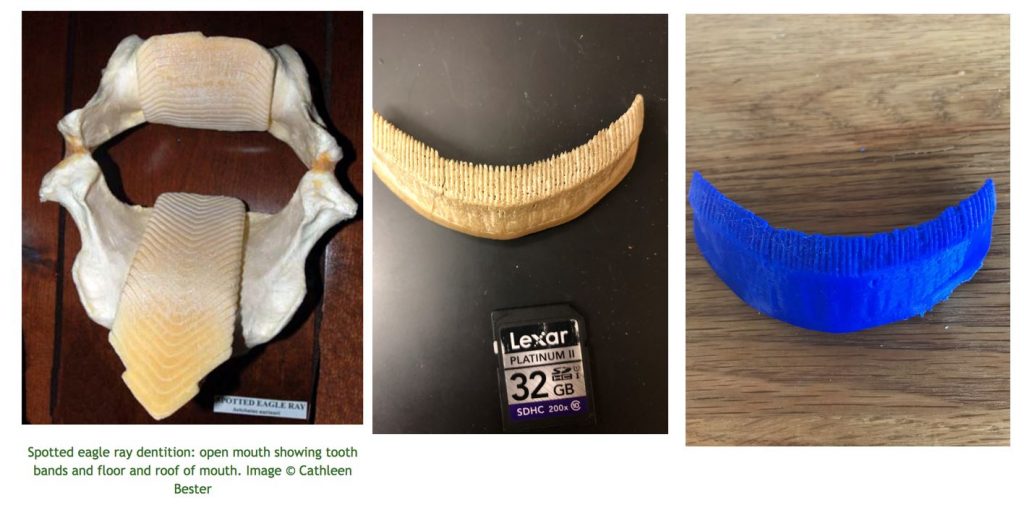
August’s reward is a row from the tooth plate of a spotted eagle ray, Aetobatus narinari! The original specimen is housed at the University of Tennessee fossil collection, and the 3D scan was shared online as part of the FOSSIL project.
I asked University of Florida/Florida Museum Ph.D. student Jeanette Pirlo about the FOSSIL project:
” The FOSSIL Project is an NSF funded project, based out of the University of Florida and the Florida Museum, devoted to cultivating a networked community of practice in which fossil club members and professional paleontologists collaborate in learning the practice of science and outreach. The myFOSSIL.org website is the platform from which our members can collaborate by sharing their fossil finds, curate their personal collections, and participate in ongoing paleontological research” – Jeanette Pirlo
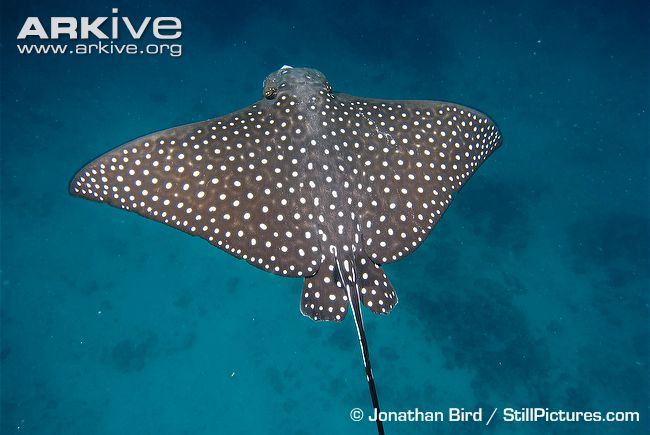
Learn more about the spotted eagle ray and it’s teeth below!
- Spotted eagle rays are a beautiful fish that is a highlight of any dive, and they are also beloved by researchers! I reached out to Dr. Kim Bassos-Hull of Mote Marine Lab to talk about what she likes about these amazing animals.
“I have really enjoyed studying spotted eagle rays over the last 10 years and shedding some light on the biology and behavior of this previously little studied ray. They are beautiful to watch as they “fly” by the reefs or over the sand shoals with their dark bodies and light spots in the shapes of spheres, donuts and peanuts. I think one of the most cool things about them is they crush their prey – molluscs like clams and snails – with their large flattened teeth and spit out the shells and only ingest the meaty part! Eagle rays are not only beautiful but one of the more intelligent ocean species with one of the largest brain to body size ratios of all fish species – they deserve our respect.”
– Dr. Kim Bassos-Hull
2. Though they’re quite different from shark teeth, yes, rays have teeth! I reached out to Dr. Matt Ajemian, who studies spotted eagle rays at Florida Atlantic University/Harbor Branch Oceanographic Institute, and here’s what he told me about eagle ray teeth:
“Despite being cartilaginous fishes, myliobatid rays like the spotted eagle ray (Aetobatus narinari) are equipped with a specialized feeding mechanism consisting of powerful jaws fortified with calcified “struts” called trabeculae and hypertrophied jaw adductor muscles. In addition, these rays have fused, flattened, and pavement-like tooth plates. The ventral (lower) dental plate is actually shaped like a “spade,” which we think is used to help dig up infauna buried in the sediment. Combined, these characteristics provide spotted eagle rays with a tremendous ability to excavate and crush hard-shelled mollusks like clams, scallops, snails, whelks and even conchs! -Dr. Matt Ajemian
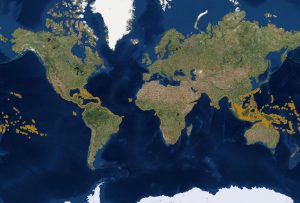
3.These rays are found in warm waters around the world, though this may be a species complex of at least four different closely related species.
4. The beautiful patterns of spots on these animals are so distinctive that they can be used to reliably identify individual rays, just like fingerprints! Check out my article about this for Hakai Magazine.
5. This species is assessed as “Near Threatened” worldwide, with some populations assessed as “Vulnerable,” by the IUCN Red List. Though there aren’t any major international markets for their meat, they are commonly caught by coastal fishing nets and many smaller local markets for their meat exist.
Want to get your own 3D printed spotted eagle ray tooth plate, and support my efforts to provide these models to schools for free? Support me on Patreon! You can also support me at a lower tier without getting these rewards, and all support is appreciated.