Andrew is a post-doctoral researcher in North Carolina focused on population and conservation genetics in hydrothermal vent communities.


David is a graduate student in Florida. He studies the ecology and conservation of sharks.


Amy is a graduate student in North Carolina studying local ecological knowledge within small scale fisheries.


Chuck is a graduate student in North Carolina focusing on apex predators and how they interact with fisheries.


Lyndell is a graduate student in North Carolina, studying the feeding ecology of cownose rays.


Iris is a graduate student in Washington studying habitat use and feeding habits of juvenile Pacific salmon and herring in Puget Sound.


Michael is a graduate student in Maryland investigating the visual systems of mantis shrimp.


Archives

The most preventable shark attack of all time?

davesquare

I don’t often cover shark attacks here at Southern Fried Science. They get plenty of news coverage on their own, they’re usually not that relevant from a science and conservation perspective, and they are outside of my expertise and interests. However, some shark attack stories, such as this one, transcend “if it bleeds, it leads” fearmongering journalism and are interesting in their own right.

I’d like to preface this story by saying that shark attacks are extremely rare to begin with (you have a 1 in 5 chance of dying from heart disease and a 1 in 3.8 million chance of being killed by a shark in the United States). If you want to further minimize your chance of being attacked by a shark, most of the few attacks that occur can be prevented by simply swimming close to shore with lots of other people nearby during the day. Even though shark attacks are rare, I still don’t want to minimize the suffering of the few attack victims and their families. With these caveats out of the way, presented below is the fascinating story of what is probably the most preventable shark attack of all time.

Continue reading The most preventable shark attack of all time?

Check out Shark Attack Experiment Live, Friday on National Geographic Wild

This Friday, tune in to National Geographic Wild for a day of sharks! Starting at noon, they will air a series of shark documentaries culminating at 9 p.m. with “Shark Attack Experiment: Live“. This show, aired live from the shark hotspot of South Africa, aims to test some common myths about shark attacks and to “to dispel negative myths about sharks and raise public awareness that some shark species are being driven to extinction by overfishing”.  In addition to the live experiments, survivors of shark attacks will get the opportunity, while surrounded by trained shark-diving professionals, to face their fears and intentionally interact with sharks.  The whole thing will also be live-blogged, and organizers have included a social media component (Twitter #sharkattack). Check it out!

Western Australia’s sharks need your help!

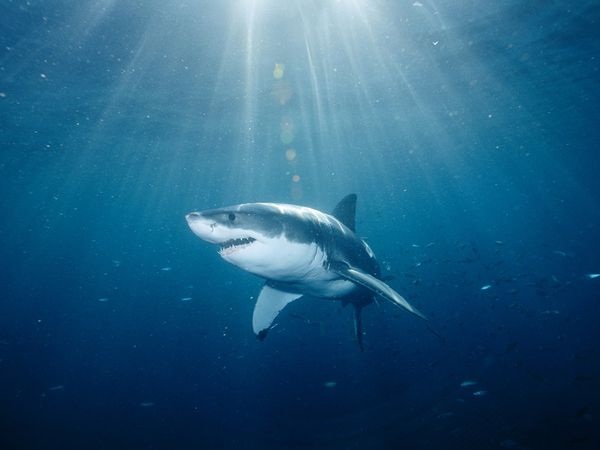
Great White Shark. Image courtesy animals.NationalGeographic.com

Last week, I wrote about three current shark conservation issues, including a proposed shark cull in Western Australia. Barbara Wueringer was able to deliver her letter to Western Australian government officials on Friday, and thanks to your help, it was signed by more than 100 scientists and conservationists from all over the world.

Yesterday, however, another swimmer was killed by a shark in Western Australian waters. George Thomas Wainwright, 32, was a native of Texas who had been working on a boat in Australia. This attack, which is the third in the last two months, has resulted in renewed calls for a “shark cull”. The proposed plan would involve both an attempt to kill the specific shark responsible for killing Mr. Wainwright and a more general killing of all the sharks in the area. It is believed that the shark that killed Mr. Wainwright was a great white shark, also known as a  ”white pointer” in Australia.

Continue reading Western Australia’s sharks need your help!

Shark bites snorkeler… who happens to be my friend

On June 30th, while vacationing in the Turks and Caicos, a 28 year old man was bitten by a large shark.  This particular attack got my attention in a hurry. For the first time in my life, a friend of mine was bitten by a shark. Obviously I know some shark biologists who have been bitten while handling sharks in the field, but that isn’t what happened in this case. This victim was simply snorkeling during a vacation. He agreed to answer some of my questions about the incident, and prefers to remain anonymous.
Continue reading Shark bites snorkeler… who happens to be my friend

Were 18 foot long thresher sharks responsible for closing a New York beach?

Earlier this week, several New York state beaches were closed due to shark sightings. Fox News’ Rick Leventhal, speaking as part of Bill Hemmer’s “America’s Newsroom” show, reported on this story, claiming that “some onlookers ID’ed them as thresher sharks, they’re estimated to be about  18 feet long”. A half-eaten seal also washed up on shore nearby.


To his credit, Mr. Leventhal  attempted to play down fears about these animals, saying that “Let’s not forget that sharks live in the ocean…as long as there’s food, they’re likely to keep hanging around”. However, I was immediately skeptical of the claim that a group of 18 foot long thresher sharks were swimming slowly just a few yards offshore. A cursory review of the known biology and ecology of thresher sharks will explain my skepticism.

Continue reading Were 18 foot long thresher sharks responsible for closing a New York beach?

Shark Science Monday: Christopher Neff discusses shark management policy in the US, Australia, and South Africa

In this week’s edition of Shark Science Monday, Christopher Neff discusses how shark attacks play a role in shark management policy in three countries- the United States, Australia, and South Africa.

If you have a question for Christopher, please leave it in the comments and I’ll make sure it gets to him.

Thoughts on the shark attacks in Egypt

While we were away on our December blog-cation, sharks were all over the news. Specifically, a series of shark attacks in the resort town of Sharm-el-Sheik, Egypt, captured the attention of the media and of beachgoing news watchers worldwide. I normally don’t talk about shark attacks on the blog, but lots of readers have been asking me for my opinion on this incident. Fortunately, even though I was on blog-cation, the rest of the shark blog-o-sphere was hard at work covering this issue.

While it’s difficult to integrate a month’s worth of news stories after the fact, I’ll do my best to provide you with a complete picture of what happened. Please feel free to point out inaccuracies in the comments section.

Continue reading Thoughts on the shark attacks in Egypt

Innovative Conservation: Shark Attack Survivors Speak About Saving Sharks

Last Monday, the Pew Environment Group’s Global Shark Conservation Campaign arranged for a brilliant PR stunt – they arranged for survivors of shark attacks to speak about shark conservation outside of the United Nations headquarters in New York.

Though very few people are ever bitten by sharks, many fear them, which makes it difficult to generate public support for their conservation. Having survivors of shark attacks speak about the need for international legal protection for sharks is a great move. As participant Debbie Salamone said, “If a group like us can see the value in saving sharks, can’t everyone?” The Pew organizers also made sure that this event was covered by the press- dozens of friends sent me this Yahoo News article, and several event participants were featured on CBS’ the Early Show.

The timing couldn’t be better. According to the Underwater Times:

“U.N. member countries have an opportunity this week and next to address this problem when they refine their annual resolution on sustainable fisheries and review the Millennium Development Goals, which include a target to reduce biodiversity loss. This is also the International Year of Biodiversity. At a press conference, meetings with U.N. missions and a panel discussion at the U.N., the survivors will ask that delegates use these opportunities to advance shark conservation.”

I hope this helps. At the very least, it resulted in some positive media coverage for sharks.

~WhySharksMatter

Shark Week 2010: A big step in the right direction!

Disclaimer: Both the Southern Fried Scientist and I received a media care package from the Discovery Channel containing a t-shirt, an adopt-a-shark packet, and DVDs of two of the premieres. While I still have some criticisms, I wanted to start this review by saying that this year’s Shark Week was a lot better than any from the past few years. Before I review each premiere I need to acknowledge that I watched all of them at their later air times, not when they originally aired. The content of each premiere is the same, but I did not see the same commercials as everyone else, I never saw the Oceana PSA, I saw very few Craig Ferguson interludes, and I don’t know if there were any pop-up ads during the shows. This was an unavoidable inconvenience and hopefully doesn’t bias my review too much.

Continue reading Shark Week 2010: A big step in the right direction!

Last year's Shark Week coverage

The online shark science community has been critical of the Discovery Channel’s “Shark Week” in the past because some of the documentaries promote fear of sharks at a time when we should be promoting respect and conservation. According to the Dorsal Fin blog, this year is looking like it will bring us more of the same, though one particular story won’t be covered because it happened so recently.  Since Shark Week is starting to be discussed again by the blogosphere, I am re-posting all of last year’s Shark Week coverage. This includes an interview with the Discovery Channel’s Senior Science Editor (originally here), a detailed evaluation of each of the Shark Week specials (originally here), and ten suggestions for how to improve future Shark Week programming (originally here). All of the original comments are preserved at the old site.

Continue reading Last year’s Shark Week coverage