 After our sustainability month, it becomes easy to ask for a plan to become more sustainable. On a national scale, this becomes demand for a blueprint or recipe for how to organize society successfully in the future along sustainability principles. The idea of a given trajectory of development goes back to Walt Rostow, who described development around the world up to 1960, ending with the emergence of a first, second, and third world. More modern theorists realize that the world is not linear, however.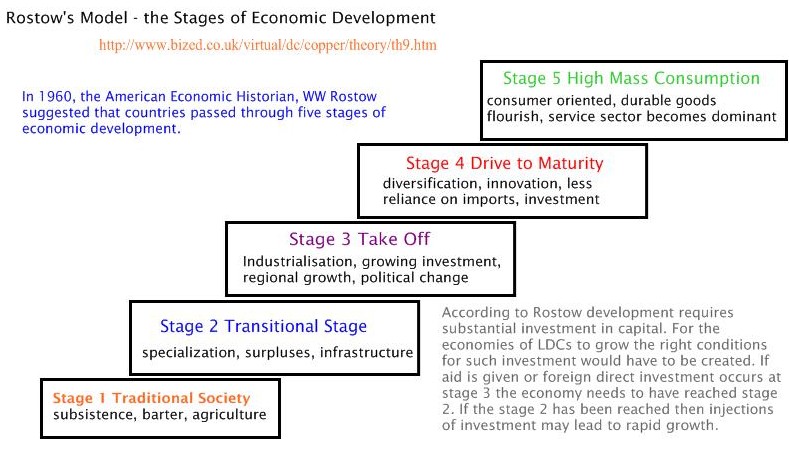
Critics of Rostow point out that the world in 1960 is very different than the modern world. “Developed” back then mostly referred to successful post-world war economies and therefore Rostow’s model aptly described England, the US, France, Australia, etc. Most critically, Rostow’s developed societies all depended on high, unsustainable use of energy and natural resources such as oil, coal, wood, and mineral ore. At the time, he didn’t venture to guess what might come beyond his consumerist stage. Moving beyond a one-size-fits all recipe into poststructuralist economics broadens the horizon of opportunities for what future development might look like.
The key to poststructuralist development is that each country or society will have a different ideal plan to their path of development. This means that coming up with a “plan for sustainable development” at a broad scale is impossible, despite the best hopes and wishes of foundations, community development organizations, and international banks.
Rostow’s theories do fit America and many European countries through the 20th century. But citizens of those high consumption societies are gradually awakening to the fact that their habits will not be able to continue indefinitely and that many of the resources they depend on are becoming exorbitantly expensive as they begin to disappear. This is the stage where structural development plans might just work – look at where consumption patterns are hurting economy and environment, then make the change for more sustainable use.
For countries and cultures that haven’t yet reached Rostow’s high consumption stage, like much of the developing world, the optimists among us would like to think that the path can be diverted or at least avoided. These cultures have the chance to learn from the mistakes of societies already in an unsustainable place and skip to a more economically and environmentally sustainable plan for their country. Like the cell phones that arose without the use of landlines in much of Africa, they have the chance to take advantage of new technologies that can help them create a more sustainable culture without following Rostow’s path.