

Foucault saw the concepts of knowledge and power as one entity, which he called “pouvoir-savoir”, based on the philosophy that knowledge and power are co-evolved. There are a number of examples where Foucault’s assertion seem to be correct. In France, a group of patients with muscular dystrophy coordinated and collected vast amounts of collective data on the rare disease by detailed recordkeeping by family members. They even held their own conferences and shared information, eventually bringing in a couple of doctors to do standard medical analysis on their data. Armed with knowledge of the disease, they were able to confront the medical establishment, which had previously ignored their cases because so little was known about the disease and the doctors did not want to look ignorant. Public attention brought by these events also brought funding to an otherwise unprofitable treatment regiment (Rabeharisoa and Callon in Jasanoff 2004). In other parts of the world, knowledge of medicinal plants and other helpful plant genotypes has been linked to indigenous rights movement through intellectual property (Whatmore 2002). Plant germplasms have become a way for communities to connect to international groups supporting biodiversity, which in turn helps secure indigenous rights over both intellectual and land properties.
More often, however, the interaction of knowledges is where the power is realized. This is the premise behind co-management. The participatory nature of comanagement legitimizes the policy, embeds it in local culture and values, and maintains ownership of the resource by the community. There are many reasons for this type of arrangement to be used and it has been shown to be successful in cases around the world, establishing the community as a knowledge-holding body and earning it political power (Jentoft, McCay et al. 1998). In addition, comanagement often inspires the development of more knowledge within the community, solidifying the community’s role in governance (Jentoft 2007).
Knowledge does not necessarily translate into power. Information management can delegitimize certain types of knowledge. Globalization processes attempt to marginalize local knowledge and cultures, placing locals at a disadvantage in the modern economic system (Escobar 2004). In addition, locals typically frame their knowledge by different schemas than science[1], focusing on procedural aspects of the knowledge. This is evidenced in the emphasis placed by participants in comanagement policies on the process more than the final product (Fischer 2002). Local knowledge is also more often experiential in nature and more tailored to specific environmental contexts, so is often ignored or misunderstood in other, usually larger contexts (Berkes 2008).
Modern society has been called a technocracy, privileging standard scientific knowledge above other types and even extending additional authority to scientific knowledge. By emphasizing objectivity and downplaying uncertainty, scientific knowledge has claimed authority and expertise in policymaking (Hilgartner 2002). In order to maintain that sole authority, this scientific movement has defined what counts as “knowledge” – and types that did not follow the scientific method and cannot produce quantitative results do not. Once authority is claimed, however, experts holding certain types of knowledge have the capability to guide and shape policy. For example, since science supported alternative service delivery of water, Ontario decided to privatize their water services even though it was highly controversial (Bakker 2010).
Problems defined by certain types of knowledge also then define what kinds of solutions are possible. For example, in the European Union, water quality is an issue defined largely by scientific monitoring and quantitative modeling, therefore the only solutions considered were technological, not political. This meant that responsibility for solutions was placed at the end of the watershed where the water quality problems aggregated by natural forces, not at the sources of the pollution (Jasanoff 2004).
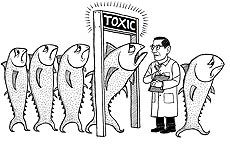
Knowledge can also be unlinked from needing a solution at all. Under the neoliberal philosophy currently guiding many environmental problems, knowledge of problems is just given to the consumers to allow them to make market decisions, which will in turn theoretically produce solutions through the market. Mansfield (2010) describes how this logic has failed for the problem of toxins (such as mercury and PCBs) in fish. Scientific test results showing unhealthy levels of contamination have been published and distributed to consumers. However, so have reports showing that fish are healthy for their high content of healthy oils. Consumers are then forced to balance the risk from toxins with the potential health benefits of the oils. Since fish consumption is rising, one can assume they’ve chosen the latter. As a result, new types of fish production (aquaculture) are necessary to meet the demand and the inputs for aquaculture increase the toxin load in fish tissue. Instead of a solution to the toxin problem, market forces have made the problem worse.
Ignorance can also be used as a tool in the knowledge-power balance. Michael describes that in his field work, discourses of ignorance were not just simply a lack of knowledge, but instead were created by people to form a representation of themselves based on certain knowledges. People reflect on the epistemological status of their knowledge and then social and political contexts are drawn on to create a relation to science. Michael determined that people use the discourse of ignorance to three ends: to place themselves as subservient to science, to create a division of labor between themselves and science, and to declare science irrelevant by creating moral and political challenges (Nader 1996).
In conclusion, knowledge can mean power, but existing powers may manipulate knowledge to eliminate threats to authority (Jasanoff 2004). Participatory research emerged as a response to the authority of positivist science and now serves as a critical link between knowledge and power (Fischer 2002). Participatory methods blend ways of knowing, lending higher authority to both through a wider audience with trust and understanding in a particular way of knowing. They also allow for more knowledge to be created and often result in better, more locally tailored management, continuing the cycle of empowerment (Fischer 2002). Participatory methods and co-management, then, serve as a means of ensuring knowledge is power.
[1][1] I am using “local” and “science” here as types of knowledge that are included in a common juxtaposition. By “local” I largely mean knowledge formed through experience and by “science” I mean knowledge formed through a standard research process (not just biology, chemistry, and physics).