
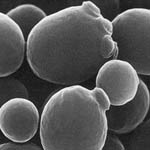
As our ancestors transitioned from hunter-gatherer to agricultural society, they had to domesticate the plants and animals we know today as farm life. Corn kernels became larger and more full of starch, cows became more docile, and all farm organisms became accustomed to life in rows or pastures tended by humans. But some of what we eat depends on more than just these plants and animals – example, take beer. A new study in PNAS by Diego Libkind et al. describes the domestication of the microbes and yeast needed to make lagers of old and describes an unwitting process paralleling agricultural domestication.
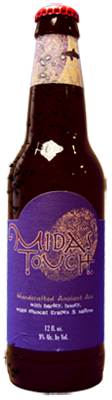 The earliest beers were developed in the Fertile Crescent after Sumerians tamed the barley plant some 6000 years ago and is credited with helping to shape the strong culture that emerged in the region. Early beers included a wide diversity of ingredients, both in the grain used for brewing and the spices that added a special taste. Smithsonian recently profiled Patrick McGovern, who isolates and identifies the chemicals from these ancient beers to create an ingredient list to re-create these beers (you can check out one of these, called Midas Touch, at Dogfish Head). According to McGovern, these ingredients, including “olive oil, bog myrtle, cheese, meadowsweet, mugwort, carrot, not to mention hallucinogens like hemp and poppy”, gives insight into the cultures that created these concoctions. So with such a rich history, how did we manage to pull together what we now recognize as beer?
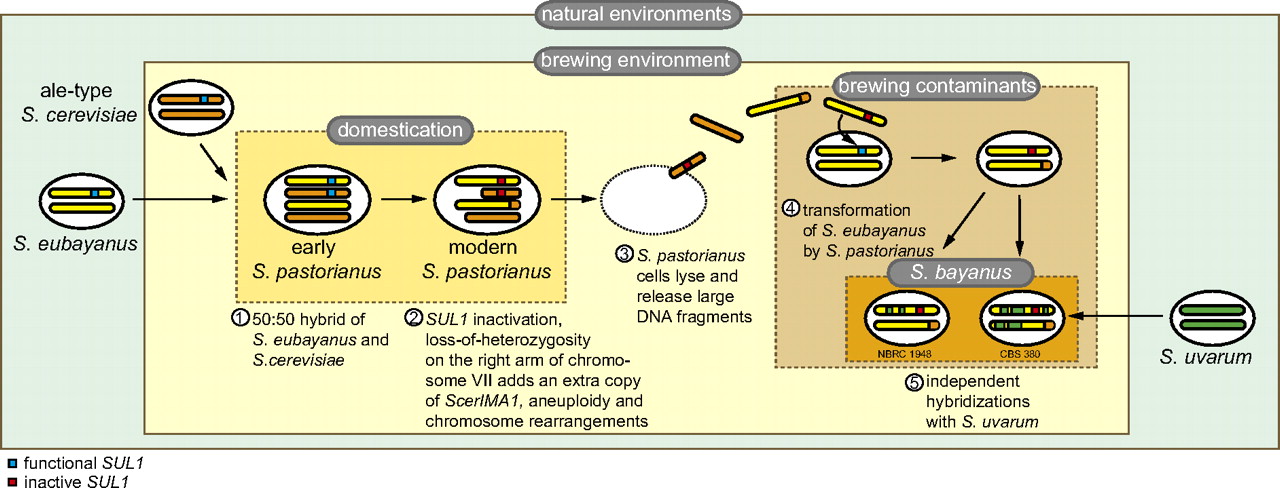
Ales, wines, and leavened bread all use the same yeast, Saccharomyces cerevisiae, to ferment grain and provide food and fun. Lagers, on the other hand (the most popular of alcoholic beverages worldwide) use S. pastorianus with the occasional ‘contamination’ of S. bayanus, neither of which as ever been isolated from the wild. They appear to depend on humans for propagation, specifically on the beer brewing process – evidence that early humans domesticated these yeast species (whether they meant to or not). However, the authors of this study thought existing relatives of the original yeast species must still be out there, offering a stock of wild yeast traits that may yield exciting new beers as well as a genetic safety net should something happen to S. pastorianus.
After extensive field collections of Saccharomyces from around the world, genome sequencing revealed that S. pastorianus is likely a hybrid of S. eubayanus, a pure strain identified in the unique Pagagonian ecosystem, and S. cerevisiae, sequences of which had previously been identified in the genome. So what did domestication change in the genome? A sugar-processing gene that cleaves the sugar disaccharide isomaltose, efficient nutrient transport, and increased sulfite formation are all present in domesticated strains at a much higher frequency than the wild strains. This suggests the brewing process strongly favors these traits. The hybridization appears to have happened at least twice since the 15th century.
Reference:
Libkind, D., Hittinger, C., Valerio, E., Goncalves, C., Dover, J., Johnston, M., Goncalves, P., & Sampaio, J. (2011). From the Cover: Microbe domestication and the identification of the wild genetic stock of lager-brewing yeast Proceedings of the National Academy of Sciences, 108 (35), 14539-14544 DOI: 10.1073/pnas.1105430108