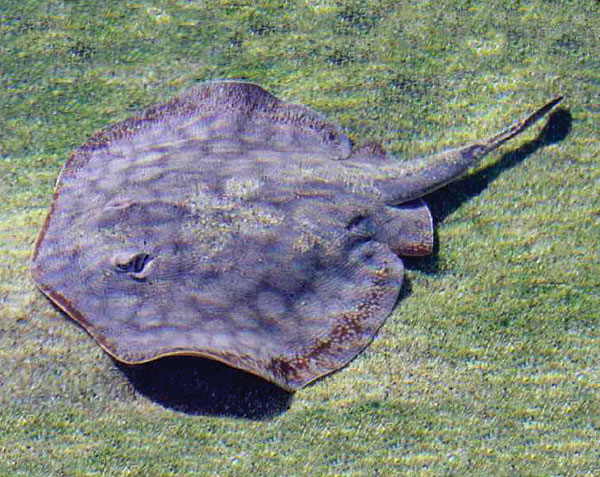
Kady Lyons is a Ph.D. candidate whose research focuses on the intersection of physiology, ecology and toxicology. Her Master’s at Cal State Long Beach with Dr. Chris Lowe got her involved in elasmobranch toxicology. She is interested in how elasmobranchs respond to anthropogenic contaminants and how contaminants can be used as another tool to study ecology. Currently, her Ph.D. is examining how accumulation of these man-made contaminants influences round stingray growth and reproduction. As part of her Master’s work, she began to investigate mercury accumulation and body distribution of mercury, a potent neurotoxin, in elasmobranchs using the round stingray as a model species. She is continuing to work on this project and will be raising funds to finish this research as part of The Experiment’s Sharks Grant Challenge beginning June 8th and running through the Discovery Channel’s Shark Week.
Mercury concentrations in the earth’s atmosphere have significantly increased with human activities such as mining and fossil fuel burning. Mercury can be transformed into its more dangerous form (methylmercury) and this form is what becomes concentrated in animals’ tissues. For animals that occupy higher positions in the food web such as elasmobranchs (sharks, skates and rays), mercury can bioaccumulate to high levels due to their long life and carnivorous behavior.
While mercury is well known to accumulate in the muscle of sharks, the distribution of this contaminant within an individual’s different tissue types and how mercury fluxes from one part of the body to another with age is poorly understood in elasmobranchs. In particular, this phenomenon is especially poorly known for rays and skates as most attention has been directed towards sharks.
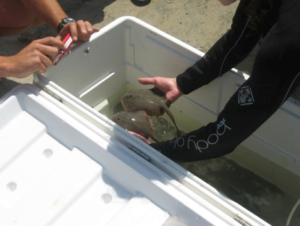
Previous studies on elasmobranchs have started to examine the interplay between mercury that is accumulated in muscle and liver. However, the dynamic that exists between these two tissue types is still not well understood. The liver plays a detoxification role in the body while the muscle potentially represents a mercury reservoir. Therefore, mercury accumulation will be dependent on the dynamics of mercury distribution in the body between these two major tissues.
This project will investigate how mercury concentrations change with age in each of these tissue compartments (i.e. liver and muscle), which is important for understanding what negative physiological impacts mercury exposure may be having in elasmobranchs. Mercury accumulation and how it is distributed in fishes has implications for human health when elasmobranchs are consumed. Since mercury is a potent neurotoxin, understanding what fish tissues have the highest concentrations is especially important with regards to consumption by children, whose nervous systems are still developing, and women of reproductive age, who can expose developing fetuses to mercury during pregnancy.
If you are interested in this research, check out my Experiment crowdfunding page. There you can ask me questions directly, keep tabs on the progress of this research, and help support it until the end of June.