 Manuel Dureuil is a Ph.D. candidate whose research focuses on the conservation ecology of sharks. He did both, his Bachelor and Master thesis, in the field of shark conservation at the University of Marburg and Kiel in Germany. His main interest are spatial ecology and data-limited assessment approaches to form a scientific basis for a more comprehensive protection of sharks. A species with particular focus of his research is the Atlantic weasel shark, which is only found in West Africa. Sharks in this area are among the least researched yet most threatened by illegal and unregulated fishing. The weasel shark fulfills all criteria to be considered data-limited: there is no population assessment, no information on its spatial ecology and almost no information on its biology. Manuel is raising funds till the 9th of July as part of The Experiment’s Sharks Grant Challenge, to start a weasel shark project in Cabo Verde, West Africa. Using the weasel shark as an umbrella species the researchers also hope to create awareness for sharks in this region in general, on a national and international level.
The remote island nation of Cabo Verde holds one of the last remaining hotspots for sharks in the entire North Atlantic Ocean and therefore could offer some degree of protection from the ongoing decline in shark populations. This is particularly important for locally endemic species which only occur in this area, such as the Atlantic weasel shark. We know almost nothing about this species and accordingly it is listed as ‘data deficient’ on the IUCN Red List. However, the little we know suggest that this shark is vulnerable to overfishing, making the protection of important habitats (such as nursery grounds) crucial for healthy populations and preventing extinction.
Acoustic tagging is ideal to provide information on the presence or absence of individuals in a specific area over time. This technique allows us to investigate for example ‘site fidelity’, a behavior where the same shark individuals return to key aggregation sites repeatedly over time. Furthermore, the access to the animals while tagging enable us to record all kind of biological data, such as sex, genetic samples, blood and size measurements. This can eventually provide information to help us understand how vulnerable the species might be to disturbances, such as fishing pressure.
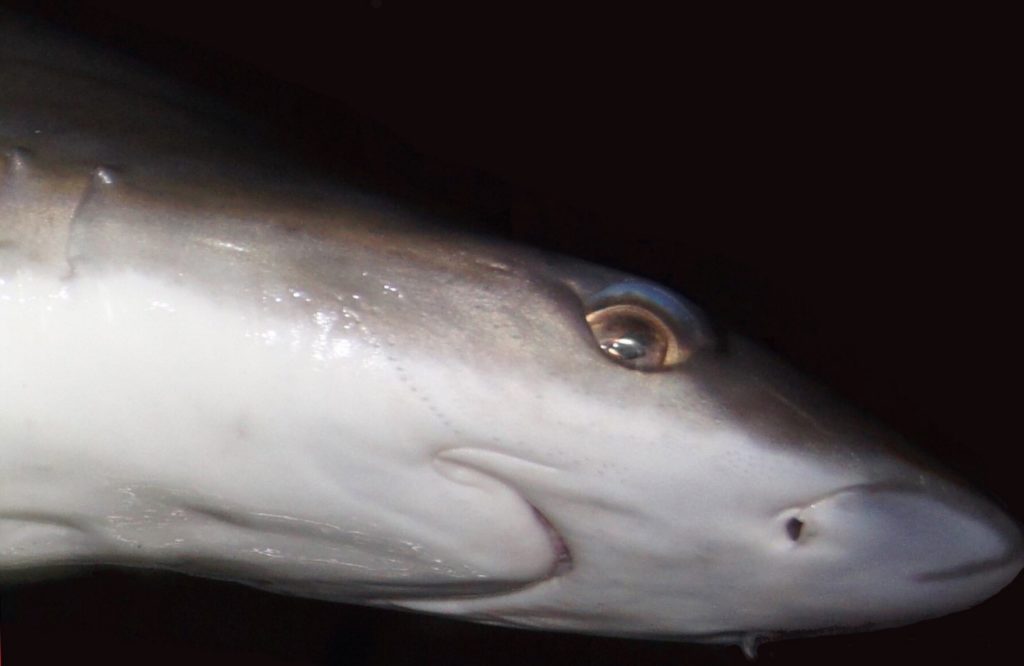
In 2015, we found a previously unknown aggregation of weasel sharks in the remote island nation of Cabo Verde, which could be one of the last strongholds of this enigmatic species. We are currently raising funds in order to launch a second expedition where we will tag sharks with acoustic transmitters. This will allow us to find out which areas are most often used by this species and which areas would be most important for this species to become protected.
If you are interested in this research project, check out my Experiment crowdfunding page. There you get more information about the project, can ask me questions and support it.