

Following our discussion of scale, management boundaries must match ecological processes which are now recognized to be dynamic and complex. This means that management must manage not for a known equilibrium, but a dialectic system full of uncertainty (Berkes 2008). Instead of attempting to predict from the instigation of a policy what the effects may be, governance should be structured to constantly evaluate the system and incorporate feedbacks. This process, known as adaptive management (also check out statements on the subject from the Resilience Alliance and US Department of Interior), provides for the co-evolution of the system and its governance to ensure that they remain an effective match.
Under adaptive management, episodes of disturbance are learning opportunities, not a signal of policy failure. Berkes (2008) describes this phenomenon: “’conservation’ is not a state of being. It is a response to a people’s perceptions about the state of their environment and its resources, and a willingness to modify their behaviors to adjust to new realities”. He goes on to say that disturbances are not only opportunities for learning, but that they are necessary for that learning to occur. Gunderson and Carpenter (2006) add that disturbance is necessary for transformational learning – the type of learning that allows for the emergence of novelty. Therefore, disturbances should be allowed to occur in order to foster community and governmental innovation.
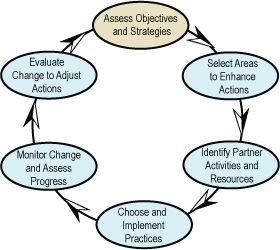
Adaptive management involves both small-scale learning that makes changes to existing policy and a philosophical shift in what a policy is. Policies must be viewed as experiments as “our ability to play with alternative images will to a great extent determine our ability to change, improve and innovate, since it is essential to institutional learning” (Jentoft 2007). Policy goals then are viewed as hypotheses and past experience as theory. Under our current governance structure, however, such a shift in the philosophy of policy is impossible because the US governance system was designed to be slow and recalcitrant to change in order to guard against “the tyranny of the majority”. Institutions of governance, once built, are nearly impossible to remove even if desired. Therefore, there are limits to the ability of formal government to adaptively manage (Jentoft 2007).
Bottom line is that the theory behind adaptive management and the few real-world examples that have tried adaptive policies are optimistic about success. However, we have a long way to go in order to change our already in-place governance structure to be able to adapt to the degree necessary required for adaptive management. In the end, both utilizing adaptive management and the rebuilding and questioning of our institutions will be helpful to conservation measures in the future.
Sources:
Berkes, F. 2008. Sacred Ecology. Routledge.
Gunderson, L, S. Carpenter. 2006. Water RATs (resilience, adaptability, and transformability) in lake and wetland social-ecological systems. Ecology and Society.
Jentoft, S. 2007. Limits of governability: Institutional implications for fisheries and coastal governance. Marine Policy.