Skip to content

Southern Fried Science

Over 15 years of ocean science and conservation online

  • Home
  • About SFS
  • Authors
  • Support SFS

Tag: Chernobyl

Monday Morning Salvage: January 23, 2017

Posted on January 23, 2017January 23, 2017 By Andrew Thaler
Weekly Salvage

Flotsam (what we’re obsessed with right now)

  • Come back to the Mariana Trench with me! I’ve taken the almost ten hours of assorted dive footage from our adventures in Saipan, Tinian, Rota, and Guam and edited it down to just the best four minutes. Share, subscribe, and enjoy!

Jetsam (what we’re enjoying from around the web)
Read More “Monday Morning Salvage: January 23, 2017” »

Monday Morning Salvage: January 9, 2017

Posted on January 9, 2017January 9, 2017 By Andrew Thaler
Weekly Salvage

Flotsam (what we’re obsessed with right now)

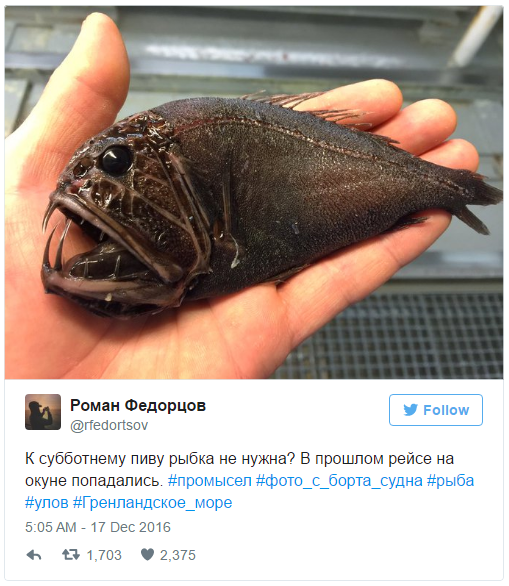
  • Roman Fedorsov, a Russian fisherman who posts all the weirdest bycatch from deep-sea trawls to his twitter account.

Jetsam (what we’re enjoying from around the web)
Read More “Monday Morning Salvage: January 9, 2017” »

Five organisms with real super powers that rival their comic book counterparts

Posted on January 2, 2013September 19, 2013 By Andrew Thaler 6 Comments on Five organisms with real super powers that rival their comic book counterparts
Popular Culture, Science

Andrew ThumbThere is no force more creative than the painstakingly slow process of evolution. Ever wanted to walk through walls? Naked mole rats can physically bore through concrete. How about fly? There are a couple dozen different ways to accomplish that goal, even if you’re a squid. Incredible power of regeneration? Flatworms, roundworms, and echinoderms have us beat. Among the vertebrates, species like the axolotl can regrow limbs, organs, and parts of their brain. For practically every super power we can imagine, something on the tree of life has come up with a real-world analog.

Some real super power are more super than others:

1. The immortal rotifer that absorbs the abilities of anything it touches.

Bdelloid Rotifers. photo by Diego Fontaneto

Around 80 million years ago, a small, unassuming group of metazoa decided that sex just wasn’t for them. Instead of going through the effort of recombining their genetic material with a mate every generation to produce a viable offspring with a roughly 50% contribution from each parent, Bdelloid Rotifers started reproducing asexually. Males completely disappeared from class bdelloidea, leaving females to generate genetic duplicates through parthenogenesis. This is not their super power.

Bdelloid rotifers are incredibly tough. When environmental conditions are less than favorable, they can enter a dormant state. In this dormant state,they can survive the worst unscathed. Dehydrated, they can endure extreme temperatures, drought, even ionizing radiation. A bdelloid rotifer in its dormant state can even survive in space. If that isn’t enough, while dormant, these rotifers continue to produce offspring, which also remain  dormant. This is not their super power.

Bdelloid rotifers’ super power appears when they recover from their dormant state. As they rehydrate and repair whatever damage their cells incurred, they incorporate DNA fragments from their environment. This includes partially digested food and any DNA in close proximity to them, even bacterial and archael DNA. It is this ability that allows bdelloid rotifers to overcome the limitations of asexual reproduction and survive for 80 million years without mates. They can literally absorb the attributes of those around them.

Their incredible toughness, celibate lifestyle, and ability to absorb the powers of anything they touch, put Bdelloid Rotifers firmly on par with X-Men perennial favorite: Rogue.

Read More “Five organisms with real super powers that rival their comic book counterparts” »

Climbing Mount Chernobyl: a repost for World Ocean Day

Posted on June 8, 2012June 10, 2012 By Andrew Thaler 2 Comments on Climbing Mount Chernobyl: a repost for World Ocean Day
Conservation, Science

Originally published on August 30th, 2011, Climbing Mount Chernobyl is one of my personal favorite posts. It feels appropriate to re-post it today for World Ocean Day.

Read More “Climbing Mount Chernobyl: a repost for World Ocean Day” »

Climbing Mount Chernobyl

Posted on August 30, 2011June 6, 2012 By Andrew Thaler 5 Comments on Climbing Mount Chernobyl
Conservation, Science

Chernobyl Reactor 4, after the explosion

In the last century, humans have made dramatic changes to both local and global ecosystems. Some of these changes have been subtle and remained unnoticed until very recently, while others were so visible and so destructive that their names are indelibly etched into our collective consciousness. Despite a legacy of desolation, many of these places, unsafe and long-abandoned, have made dramatic recoveries. Standing tall, but not alone, among these environmental catastrophes is the melt-down of reactor 4 at the Chernobyl Nuclear Power Plant.

Read More “Climbing Mount Chernobyl” »

Popular Posts

Why the new Trump order to shoot wolves is both illegal and a dreadful precedent for endangered speciesWhy the new Trump order to shoot wolves is both illegal and a dreadful precedent for endangered speciesSeptember 5, 2026Ali Gaster
5 things you need to know about the proposed European Union shark finning ban, including how you can helpSeptember 17, 2012David Shiffman
Severely injured great white shark found, are scientists responsible?Severely injured great white shark found, are scientists responsible?March 29, 2011David Shiffman
5 things I learned helping to reassess the global conservation status of every species of tuna and billfish5 things I learned helping to reassess the global conservation status of every species of tuna and billfishSeptember 15, 2026David Shiffman
That's not a blobfish: Deep Sea Social Media is Flooded by AI SlopThat's not a blobfish: Deep Sea Social Media is Flooded by AI SlopDecember 19, 2025Andrew Thaler
13 wrong things about sharks that conservation advocates should stop saying in 2013 (and what they should say instead)December 27, 2012David Shiffman
I can serve on your graduate thesis committee. Here’s what you can expect of me, and what I expect in return.I can serve on your graduate thesis committee. Here’s what you can expect of me, and what I expect in return.October 16, 2025David Shiffman
Getting a sense of porpoiseJanuary 20, 2009Andrew Thaler
U.S. government: shark fin bans "significantly undermine conservation and management of Federal shark fisheries"May 2, 2013David Shiffman
What is a Sand Shark?What is a Sand Shark?November 12, 2017Chuck Bangley
Subscribe to our RSS Feed for updates whenever new articles are published.

We recommend Feedly for RSS management. It's like Google Reader, except it still exists.

Southern Fried Science

  • Home
  • About SFS
  • Authors
  • Support SFS


If you enjoy Southern Fried Science, consider contributing to our Patreon campaign.

Copyright © 2026 Southern Fried Science.

Theme: Oceanly Premium by ScriptsTown