Skip to content

Southern Fried Science

Over 15 years of ocean science and conservation online

  • Home
  • About SFS
  • Authors
  • Support SFS

There is 10,000 times more plastic in the deep sea than in surface waters.

Posted on December 17, 2014December 17, 2014 By Andrew Thaler
Science
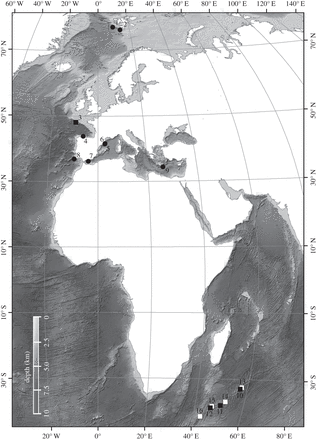
Locations of sampling sites of bottom sediment and deep-water coral where content of microplastics was investigated.
Locations of sampling sites of bottom sediment and deep-water coral where content of microplastics was investigated. From Woodall et al. 2014.

Ocean plastics is one of the most pernicious problems facing the ocean. One-time use plastics, which, ironically, can persist for thousands of years, often find themselves carried downstream, settling on our beaches, our coastlines, and in large aggregations within oceanic gyres. We’re still trying to cope with the extent to which plastics, and particularly microplastics–tiny photodegraded plastic particles, impact marine ecosystems. Earlier this year, ocean plastics made major waves when it was reported that not only do we not know how much damage they really cause, but we don’t even know where most of them go: 99% of the plastic that should be in the ocean is missing.

It looks like we found the missing plastic.

A new paper, published today, finally sheds some light on the fate of missing plastics. In “The deep sea is a major sink for microplastic debris” Woodall and friends reveal that there are four orders of magnitude–that’s 10,000 times–more microplastics in deep-sea sediments than in surface waters. They surveyed deep-sea sediments from around the world, in the Indian and Atlantic Oceans, as well as the Mediterranean Sea, and discovered that fibrous microplastics, particularly rayon and polyester, were ubiquitous in all sediment samples.

Let that sink in. 

Human-generated microplastics are not just abundant in the deep sea, but they are a global component of all deep-sea sediments. In my own expeditions, I’ve seen garbage littering the seafloor at even the deepest and most remote locations, but it was also in discrete patches and low abundance. This new study suggests that plastic pollution has impacted all deep-sea ecosystems in tremendous quantities. Microplastic fibers were also found covering delicate deep-sea octocorals–not at some sites, but at every site.

They estimate that there are four billion fibers per square kilometer in Indian Ocean sediments. It is clear that the deep sea has become a sink for our plastic waste.

Sadly, this study only looks at presence and abundance, but it is an important first step in understanding how human garbage impact the deep sea. We have no idea what, if any, effect these microplastics have on deep benthic communities–heck, we barely understand what microplastics do to surface ocean communities. That 99% of all ocean plastic could be hidden in the deep sea, even as public awareness of plastic pollution continues to rise points to on critical solution.

The only way to fix the plastic problem is to prevent plastic from reaching the ocean in the first place.

The paper, The deep sea is a major sink for microplastic debris, is short, excellently written, and open-access. I encourage everyone to read it.

Share this:

  • Click to share on Bluesky (Opens in new window) Bluesky
  • Click to share on Facebook (Opens in new window) Facebook
  • Click to share on Reddit (Opens in new window) Reddit
  • Click to share on Threads (Opens in new window) Threads
  • Click to share on WhatsApp (Opens in new window) WhatsApp
  • Click to share on Mastodon (Opens in new window) Mastodon

Related

Tags: ocean plastics

Post navigation

❮ Previous Post: No Endangered Listing for Dusky Sharks (and That’s a Good Thing)
Next Post: What can Cloudy with a Chance of Meatballs teach us about ecology, sustainability and conservation? ❯

Popular Posts

Shark scientists want their research to help save threatened species, but don’t know how. Our new paper can help.Shark scientists want their research to help save threatened species, but don’t know how. Our new paper can help.December 1, 2025David Shiffman
Norway and Cook Islands put their deep-sea mining plans on pause.Norway and Cook Islands put their deep-sea mining plans on pause.December 3, 2025Andrew Thaler
What Ocean Ramsey does is not shark science or conservation: some brief thoughts on "the Shark Whisperer" documentaryWhat Ocean Ramsey does is not shark science or conservation: some brief thoughts on "the Shark Whisperer" documentaryJuly 2, 2025David Shiffman
The Trouble with Teacup PigsThe Trouble with Teacup PigsOctober 14, 2012Andrew Thaler
What we know we don't know: impacts of deep-sea mining on whales, dolphins, sharks, turtles, and other migratory species.What we know we don't know: impacts of deep-sea mining on whales, dolphins, sharks, turtles, and other migratory species.November 20, 2025Andrew Thaler
2025: My year in writing, public speaking, and media interviews2025: My year in writing, public speaking, and media interviewsDecember 3, 2025David Shiffman
Urea and Shark OsmoregulationUrea and Shark OsmoregulationNovember 15, 2010David Shiffman
Shark of Darkness: Wrath of Submarine is a fake documentaryShark of Darkness: Wrath of Submarine is a fake documentaryAugust 10, 2014Michelle Jewell
How tiny satellites are tracking marine wildlifeDecember 1, 2025Andrew Thaler
Build a dirt cheap, tough-as-nails field computer in a Pelican caseBuild a dirt cheap, tough-as-nails field computer in a Pelican caseJuly 21, 2015Andrew Thaler
Subscribe to our RSS Feed for updates whenever new articles are published.

We recommend Feedly for RSS management. It's like Google Reader, except it still exists.

Southern Fried Science

  • Home
  • About SFS
  • Authors
  • Support SFS


If you enjoy Southern Fried Science, consider contributing to our Patreon campaign.

Copyright © 2025 Southern Fried Science.

Theme: Oceanly Premium by ScriptsTown