Barndoor skates were once thought to be so overfished that a highly-publicized paper from 1998 noted that they had been “driven to near extinction without anyone noticing.” One of the largest skates, barndoor skates can reach over 5 feet in wingspan, which is large enough that their diet includes small sharks like spiny dogfish; for a skate, that’s about as close as it gets to charismatic megafauna!

Recently, NOAA Fisheries announced that Barndoor skate populations off the Northeastern United States had finally recovered enough that fishing for them could resume. This move comes after a 2009 NOAA Fisheries report showed that the species had begun to recover enough that they could be removed from the species of concern list, though they remained protected at the time. “This is good news,” Mike Ruccio, a Supervisory Fishery Policy Analyst for NOAA Fisheries Greater Atlantic Regional Fisheries Office, told me. “Rebuilding overfished stocks is one of the cornerstones of the US domestic policy on fisheries.”
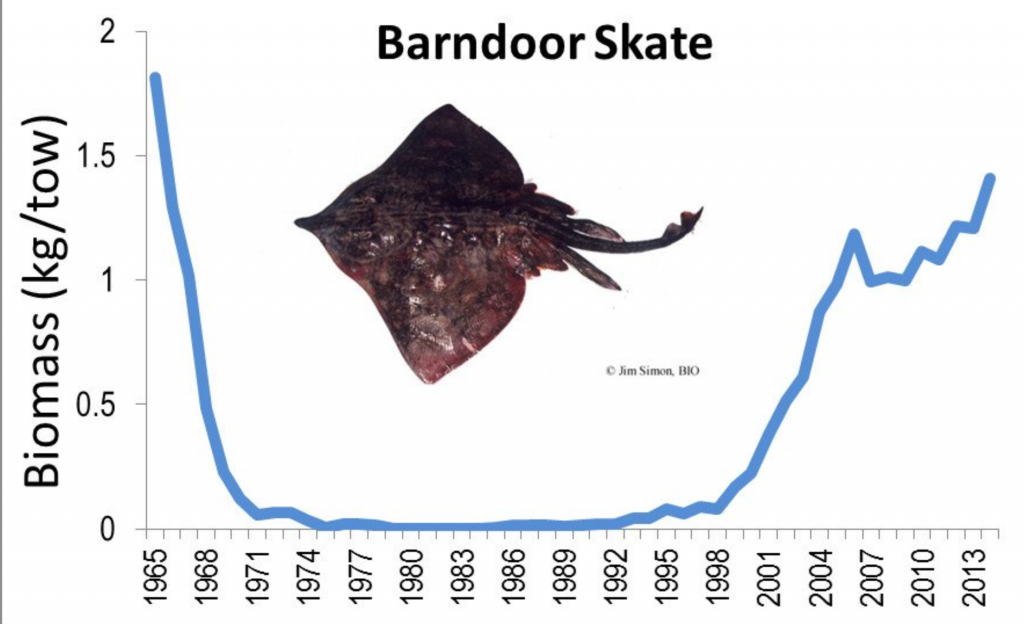
Conservationists are cautiously pleased with this news. “While abundance estimates show amazing rebuilding for such a slow growing species, there is still much uncertainty regarding population health due to poor catch reporting,” said Sonja Fordham, President of Shark Advocates International, a project of the Ocean Foundation. “Skate body size is thought to be a good predictor of vulnerability to overfishing, and this skate species is the largest in the Northwest Atlantic. These factors argue for caution as restrictions are relaxed.”
While NOAA Fisheries had long agreed that the barndoor skate had declined enough to need some protection, the paper referenced above has long been considered controversial by many fisheries scientists and managers. NOAA denied an Endangered Species Act listing for the species in the year 2000, while still offering other protections.
“Casey and Myers 1998 indicated that barndoor skates had significantly declined,” Kimberly Damon-Randall, Acting Deputy Regional Administrator for NOAA Fisheries Greater Atlantic Regional Fisheries Office, said. “However, a couple of years later, new research indicated that barndoor skates were more fecund than previously thought and that new information was factored into the new population models. Additionally, it was determined that barndoor skates are more widely distributed (go into deeper water) than Casey and Myers thought so their analyses most likely underestimated the population.”
Skate fisheries in the United States are actually bigger than fisheries for their shark cousins, despite getting much less public attention. In 2016, U.S. skate fisheries landed about 25,000 metric tons of skate worth about eleven million dollars nationwide (worth over $5 million in the Northeastern U.S., where barndoor skates live, alone). “Skate in the northeast are landed in two separate fisheries: one for human consumption and one for use as bait in lobster and crab fisheries,” Mike Ruccio said.
Barndoor skates are one of seven species of skates the Northeast skate complex in addition to clearnose, little, rosette, smooth, thorny, and winter skates. Mike Ruccio pointed out that thorny skates remain protected, and smooth skates are protected in part of their range, policies designed to allow those species to recover from past overfishing. “In the case of the Barndoor skate, a simple prohibition on landing appears to have been an important factor in dramatically improving population status, and yet the same protection adopted the same year for thorny skates has not,” Sonja Fordham said. “In fact, things got worse for thorny skates after management started, and yet fishery managers are giving minimal attention to finding out why. Skates are exceptionally vulnerable and economically important species. Overall, they deserve a much higher conservation priority than they are getting. For that to happen, the public will have to expand and express their concern for “flat sharks.”
The recovery of a species thought to be on the brink of extinction, due both to new scientific data and the success of science-based fisheries management plans, is cause for #OceanOptimism.
This news story is brought to you by my Patreon supporters! If you appreciate my shark research and conservation outreach, please consider supporting me on Patreon! Any amount is appreciated, and supporters get exclusive rewards!