Skip to content

Southern Fried Science

Over 15 years of ocean science and conservation online

  • Home
  • About SFS
  • Authors
  • Support SFS

Let’s make America think again …

Posted on October 9, 2016October 9, 2016 By Chris Parsons
Education

“Nothing in all the world is more dangerous than sincere ignorance and conscientious stupidity.” Martin Luther King, Jr.

I think everyone would agree that the current US presidential election has been one for the history books … and not in a good way. One of the running themes in this election has been how many people do not understand the difference between a verified fact and something they saw on “the interwebs”. That “doing research” to far too many in the US means Googling until they find a website that supports their opinion (and ignoring any other source that does not). Those involved in science communication have long been aware of this problem, especially those involved in communicating issues such as climate change, evolution and health issues. However, perhaps now more of the country is aware that the lack of public understanding of what a fact is has become a major problem, and how substantive the proportion of the country is that can’t tell the difference  between a fact and a belief or opinion or, quite frankly, a bold-faced lie. Perhaps now more people realize how dangerous it can be when facts no longer matter.
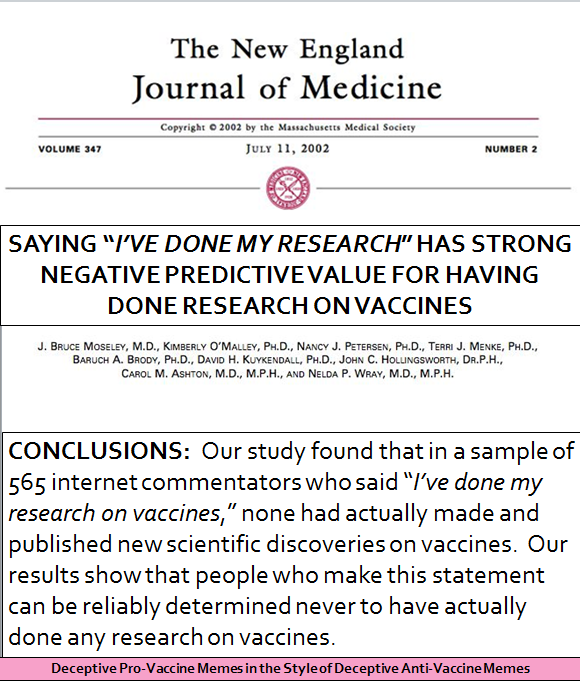
done-my-research-meme

“The greatest obstacle to discovery is not ignorance – it is the illusion of knowledge.” Daniel J. Boorstin

It is now more urgent than ever that the US education system introduce into middle school class content on: (a) how to do research properly on the internet; (b) the difference between a “fact” and an opinion; and (c) what is a suitable source of information. We should also bring back classes on logical reasoning and critical thinking, in particular all children should taught about the logical fallacies, so they can detect them when they see them them. While we’re at it why not teach them what the scientific method actually is, and the difference between “theory” in the scientific sense and the colloquial sense…


Image result for logical fallacies poster

Logical fallacies

While we’re at it,when school kids start learning about science, why not tell them about how to be critical when they see scientific information in the media, and how to tell “good” from “bad” science (see also “The Good, the bad and the ugly science”) .
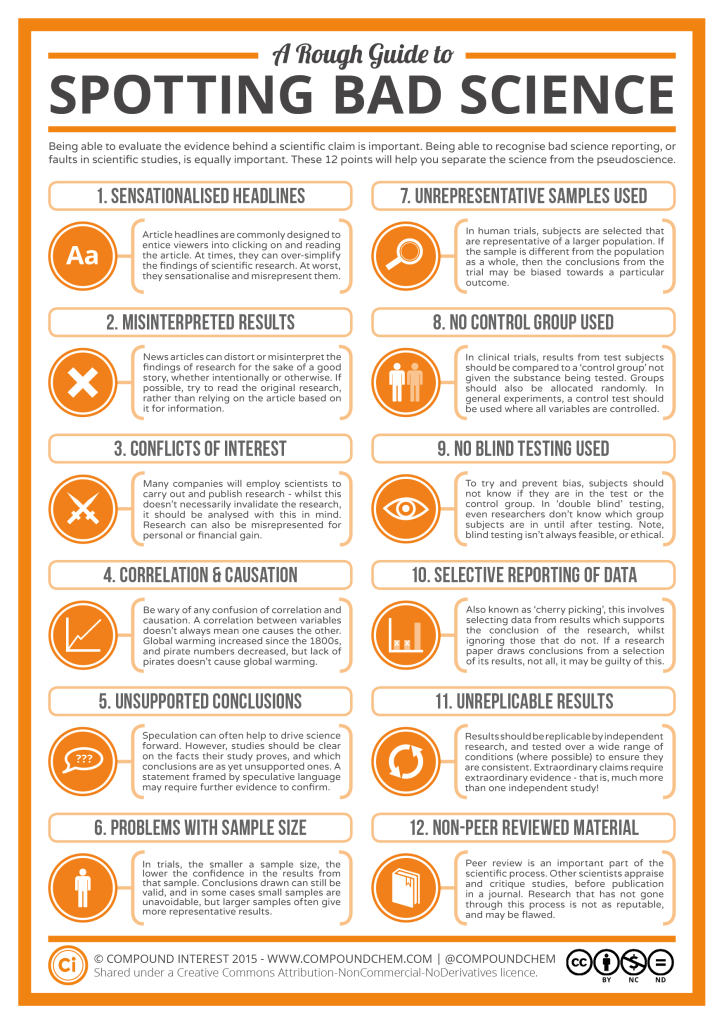
A Rough Guide to Spotting Bad Science 2015

How to spot bad science (a poster available from: http://www.compoundchem.com/) 

Perhaps we can use the current election as a wake up call for understanding the importance of factual accuracy and logic.

 “They say a little knowledge is a dangerous thing, but it’s not one half so bad as a lot of ignorance.” Terry Pratchett

P.S. For more on this issue of “good” vs “bad” science why not try our article in Frontiers in Marine Science: The good, the bad and the ugly science: examples from the marine science arena. doi: 10.3389/fmars.2015.00033

Share this:

  • Click to share on Bluesky (Opens in new window) Bluesky
  • Click to share on Facebook (Opens in new window) Facebook
  • Click to share on Reddit (Opens in new window) Reddit
  • Click to share on Threads (Opens in new window) Threads
  • Click to share on WhatsApp (Opens in new window) WhatsApp
  • Click to share on Mastodon (Opens in new window) Mastodon

Related

Tags: bad science facts logic logical fallacies school curriculum the U.S. election

Post navigation

❮ Previous Post: The 3D-Printed Giant Deep-sea Isopod You Always Wanted.
Next Post: Columbus doesn’t deserve a day ! (We should be giving credit to Cabot anyway) ❯

You may also like

Uncategorized
365 days of Darwin: September 4, 2010
September 4, 2010
Uncategorized
Scientific literature needs discipline – an example from a killer whale life expectancy study
August 23, 2016
Conservation
Everything you need to know about conservation you can learn from Alien(s)
August 8, 2018

Popular Posts

Shark scientists want their research to help save threatened species, but don’t know how. Our new paper can help.Shark scientists want their research to help save threatened species, but don’t know how. Our new paper can help.December 1, 2025David Shiffman
Norway and Cook Islands put their deep-sea mining plans on pause.Norway and Cook Islands put their deep-sea mining plans on pause.December 3, 2025Andrew Thaler
What Ocean Ramsey does is not shark science or conservation: some brief thoughts on "the Shark Whisperer" documentaryWhat Ocean Ramsey does is not shark science or conservation: some brief thoughts on "the Shark Whisperer" documentaryJuly 2, 2025David Shiffman
The Trouble with Teacup PigsThe Trouble with Teacup PigsOctober 14, 2012Andrew Thaler
What we know we don't know: impacts of deep-sea mining on whales, dolphins, sharks, turtles, and other migratory species.What we know we don't know: impacts of deep-sea mining on whales, dolphins, sharks, turtles, and other migratory species.November 20, 2025Andrew Thaler
2025: My year in writing, public speaking, and media interviews2025: My year in writing, public speaking, and media interviewsDecember 3, 2025David Shiffman
Urea and Shark OsmoregulationUrea and Shark OsmoregulationNovember 15, 2010David Shiffman
Shark of Darkness: Wrath of Submarine is a fake documentaryShark of Darkness: Wrath of Submarine is a fake documentaryAugust 10, 2014Michelle Jewell
How tiny satellites are tracking marine wildlifeDecember 1, 2025Andrew Thaler
Build a dirt cheap, tough-as-nails field computer in a Pelican caseBuild a dirt cheap, tough-as-nails field computer in a Pelican caseJuly 21, 2015Andrew Thaler
Subscribe to our RSS Feed for updates whenever new articles are published.

We recommend Feedly for RSS management. It's like Google Reader, except it still exists.

Southern Fried Science

  • Home
  • About SFS
  • Authors
  • Support SFS


If you enjoy Southern Fried Science, consider contributing to our Patreon campaign.

Copyright © 2025 Southern Fried Science.

Theme: Oceanly Premium by ScriptsTown