 William E Bemis is Professor of Ecology and Evolutionary Biology at Cornell and lead faculty member for the edX MOOC Sharks! Global Biodiversity, Biology, and Conservation. He studied at Cornell University, the University of Michigan, the University of California Berkeley, and the University of Chicago before serving 20 years as Professor of Biology at the University of Massachusetts Amherst. From 2005 to 2013, he served as Kingsbury Director of Shoals Marine Laboratory at Cornell. Bemis conducts research in comparative vertebrate anatomy, trains research students, and teaches courses in vertebrate anatomy and evolution.
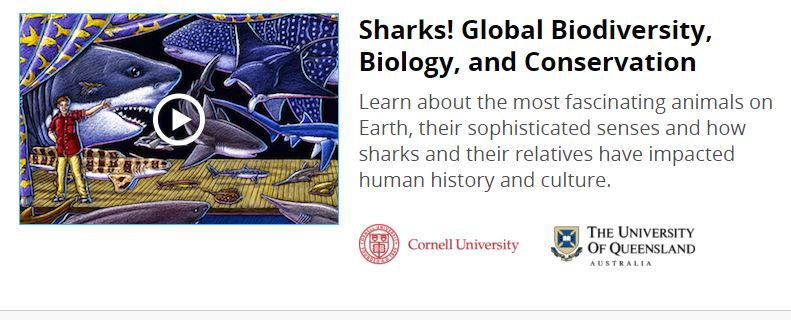
How do you get thousands of people interested in basic biological concepts? By teaching a course on some of the most fascinating animals on Earth – sharks and their relatives.
This is a particularly exciting time to be a shark scientist. An explosion of new research methods and technologies are leading to a surprising world of discovery. Our new course, free and open to anyone in the world, explores discoveries in many areas, including:
● Habitats and distributions of sharks around the world.
● Evolutionary history and relationships of sharks and allies.
● Functional anatomy of swimming, breathing, and eating.
● Aspects of sensory biology, reproduction, and behavior.
● Ecological roles of sharks.
● Historical and cultural aspects of shark-human interactions.
● The impacts of humans on shark populations
● Role of the media and how biology can inform conservation efforts.
To help us dig into these topics, we developed new teaching materials including a series of interviews with leading shark scientists to give students a sense of the action happening right now. And in the process, we treat some of the major concepts that underlie all of modern biology: constructing and thinking about evolutionary trees, interpreting fossils and the fossil record, observing living animals and interpreting their behavior, exploring links between anatomy and function, and connecting organisms within communities. Sharks are important to people, too, so we explore shark fishing, human-shark encounters – including attacks – and the role that sharks play in popular media and culture.
We designed our course to help students hone critical skills that can lead to broader observations about the ongoing history of life on Earth. But rather than focusing on classroom lectures and textbook assignments, our team of scientists, faculty, and academic technologists at Cornell University and the University of Queensland sought new, interactive, online approaches to engage anyone in the world. So we developed our course on shark biology as an edX Massive Open Online Course, or MOOC for short. It’s free to anyone, anywhere, with an Internet connection. The result: Shark MOOC, more formally known as Sharks! Global Biodiversity, Biology, and Conservation. We will go live on June 28, 2016.
Shark MOOC will help you learn to see virtually any animal with new eyes, eyes tuned to look for details that you can interpret in broader contexts. It also is going to be a lot of fun, with opportunities to make friends and connections around the world. So register now and plan to join our Big Shark Party!