Skip to content

Southern Fried Science

Over 15 years of ocean science and conservation online

  • Home
  • About SFS
  • Authors
  • Support SFS

Tag: shark bycatch

First systematic threat analysis reveals that 1/4 of sharks, rays, and chimaeras are threatened with extinction

Posted on January 21, 2014 By David Shiffman
Conservation, Science

It took a team of over 300 scientists nearly two decades, but the first systematic analysis of the conservation status of chondrichthyans (sharks, rays and chimaeras) has been completed. The results, published today (open access) in a paper titled “Extinction risk and conservation of the world’s sharks and rays,” are chilling.

“Our unprecedented analysis shows that sharks and their relatives – which make up one of the earth’s oldest and most ecologically diverse groups of animals  —  are facing an alarmingly elevated risk of extinction,” said Dr. Nick Dulvy, IUCN SSG Co-Chair and Professor at Simon Fraser University in British Columbia.

As of the writing of this paper, the IUCN Shark Specialist Group recognized 1,041 species of chondrichthyans. However,  a new species is described, on average, every two or three weeks! Out of these 1,041 species of chondrichthyans, approximately one in four are considered “Threatened” by IUCN Red List criteria;  113 species are Vulnerable, 43 are Endangered, and 25 species are Critically Endangered. 487 species are considered Data Deficient, but the IUCN Shark Specialist Group estimates that 68 of them are likely to be Threatened as well! Most alarmingly, only 23% of known chondrichthyan species are considered Least Concern, the lowest percentage out of any group of vertebrates on land or sea!
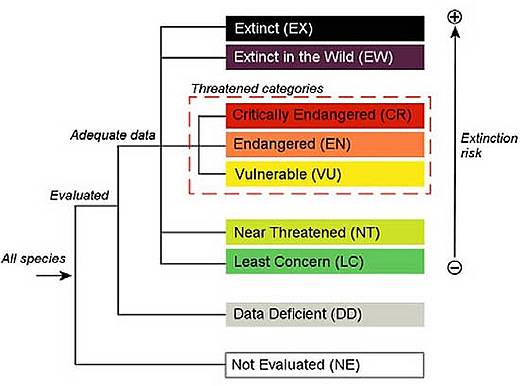
A hierarchy of IUCN Red List categories. Note that "Threatened" includes Vulnerable, Endangered, and Critically Endangered
A hierarchy of IUCN Red List categories. Note that “Threatened” includes Vulnerable, Endangered, and Critically Endangered

One of the two main factors influencing Threatened status is the size of the animal. Larger bodied species are sensitive to overfishing because they typically have a life history with slow growth, late age at maturity, and relatively few offspring. Additionally, living in coastal habitats (in other words, close to humans) makes a species more likely to be Threatened.

Read More “First systematic threat analysis reveals that 1/4 of sharks, rays, and chimaeras are threatened with extinction” »

Popular Posts

5 things you need to know about the proposed European Union shark finning ban, including how you can helpSeptember 17, 2012David Shiffman
5 fantastic nautical science fiction novels5 fantastic nautical science fiction novelsJanuary 27, 2014Andrew Thaler
State of the Field: Shark Conservation PoliciesMarch 1, 2011David Shiffman
What can Cloudy with a Chance of Meatballs teach us about ecology, sustainability and conservation?What can Cloudy with a Chance of Meatballs teach us about ecology, sustainability and conservation?December 21, 2014David Shiffman
Fun Science FRIEDay - A fish without bloodFun Science FRIEDay - A fish without bloodMarch 13, 2020Kersey Sturdivant
Charlie and the Adventure: July 18, 2010Charlie and the Adventure: July 18, 2010July 18, 2010David Shiffman
The story of the pride flag made from NASA imagery: Bluesky's most-liked imageThe story of the pride flag made from NASA imagery: Bluesky's most-liked imageSeptember 27, 2024David Shiffman
A brief example of asymmetry in Sperm WhalesA brief example of asymmetry in Sperm WhalesMarch 23, 2011Andrew Thaler
That's not a blobfish: Deep Sea Social Media is Flooded by AI SlopThat's not a blobfish: Deep Sea Social Media is Flooded by AI SlopDecember 19, 2025Andrew Thaler
Ocean Conservation, Ecology, Science, and Outreach on Dr. Kiki's Science HourJuly 10, 2011Andrew Thaler
Subscribe to our RSS Feed for updates whenever new articles are published.

We recommend Feedly for RSS management. It's like Google Reader, except it still exists.

Southern Fried Science

  • Home
  • About SFS
  • Authors
  • Support SFS


If you enjoy Southern Fried Science, consider contributing to our Patreon campaign.

Copyright © 2026 Southern Fried Science.

Theme: Oceanly Premium by ScriptsTown