Skip to content

Southern Fried Science

Over 15 years of ocean science and conservation online

  • Home
  • About SFS
  • Authors
  • Support SFS

This month’s 3D printed reward is a horn shark and horn shark egg case!

Posted on April 18, 2018April 17, 2018 By David Shiffman
Science

I recently unveiled a new tier of Patreon rewards: 3D printed shark and ray models! For $17 per month, you will get a monthly 3D printed educational model of different shark or ray parts in the mail, and you’ll be supporting my efforts to provide these models to schools for free.

This month’s reward is a model of a horn shark (Heterodontus francisci) and a horn shark egg case!
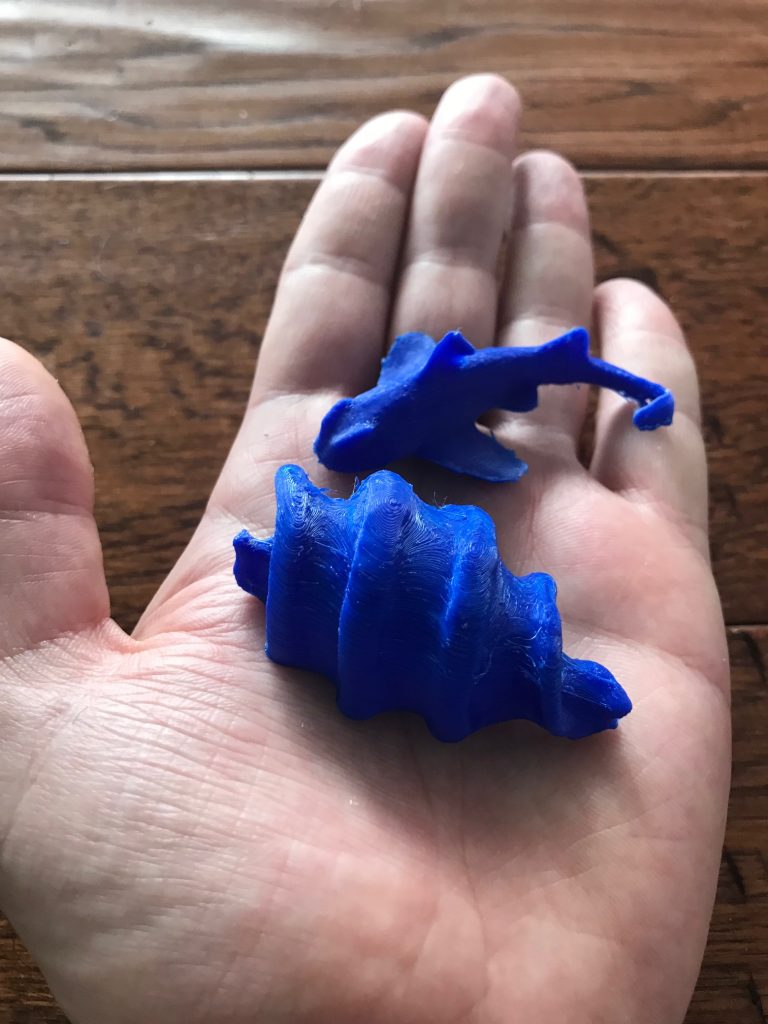
It comes from Alex Warneke, the Science Education Coordinator of Cabrillo National Monument! “”Using 3D printing technology has not only changed the way we educate the public, but it has broadened our perspective on what is possible in National Parks,” Alex told me. “We have been able to connect students to nature from an entirely different angle and provide them the tools and context they will need to succeed as scientists of the next generation.” This individual horn shark comes from the ichthyology collection at Cabrillo, and has been used for public education as well as research. The egg case is one of many that wash up on California beaches.
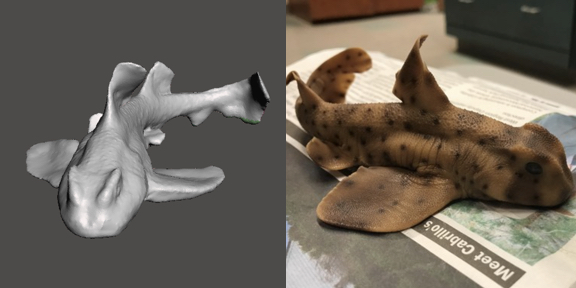
The original horn shark specimen and the 3D model of it, courtesy Alex Warneke, Cabrillo National Monument

Learn more about horn sharks and their egg cases below!

1. These small, benthic sharks live in shallow coastal waters off the coast of southern California and Mexico. Though they can go deeper, they are most commonly seen in depths of 2-11 meters, and are frequently encountered by SCUBA divers in these regions. Younger horn sharks tend to live in much deeper water than adults.

IUCN Red List range map for H. francisci

2. Their maximum size is only around 4 feet. Though they generally do not pose any kind of safety risk to humans, their powerful jaws, which are used for munching through the tough spines and tests of sea urchins, could cause injury if provoked. They have different kinds of teeth (which is actually what “Hetero Dontus” means), including sharp front teeth and flat, crushing teeth in the back of their mouth. They usually just rest during the day and are more active at night. (No, not all sharks need to constantly swim in order to breathe!)
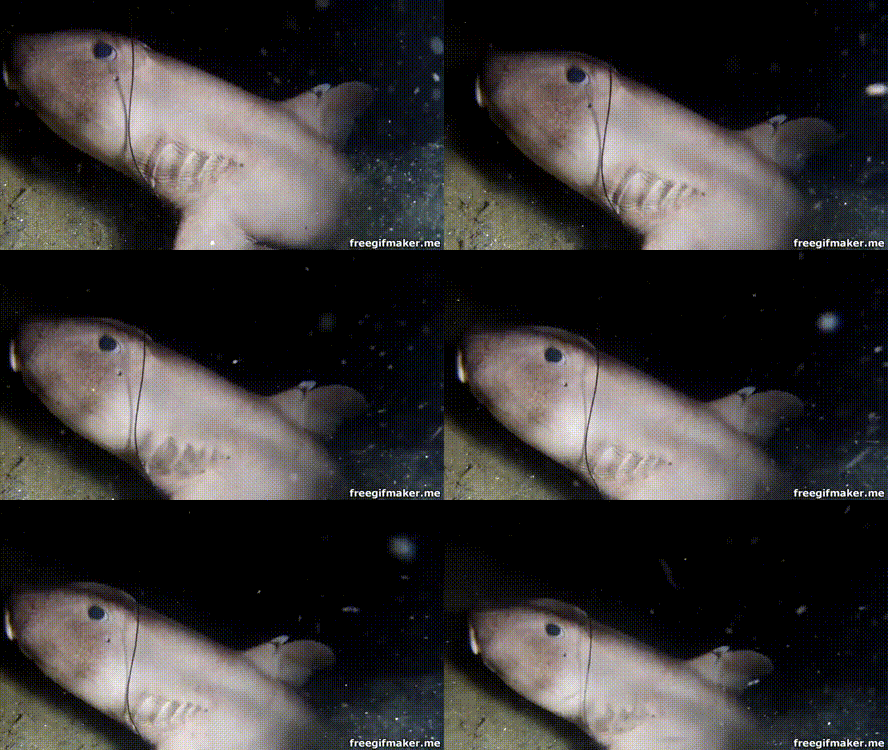
From a video by California diver Mike Bear. See how it’s just sorta sitting there? This is a typical behavior.

3. Like many species of sharks and their relatives, horn sharks lay eggs. Three families of sharks lay eggs: Heterodontidae (which include horn sharks as well as Port Jackson sharks), Scyliorhinidae (catsharks), and Orectolobidae (wobbegongs). Elasmobranch egg cases, sometimes called “mermaid’s purses,” vary widely in size, shape, and color, and the ridges on the horn shark egg case  help wedge it between rocks. “Egg cases deposited by oviparous, or egg-laying, sharks are reminiscent of space ships from Roddenberry’s Star Trek,” Meaghan McCord-Grey, scientist and director of the South African Shark Conservancy  told me. “Perfectly alien, beautifully shaped and impeccably designed by nature to ensure the delicate embryonic shark survives the months that it takes to develop before a fully formed, miniature shark hatches.Many egg laying sharks select the ‘nursery’ area, depositing their eggs in habitats that perfectly camouflage them from predators. For believe it or not, during early life, snails remain some of the biggest predators of the embryonic developing sharks.”
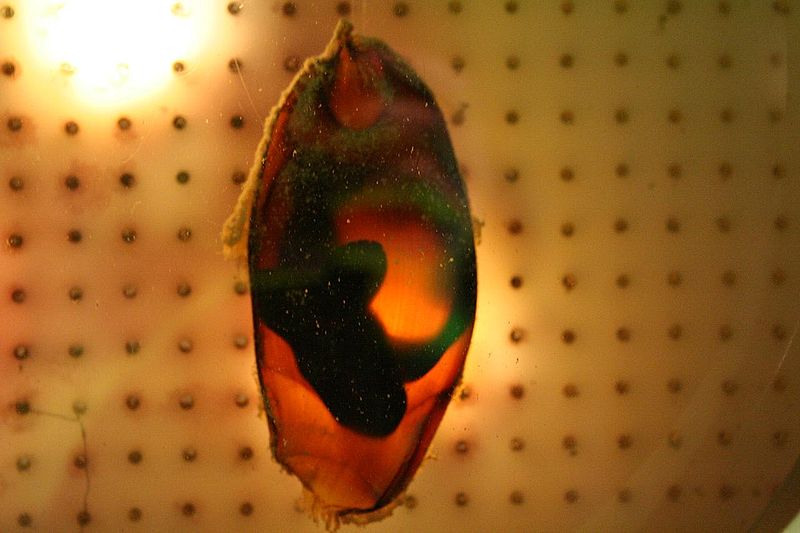
The egg case of a swell shark at the Shedd Aquarium. Photo credit: Stephanie Seskin, Wikimedia Commons

4. Once the eggs are laid, it takes between several months to over a year for them to hatch (6-9 months for horn sharks), during which time they are vulnerable to predators. Other shark species have a variety of other reproductive methods, including live birth and parthenogenesis (essentially a female self-cloning without the aid of a male). Fertilization is internal for both egg-laying and live-bearing sharks, sharks do not spawn.
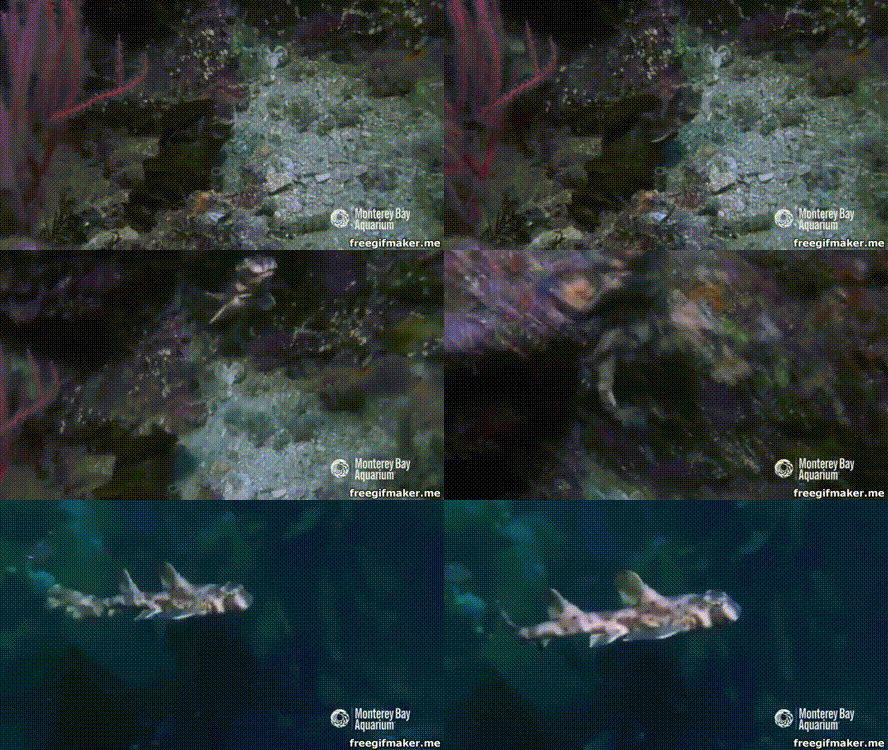
From the Monterey Bay Aquarium’s YouTube page

5. Like many species of sharks, horn sharks are assessed as “Data Deficient” by the IUCN Red List. This just means that there isn’t enough evidence to say one way or the other whether they are threatened. However, the Red List assessment notes that there aren’t any major threats for these sharks other than some bycatch (in traps and trawls) and some small-scale consumption in Mexico. These adorable little weirdos will probably be swimming in the Eastern Pacific for a long time.

Want to get your own model horn shark and horn shark egg case? Support me on Patreon! This reward is only available to US residents, but other rewards, including exclusive access to my shark science and conservation newsletter, are available to all.

Share this:

  • Click to share on Bluesky (Opens in new window) Bluesky
  • Click to share on Facebook (Opens in new window) Facebook
  • Click to share on Reddit (Opens in new window) Reddit
  • Click to share on Threads (Opens in new window) Threads
  • Click to share on WhatsApp (Opens in new window) WhatsApp
  • Click to share on Mastodon (Opens in new window) Mastodon

Related

Tags: 3D printing Heterodontus francisci horn shark mermaids purse shark shark egg case

Post navigation

❮ Previous Post: An open letter to the Florida Fish and Wildlife Conservation Commission on revising land-based recreational shark fishing regulations
Next Post: Ocean apps and beluga migrations: Thursday Afternoon Dredging, April 19th, 2018 ❯

You may also like

Weekly Salvage
Octopus Genes, Decolonization, and a mega-dose of Citizen Science! Monday Morning Salvage: April 10, 2017
April 10, 2017
Education
5 things to know about spotted eagle ray tooth plates, August’s 3D printed reward!
August 17, 2018
Science
The BeagleBox 2: a dirt-cheap, tough-as-nails, 3D-printed, versatile field laptop.
May 9, 2016
Weekly Salvage
2 minutes to midnight, 3D printed turtle eggs, awkward fiddlers, Egyptian welders, and more! Monday Morning Salvage: January 29, 2018.
January 29, 2018

Recent Popular Posts

What Ocean Ramsey does is not shark science or conservation: some brief thoughts on "the Shark Whisperer" documentaryWhat Ocean Ramsey does is not shark science or conservation: some brief thoughts on "the Shark Whisperer" documentaryJuly 2, 2025David Shiffman
Shark of Darkness: Wrath of Submarine is a fake documentaryShark of Darkness: Wrath of Submarine is a fake documentaryAugust 10, 2014Michelle Jewell
What can the funniest shark memes on the internetz teach us about ocean science and conservation?What can the funniest shark memes on the internetz teach us about ocean science and conservation?November 8, 2013David Shiffman
Your car has just been crushed by hagfish: Frequently Asked QuestionsYour car has just been crushed by hagfish: Frequently Asked QuestionsJuly 13, 2017Andrew Thaler
Mermaids: The New Evidence is a Fake DocumentaryMermaids: The New Evidence is a Fake DocumentaryMay 28, 2013Andrew Thaler
"Twitter sucks now and all the cool kids are moving to Bluesky:" Our new survey shows that scientists no longer find Twitter professionally useful or pleasant"Twitter sucks now and all the cool kids are moving to Bluesky:" Our new survey shows that scientists no longer find Twitter professionally useful or pleasantAugust 19, 2025David Shiffman
Your car has just been crushed by hagfish: Frequently Asked QuestionsYour car has just been crushed by hagfish: Frequently Asked QuestionsFebruary 27, 2024Andrew Thaler
I built the cheapest 3D printer available online so that you don't have to: iNSTONE Desktop DIY (review)I built the cheapest 3D printer available online so that you don't have to: iNSTONE Desktop DIY (review)March 14, 2019Andrew Thaler
Urea and Shark OsmoregulationUrea and Shark OsmoregulationNovember 15, 2010David Shiffman
Jumping the shark: New study reviews the breaching behavior of sharks and raysJumping the shark: New study reviews the breaching behavior of sharks and raysSeptember 19, 2024David Shiffman
Subscribe to our RSS Feed for updates whenever new articles are published.

We recommend Feedly for RSS management. It's like Google Reader, except it still exists.

Southern Fried Science

  • Home
  • About SFS
  • Authors
  • Support SFS


If you enjoy Southern Fried Science, consider contributing to our Patreon campaign.

Copyright © 2025 Southern Fried Science.

Theme: Oceanly Premium by ScriptsTown