Skip to content

Southern Fried Science

Over 15 years of ocean science and conservation online

  • Home
  • About SFS
  • Authors
  • Support SFS

What is going on at Solwara I?

Posted on September 10, 2024 By Andrew Thaler
News, Science

Over 15 years ago, I set sail from Matupi Harbor, Papua New Guinea to a spot in the middle of the Bismarck Sea between New Britain and New Ireland to study and understand the ecological diversity of a hydrothermal vent system resting beneath a submerged volcano 1600 meters beneath the sea. That hydrothermal vent system was Solwara I, and it was slated to become the first commercial deep-sea mine. In 2011, Nautilus Minerals was awarded the world’s first exploitation lease for a deep-sea mine.

The story of Nautilus Minerals and Solwara I is long and complicated, but ended with the mining company declaring bankruptcy and liquidating its assets, allegedly leaving Papua New Guinea holding the bag to the tune over a hundred million dollars. Their assets were sold of, with leases ending up in the hands of Deep Sea Mining Financing and, int he case of Nautilus’s Tonga claims, with the Metals Company.

Nautilus was, for all intents and purposes, gone. The three massive mining tools that were delivered to the Port Moresby port were never tested at sea and, as of December 2023, remained in the port, exposed to the elements and visible by passing satellite. Papua New Guinea would go on to pass a 10-year moratorium on deep-sea mining in national waters. That moratorium expires in 2029.
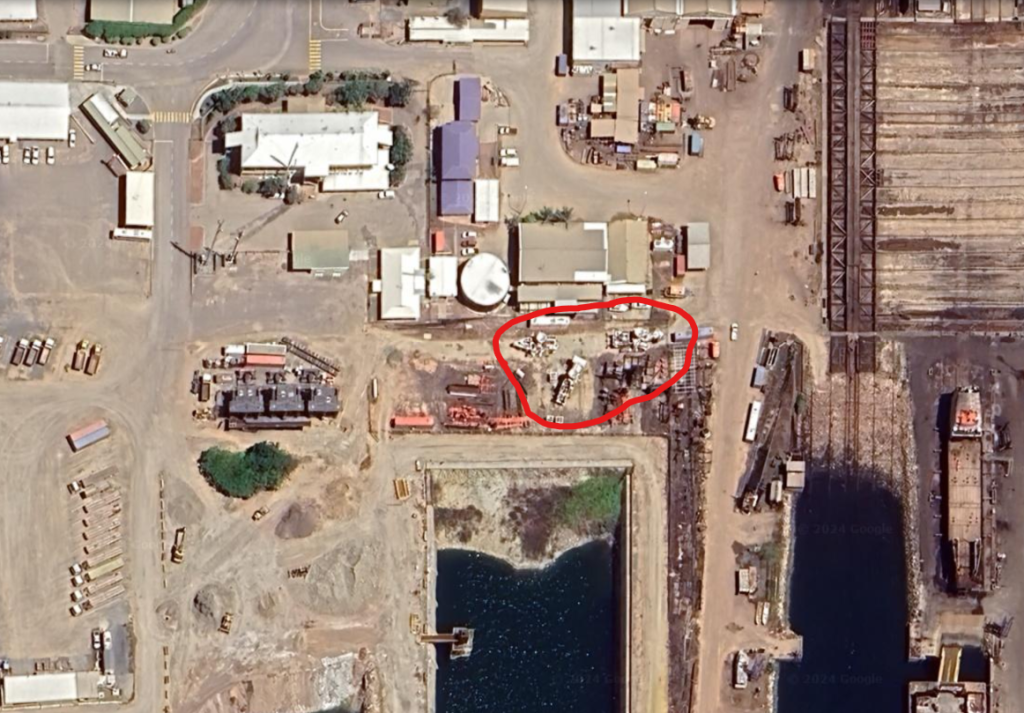
Three deep-sea mining tools, circled in red, in Port Moresby.

In the midst of this summer’s International Seabed Authority meeting, my news alerts for Solwara I started pinging. A July 26 article in PIME Asia News reported that locals had observed a vessel identified as Coco was on station above Solwara I and apparently conducting mining tests, removing 180 tons of seabed material. A follow up article in the Papua New Guinea Post Courier reported on a local environmental NGO’s response to the alleged test mining. A few calls to colleagues suggested that “Nautilus is back” and a quick review of vessel AIS data revealed that it was the MV Coco, the multipurpose vessel that is also used by The Metals Company for its work in the Clarion-Clipperton Zone, which was on station above Solwara I during that time period.
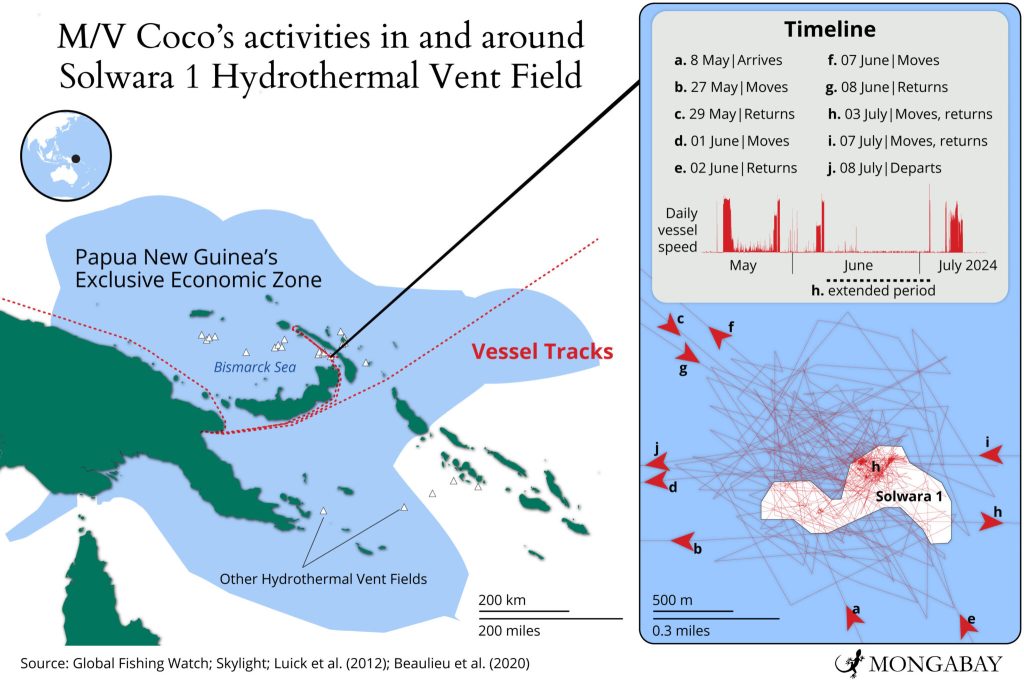
Illustration of vessel tracks from the MV Coco over Solwara I. From Mongabay: https://news.mongabay.com/2024/09/not-merely-exploration-png-deep-sea-mining-riles-critics-surprises-officials/

I sent out queries to colleagues both international and within Papua New Guinea, but no one had much additional information. Whoever knew about and approved this operation were keeping a tight lid on it. Papua New Guinea’s Mineral Resources Authority also report that they were unaware of any activity. Opposition groups have reported that they believe the amount of material removed goes far beyond that which would be allowed by extant exploration licenses and is in violation of the moratorium.

If Nautilus is returning to PNG in some form, that raises a lot of questions about the current status of their environmental impact assessment. Almost a decade and a half ago, the Nautilus environmental team released what is still considered, for better or worse, on of the most thorough and comprehensive EIA’s by a deep-sea mining company. It’s still referenced as a standard within the industry.

(For what it’s worth, it was that very EIA which fully convinced me that there was no viable path forward for deep-sea mining at hydrothermal vents. Solwara I was the best case scenario, with a reasonably solid collaborative EIA, that I, and many others felt ultimately failed to demonstrate that the losses to the deep ecosystem could be justified, mitigated, or offset.)

That EIA was heavily influenced by the specific mining process that Nautilus proposed for Solwara I, a mining process that depended on three massive mining robots operating in tandem on the seafloor and launched from the deck of a bespoke mining vessel the size of an aircraft carrier. Those mining robots have been sitting in Port Moresby for over half a decade, there’s no vessel currently available to support them. If those mining tools aren’t being used, is the nearly 15-year-old EIA still valid?

I don’t really know what’s going on with Nautilus right now. My sources are largely in the dark and it’s unclear whether there is a real plan in place or if this is a zombie company rearing up to reassert it claims over a few mining leases in hopes of a sell off. But regardless, it is clear that the Solwara I story is not over yet.

Share this:

  • Click to share on Bluesky (Opens in new window) Bluesky
  • Click to share on Facebook (Opens in new window) Facebook
  • Click to share on Reddit (Opens in new window) Reddit
  • Click to share on Threads (Opens in new window) Threads
  • Click to share on WhatsApp (Opens in new window) WhatsApp
  • Click to share on Mastodon (Opens in new window) Mastodon

Related

Tags: deep-sea mining Papua New Guinea Solwara I

Post navigation

❮ Previous Post: Resources for Donald Trump’s Project 2025 and the Environment
Next Post: Jumping the shark: New study reviews the breaching behavior of sharks and rays ❯

You may also like

Weekly Salvage
Bone-eating Jabba worms, the world’s deepest plastic bag, new shipwrecks, climate change art, and more! Monday Morning Salvage: May 14, 2018.
May 14, 2018
Weekly Salvage
Southern Fried Science year-in-review, Palau’s Giant, a new challenge for deep-sea mining, Porgs are Puffins, and more! Monday Morning Salvage: December 25, 2017.
December 25, 2017
Science
Two Years of Deep-sea Mining in Review: ISA rushes forward
March 18, 2022
Weekly Salvage
The fate of the deep sea is being decided behind closed doors, plastic in the deepest trench, memories of whales, and more! Monday Morning Salvage: March 4, 2019
March 4, 2019

Popular Posts

Florida angler catches (and likely kills) Endangered great hammerhead sharkFlorida angler catches (and likely kills) Endangered great hammerhead sharkFebruary 13, 2012David Shiffman
Shark of Darkness: Wrath of Submarine is a fake documentaryShark of Darkness: Wrath of Submarine is a fake documentaryAugust 10, 2014Michelle Jewell
Full video of injured shark shows numerous natural injuriesFull video of injured shark shows numerous natural injuriesMay 3, 2011David Shiffman
Severely injured great white shark found, are scientists responsible?Severely injured great white shark found, are scientists responsible?March 29, 2011David Shiffman
What Ocean Ramsey does is not shark science or conservation: some brief thoughts on "the Shark Whisperer" documentaryWhat Ocean Ramsey does is not shark science or conservation: some brief thoughts on "the Shark Whisperer" documentaryJuly 2, 2025David Shiffman
The Urgency Does Not Exist: My statement on Deep-sea Mining to the Subcommittee on Energy and Mineral ResourcesThe Urgency Does Not Exist: My statement on Deep-sea Mining to the Subcommittee on Energy and Mineral ResourcesJanuary 24, 2026Andrew Thaler
I'm getting married! Want to honor us? Here are some great charities you can donate to.I'm getting married! Want to honor us? Here are some great charities you can donate to.January 23, 2026David Shiffman
10 Tips for grad students to make the most of a scientific conference10 Tips for grad students to make the most of a scientific conferenceAugust 21, 2013David Shiffman
At least 74 practicing shark researchers: How a silly thing I said online raised thousands for conservationAt least 74 practicing shark researchers: How a silly thing I said online raised thousands for conservationFebruary 26, 2025David Shiffman
Bipartisan Concern Expressed Over Deep Sea Mining at Congressional HearingBipartisan Concern Expressed Over Deep Sea Mining at Congressional HearingJanuary 23, 2026Angelo Villagomez
Subscribe to our RSS Feed for updates whenever new articles are published.

We recommend Feedly for RSS management. It's like Google Reader, except it still exists.

Southern Fried Science

  • Home
  • About SFS
  • Authors
  • Support SFS


If you enjoy Southern Fried Science, consider contributing to our Patreon campaign.

Copyright © 2026 Southern Fried Science.

Theme: Oceanly Premium by ScriptsTown