
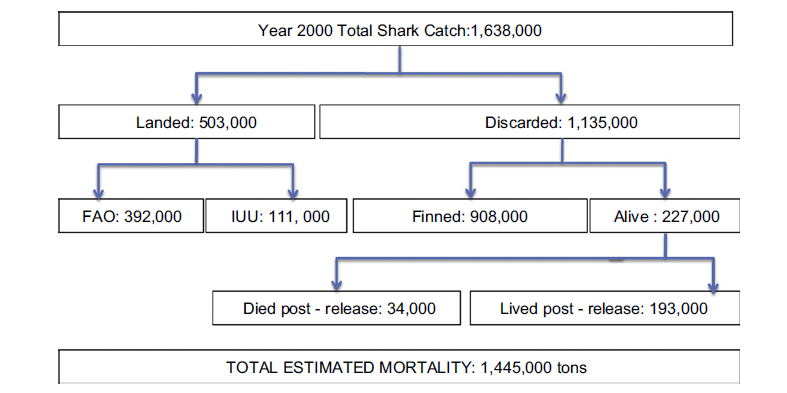
A new study* has estimated that the total number of sharks killed by fisheries each year is between 63 and 273 million, with a average of approximately 100 million.In an interview, lead author Dr. Boris Worm explains the importance of this estimate:
“This is by far the most comprehensive estimate of shark mortality yet,” he said, “because we consider all sources of mortality, from direct fishing, finning, and discard mortality. the estimate was derived by crunching numbers from almost 100 publications on the catches and mortality of sharks.”
Of all the numbers this team crunched, the most important thing to consider is whether the exploitation rate is greater than the rebound rate. In other words, is this level of exploitation more than the populations can recover from? Though many estimates and approximations went into calculating these figures, it seems quite clear that sharks are being harvested at an unsustainable rate.
The average of the rebound rates for 62 sharks that have been studied this far is 4.9%. Three estimates of exploitation rate (for all sharks combined) in this study range from 6.4% to 7.9%. Additionally, 48% of shark species whose rebound rates are known are currently fished above those rates, and more than 2/3 of all known rebound rates are below the average exploitation rates found in this study. ““This paper shows that a staggering amount of sharks are killed,” Dr. Worm said. “We estimate that one in 15 sharks dies every year from fishing.”
Perhaps the most troubling result of the study is that despite increased public awareness and advocacy, the authors have not detected a significant decrease in fin consumption since the year 2000. They suggest that this may be due to fishermen overfishing a particular area or species, and then moving on to a new area or species, which is clearly not sustainable in the long term.
To combat the problem, the authors make several policy recommendations. They reiterate that focusing on finning alone is inadequate because the problem is overfishing, and instead recommend focusing on the most threatened species through policies like CITES, instituting strict science-based fishing quotas (with enforcement), and protecting critical habitats. The authors note that localized protection measures may protect sharks locally, but have little effect on global demand as fishermen can just move their fishing effort elsewhere. Additionally, they suggest an international agreement similar to the International Whaling Commission.
In the press release for this study, Dr. Worm noted “Protective measures must be scaled up significantly in order to avoid further depletion and the possible extinction of many shark species.”
Dr. Worm has particularly high hopes for CITES:
“[Our paper] shows that the problem of unsustainable shark fishing has not been solved by existing regulations, and that a majority of shark species are threatened by overfishing. CITES is an effective tool in preventing extinction of some of the most vulnerable species. on land, CITES has been 100% effective in preventing extinction of thousands of listed species. I hope this can be applied effectively to ocean creatures as well.”
We’ll have updates on CITES as things develop, but I remain, as always, cautiously optimistic.
Author’s note: Regular readers may recall that “100 million sharks are killed for their fins” ranks as #2 on my list of “13 wrong things about sharks that advocates should stop saying“. This was because the previous best estimate for the scale of the fin trade was between 26 and 73 million sharks a year. That estimate focused on the number of sharks passing through the Hong Kong markets, while this estimate is for total global mortality. They are measuring separate things. As Dr. Worm stated in his interview, It remains true that anyone saying “100 million sharks are killed for their fins” prior to the publication of this study was misrepresenting the state of the science.
*Boris Worm, Brendal Davis, Lisa Kettemer, Christine Ward-Paige, Demian Chapman, Michael Heithaus, Steven Kessel, and Samuel Gruber (2013) Global catches, exploitation rates, and rebuilding options for sharks. Marine Policy 40: 194-204

David. Seems to me to be another case of “Nobody knows”.
The number is about 100 million sharks in 2000, and about 97 million sharks in 2010.
David, from the paper…
“A key problem is the incomplete reporting of shark catches to the United Nations Food and Agriculture Organization (FAO), which tracks the status of fisheries worldwide …Therefore it is very likely that reported catches represent only a fraction of total shark mortality.”
“… the FAO, among other management bodies, has long recognized the conservation challenges associated with sharks and their relatives, and it launched an International Plan of Action for Sharks in 1999.”
“The IPOA- Sharks further recommends that all states contributing to fishing mortality on sharks should participate in its management, and should have developed a National Shark Plan by 2001. However, progress remains disappointing so far, with limited adoption and implementation of IPOA goals at the national level.”
“Given the results of this paper, and much previous work on the vulnerability of sharks to overfishing, it is imperative that robust strategies for shark management and conservation be designed. This was formally recognized by the FAO in 1999, when it published an International Plan of Action for Sharks (IPOA-Sharks), a ‘VOLUNTARY’ policy instrument within the framework of the Code of Conduct for Responsible Fisheries.”
So I was thinking, David, science-based management – sustainable fishing – whysharksmatter
~ strict science-based fishing quotas (with enforcement)
~ an international agreement similar to the International Whaling Commission
~ ‘VOLUNTARY’ policy instrument CHANGED TO COMPULSORY
Remembering that the most important thing to consider is whether the exploitation rate is greater than the rebound rate… Your voice will make a difference! (& then EVERYONE will sign that very important other petition you’re petitioning to petition – without even reading it 😉
I’m really not sure what you’re trying to say here, Paul. Are you suggesting that I haven’t previously been advocating for more effective management measures? I have. Lots of times.
We’ll never know the exact number for sure, but that doesn’t mean that a scientific attempt to estimate it from available information has no value.
As numerous assumptions went into calculating the number, the range is more useful and relevant than the average.
Fair enough.
The range for 2010 is possibly 61m to 267m, slightly lower than the numbers you have posted that are those for 2000.
“Are you suggesting that I haven’t previously been advocating for more effective management measures?”
Absolutely not, David, & never…
Sorry for the confusion — I had previously read your idea for a petition against (dud) petitions, of which I found just as humorous as it is serious, & so I was attempting to give you a laugh in return.
I can now see the confusion is likely due to the term -“Your voice will make a difference” – this term being a notable part of most petitions posted/shared on F.B… So my idea (& humour) being; if you drafted/posted a petition as outlined in my first 4 paragraphs & with the solutions indicated by the tilde (~), surely the exploitation rate would be higher than the rebound rate, i.e; everybody would sign this & few would post/share it back to you then everybody would sign the other petition (against dud petitions) without so much as reading it, again with few posting/sharing back to you, the end result being far-fewer petitions “rebounded” to you… (& me too for that matter).
So much for that – I won’t give up my day job to become a comedian – I can see how this “silliness” may have slipped by you – but I DO hope the idea works, SERIOUSLY!
The rest of my post is indeed what I identify from the paper & also, I thoroughly agree with your reply to Dashark – “the range is more useful and relevant than the average”…
& so I recommend people stick with the term, “the total number of sharks killed by fisheries each year is between 63 and 273 million (Worm et. al, 2013).”
NOT average, NOT 273 million & NOT from finning alone.
NOT FUNNY !!
The point I’m trying to make here is that I read that
A new study* has estimated that the total number of sharks killed by fisheries each year is between 63 and 273 million, with a average of approximately 100 million
Correct – but that is the estimate for the year 2000!.
However, if you read the paper, you will discover that the authors have also made an estimate for 2010, and the respective numbers are
“possibly between 61 and 267 million, with an average of approximately 97 million”
Should we not rather cite these latter numbers when talking about the present fishing-related mortality of Sharks?
No worries, thanks for clarifying.