Skip to content

Southern Fried Science

Over 15 years of ocean science and conservation online

  • Home
  • About SFS
  • Authors
  • Support SFS

Six things I learned about Giant Isopods while Sizing Ocean Giants

Posted on January 13, 2015January 13, 2015 By Andrew Thaler 4 Comments on Six things I learned about Giant Isopods while Sizing Ocean Giants
Science

Today, Craig McClain, along with a massive team of ocean scientists (including me!) published our monumental paper: Sizing ocean giants: patterns of intraspecific size variation in marine megafauna. This massive monograph investigates patterns of size among 25 ocean giants, the biggest, most massive members of their respective taxa. You can probably guess which species I had a hand in reviewing.

httpv://www.youtube.com/watch?v=xtk5t7sSb3s

Along the way, I learned quite a few cool things about the magnificent giants of the deep sea.

1. Giant deep-sea isopods are sexually dimorphic. 

This was, perhaps, the most notable isopod related finding of our paper. By pooling from hundreds of records across dozens of databases, we were able to statistically show sexual dimorphism in giant isopods. Both sexes are huge, compared to their roly-poly cousins, but if you’re staring at a half-meter beast, you’re almost certainly looking at a male. Males, on average, were 5 cm longer than females.

2. Giant deep-sea isopod reproduction is seasonal.

It makes sense. During the winter and spring, plankton blooms bring more biomass to the seafloor. Giant isopods are scavengers, they live or die by what they can find rotting on the seafloor and will get busy making babies when their is more abundant food.

3. Female giant deep-sea isopods carry their young around in a pouch. 

It’s called a marsupium (same word root as marsupial) and is formed from overlapping plates of their exoskeleton called oostegites. There’s a tremendously adorable picture of another Bathynomous species carrying her young in a marsupium over at the Echinoblog.
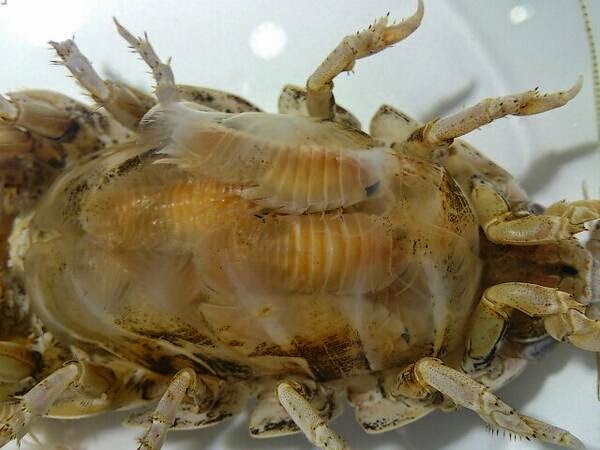
From  @NumazuDeepsea
From @NumazuDeepsea


4. Some of the deep-sea isopod reproductive structures are also seasonal.

Giant deep-sea isopods don’t have oostegites all the time. During the summer months, these structures are absent from females.

5. Baby deep-sea isopods look like adult deep-sea isopods.

They eschew a larval stage and go straight to juveniles, called manca, they look pretty much exactly like tiny versions of their gigantic parents. Neat!

6. You can rock out to the ultimate Giant Isopod mix tape.

Yes, Songs About Giant Isopods exists, it has 17 tracks, and every one of them is amazing. There’s even a music video

httpv://www.youtube.com/watch?v=J6AiZaGBal0

Share this:

  • Share on Bluesky (Opens in new window) Bluesky
  • Share on Facebook (Opens in new window) Facebook
  • Share on Reddit (Opens in new window) Reddit
  • Share on Threads (Opens in new window) Threads
  • Share on WhatsApp (Opens in new window) WhatsApp
  • Share on Mastodon (Opens in new window) Mastodon

Related

Tags: Giant Isopod

Post navigation

❮ Previous Post: An open letter to new Discovery Channel President Rich Ross from a shark scientist
Next Post: The words we use matter in climate change adaptation ❯

You may also like

Uncategorized
We love giant isopods and America should love them too!
November 3, 2016
Popular Culture
A deep-sea ecologist over-analyzes Aquaman #25
November 27, 2013
Uncategorized
365 days of Darwin: May 12, 2010
May 12, 2010
Weekly Salvage
Unprecedented destruction in the deep Gulf of Mexico, The Ocean Cleanup’s River Pivot, and More! Weekly Salvage: October 28, 2019.
October 28, 2019

4 thoughts on “Six things I learned about Giant Isopods while Sizing Ocean Giants”

  1. naomi says:
    January 13, 2015 at 10:35 am

    hi Dr. Thaler – the link to the paper doesn’t work. just wondering: did anyone review jellies?

  2. Andrew David Thaler says:
    January 13, 2015 at 11:11 am

    Thanks, link fixed. We did look at lions mane jellies. Enjoy!

  3. naomi says:
    January 13, 2015 at 11:28 am

    thanks! much appreciated.

  4. Andrew Jackson (@yodacomplex) says:
    January 14, 2015 at 10:52 am

    One species of deep sea marine isopod, Booralana tricarinata , can only perceive a maximum of 4 flashes of a flickering light every second before it sees it as a constant source of light (compared with about 60 for a human, or 100 for a pigeon ). Full paper at http://jeb.biologists.org/content/215/19/3344.full and more on variation of speed of the visual system from a paper of ours that is open access http://www.sciencedirect.com/science/article/pii/S0003347213003060

Comments are closed.

Popular Posts

Reflections on science and my role in it, ten years since my Ph.D. defenseReflections on science and my role in it, ten years since my Ph.D. defenseApril 1, 2026David Shiffman
What Ocean Ramsey does is not shark science or conservation: some brief thoughts on "the Shark Whisperer" documentaryWhat Ocean Ramsey does is not shark science or conservation: some brief thoughts on "the Shark Whisperer" documentaryJuly 2, 2025David Shiffman
Shark Science Monday: How you can help WhySharksMatter tag sharks!Shark Science Monday: How you can help WhySharksMatter tag sharks!March 14, 2011David Shiffman
We Need a "Starfleet" for the OceansMarch 30, 2026Chris Parsons
Phantom science - how "AI slop" is making environmental policyPhantom science - how "AI slop" is making environmental policyMarch 30, 2026Chris Parsons
That's not a blobfish: Deep Sea Social Media is Flooded by AI SlopThat's not a blobfish: Deep Sea Social Media is Flooded by AI SlopDecember 19, 2025Andrew Thaler
The UN Decade of Ocean Science: A failure to launchApril 1, 2026Chris Parsons
Shark of Darkness: Wrath of Submarine is a fake documentaryShark of Darkness: Wrath of Submarine is a fake documentaryAugust 10, 2014Michelle Jewell
What is a Sand Shark?What is a Sand Shark?November 12, 2017Chuck Bangley
Build a dirt cheap, tough-as-nails field computer in a Pelican caseBuild a dirt cheap, tough-as-nails field computer in a Pelican caseJuly 21, 2015Andrew Thaler
Subscribe to our RSS Feed for updates whenever new articles are published.

We recommend Feedly for RSS management. It's like Google Reader, except it still exists.

Southern Fried Science

  • Home
  • About SFS
  • Authors
  • Support SFS


If you enjoy Southern Fried Science, consider contributing to our Patreon campaign.

Copyright © 2026 Southern Fried Science.

Theme: Oceanly Premium by ScriptsTown