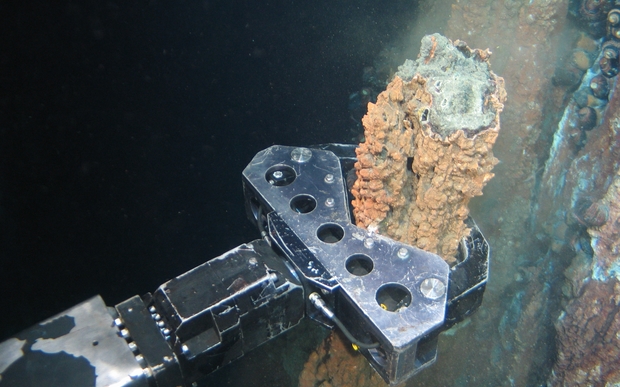
Andrew is a post-doctoral researcher in North Carolina focused on population and conservation genetics in hydrothermal vent communities.


David is a graduate student in Florida. He studies the ecology and conservation of sharks.


Amy is a graduate student in North Carolina studying local ecological knowledge within small scale fisheries.


Chuck is a graduate student in North Carolina focusing on apex predators and how they interact with fisheries.


Lyndell is a graduate student in North Carolina, studying the feeding ecology of cownose rays.


Iris is a graduate student in Washington studying habitat use and feeding habits of juvenile Pacific salmon and herring in Puget Sound.


Michael is a graduate student in Maryland investigating the visual systems of mantis shrimp.


Archives

The post-oil spill Gulf of Mexico

As some of you probably remember, there was an oil spill in the Gulf of Mexico last year. You can be forgiven for not remembering it, as our news media hasn’t been talking about it very much lately. In fact, if your only source of oil spill news was the mainstream media, you probably think that the Gulf is doing great! A little over a year ago, CNN ran a story about how the BP oil well that caused the spill was “effectively dead” and was “no longer a threat to the Gulf”. CNBC (and many others) ran stories about how 75 percent of the oil from the spill was gone from the Gulf. Bloomberg reported that the Gulf would recovery completely by 2012. London’s Telegraph celebrated a dramatic recovery after only one year. Whew… things aren’t as bad as we feared, and the Gulf has almost totally recovered! Or has it?

Continue reading The post-oil spill Gulf of Mexico

Crude Rage – A Sea in Flames reviewed

In the year since the Deepwater Horizon sunk, killing 11 people and pumping untold millions of barrels of oil into the Gulf of Mexico, much has been revealed about the causes and effects of this disaster: the chain of events leading up to the explosion, the response (or lack of response) from BP and the US government, the impact of sealife and coastal fisheries. In his most recent book, A Sea in Flames, Carl Safina lays out the timeline of the disaster, the factors the lead to such an egregious lapse in safety, the role that several corporate and government entities played, and the anger. Above all else, this book is about the rage one man feels about a situation that is almost impossible to comprehend.

Continue reading Crude Rage — A Sea in Flames reviewed

One year later.

Just a reminder that one year ago today, the Deep Water Horizon exploded and sunk into the Gulf of Mexico, taking 11 lives with it and starting a chain of event that resulted in the largest oil blowout in history.

Southern Fried Scientist’s Predictions for 2011

Happy New Year to all our readers! 2010 was a big year for Southern Fried Science. We added a new blogger, moved to our own server, and launched The Gam. Along the way we’ve won a few awards, hosted the first Ocean of Pseudoscience week, cooked a whole pig, exposed some blatant greenwashing, challenged conventional wisdom, laid out the shark ultimatum, crunched the numbers on mercury (twice!), and had some fun along the way. After 365 days, Charlie completed his epic adventure, which spanned three continents and an ocean. I’d like to thank all our readers and commenters for participating last year, and I look forward to hearing from you in 2011.

In the spirit of the pseudoscience of astrology here are our top ten predictions for 2011, based partially on informed guesswork and mostly on Yuengling.

  1. Largely ignored by the mainstream media, the impact of the Gulf of Mexico Oil Spill will continue to be felt across the Gulf Coast. BP and NOAA will continue to make it difficult for scientists to get access to sediment cores. The first developmental effects of oil and dispersant exposure to fetuses and young children will be reported.
  2. Science will be more frequently put on trial, as politicians attempt to supplant peer-review by suing climate scientists and challenging NSF and NIH grants. This approach will backfire as more Americans come to accept global climate change and a new generation of Monkey Trials makes a mockery of anti-science politicians. Both sides will frequently pat themselves on the back and declare victory.
  3. The Southern Fried Scientist will start raising chickens, Bluegrass Blue Crab will start raising goats, WhySharksMatter will raise some sort of ruckus.
  4. The economy will improve, just in time for everyone to start campaigning for the 2012 election. All sides will claim responsibility for the recovery and all side will blame the opposition for the collapse. Despite almost every politician claiming responsibility for a now successful economy, most Americans won’t notice any change.
  5. Sea Shepherd will claim their best year ever in the Southern Ocean whale campaign, despite there being no significant difference in the average number of whales killed since 2005 – 450 (+ or – 50). Theatrics will ensue.
  6. Several large mammal species will make a comeback, as populations begin to rebound after years of conservation initiatives.
  7. As the world population continues to grow, people will slowly begin to realize that Malthus was wrong, and that in cases such as India, demographic momentum will have massive positive benefits for quality of life, food availability, and environmental consciousness.
  8. Every piece of plastic you used last year will still exist this year.
  9. Sales of hybrid and electric cars will reach an all time high. I will continue to drive the same truck I’ve driven for 10 years until it won’t run, then replace it with something used.
  10. WhySharksMatter will finish his book – Why Sharks Matter: Using New Environmentalism to Show The Economic And Ecological Importance of Sharks, The Threats They Face, and How You Can Help. He will decide to use a shorter title.

What are your predictions for 2011?

~Southern Fried Scientist

http://blogs.plos.org/everyone/2010/10/01/blog-pick-of-the-month-september-2010/

The Gulf of Mexico Oil Spill: Day 209

In case anyone was under the impression that the Gulf of Mexico oil spill is over just because the well has been closed, it isn’t.

We continue to maintain our Gulf of Mexico Oilspill Page and will soon be adding a post-spill section to cover the ongoing effort in the Gulf.

Continue reading The Gulf of Mexico Oil Spill: Day 209

Sorry won't clean the spill

Hat tip to Deep Sea News.

Pretty much sums up how we all feel right now.

god damn

This is what 60 days of oil pouring into the Gulf of Mexico looks like.

This is what reckless disregard for safety and the precautionary principle looks like.

This is what irresponsible energy policy looks like.

This is what the end of Gulf Coast fisheries for the foreseeable future looks like.

This is what government weakened by special interests looks like.

This is what it looks like with the colors inverted, so you can really see the oil.

This is what it looks like when the planet bleeds.

Today is day 64. Good night.

~Southern Fried Scientist

h/t Bad Astronomy

Who should you be following for oil spill news?

Update: we’ve promoted this post to a full page on the blog. Please go here for the most up-to-date version. The comment thread will remain active here.

Real Leadership for the Deepwater Horizon Disaster

I’ve been a fan of Coast Guard Commandant Thad Allen for a while now. His blog, iCommandant, provided a window into a world few of us glimpse. His openness, honesty, and no nonsense attitude made the iCommandant blog one of the best blogs on the internet. Which is why I began today disheartened to see that he was relieved as Commandant of the U.S. Coast Guard by Admiral Robert Papp. But that sadness was short lived when it was announced the Admiral Thad Allen will continue serve as National Incident Commander for the Gulf of Mexico.

Continue reading Real Leadership for the Deepwater Horizon Disaster

Unguided deep-sea research is essential for national and global security

This Sunday on NPR I heard the following paraphrased comment: “The ROV pilots have never had to deal with anything like this before, no one has trained for the kinds of maneuvers needed to close to well.” I’ve known many ROV pilots. They are all incredibly skilled, know how to handle their robots, and generally have many years of experience working in industrial settings.

But commercial ROV work tends to be monotonous. Many pilots I know spend the vast majority of their time inspecting pipelines and oil rigs, flying over long tracks of seafloor with little to no variation, looking for any signs of damage. When their skills are put to the test, it’s often the same repetitive motion, over and over. Even training simulations to prepare them for catastrophes cannot predict the infinite variations that could occur as an oil-rig collapses. It’s impossible to train for everything.

Until you throw a biologist into the mix.

Continue reading Unguided deep-sea research is essential for national and global security