 What do you think of when you picture a fish dinner? A fancy anniversary meal atop a seaside bluff at sunset? Or a staple food, eaten daily as part of the subsistence diet of coastal community members? Seafood is a strange commodity because depending on how you answered that question, you’re right. Seafood occupies multiple rungs of the economic ladder. But the most common consumer is the middle-class, which is shrinking in the US but growing worldwide. So what does a changing seafood consumer base mean for which types of seafood we should increase through aquaculture? Here’s a few thoughts from the keynote speaker at the NC Aquaculture Development Conference, Travis Larkin from Seafood Exchange.
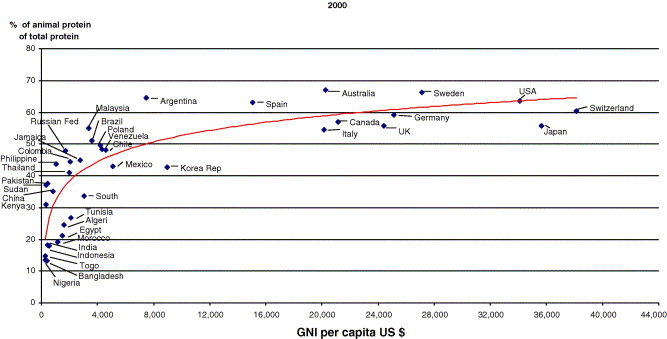
Consider for a minute how families think about protein in their diet according to income. Larkin cited the story from Jensen 2006, which used national-level statistics to tease apart the protein question. As shown in the above graph, as income rises (calculated here as gross national income per capita, converted to US dollars), animal protein comprises an increasing proportion of the diet’s total proteins. This logically makes some sense, as the staple foods in many countries are some form of beans and rice – relying on plants as the main source of protein.
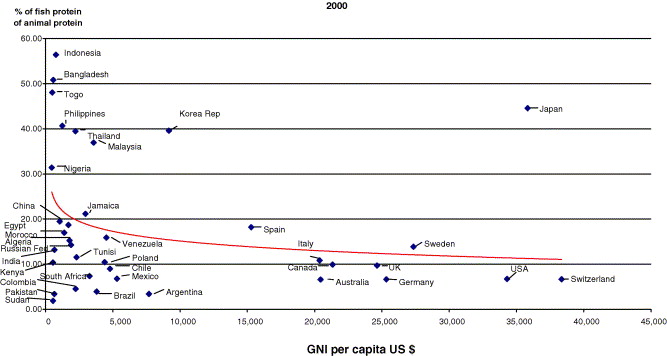
When Jensen delved deeper, asking which types of proteins constituted the increase observed with larger incomes, the answer was not seafood. The driving factor in whether a country eats more or less seafood appears to be linked more to culture and availability. Coastal countries with a culinary tradition of seafood, regardless of income, ate the most seafood. The graph above is similar to the first, plotting the gross national income per capita (translated into US dollars) against the percentage of fish protein of all animal protein in the country’s diet. This makes sense with increasing anthropological data showing the dependence of poor coastal communities on subsistence fishing, often from shore or in small boats. These areas often don’t have the soil or water resources necessary to support terrestrial animal production.
So the question becomes not “how do we feed the growing middle class demand for seafood?” but instead “how do we ensure the poorest maintain access to subsistence fisheries while meeting the rising demand from the middle and upper classes?”. Larkin suggested to growers at the conference to consciously consider which market they are trying to market to – the middle-class Chinese weeknight supper or the special occasion, upper-class North Carolinian soiree? There might be a balance there in processing, as well. The local food movement strives to connect consumers to their food and its producers, so a piece of fish here could be sold whole, in all its scaly glory – but still at an affordable price because there’s no processing needed. The middle-class overseas consumers could foot the bill for additional processing such as freezing, filleting, etc.
I’m not sure I left completely satisfied with the dichotomy, but the conversation start some cogs turning in how to think about seafood in the marketplace. For a place like eastern NC with fishing heritage and high demand for local seafood from the tourist industry, there may yet be a place for a thriving local market.