
Skip to content

Southern Fried Science

Over 15 years of ocean science and conservation online

  • Home
  • About SFS
  • Authors
  • Support SFS

The most preventable shark attack of all time?

Posted on February 19, 2013February 19, 2013 By David Shiffman 5 Comments on The most preventable shark attack of all time?
Science

davesquare

I don’t often cover shark attacks here at Southern Fried Science. They get plenty of news coverage on their own, they’re usually not that relevant from a science and conservation perspective, and they are outside of my expertise and interests. However, some shark attack stories, such as this one, transcend “if it bleeds, it leads” fearmongering journalism and are interesting in their own right.

I’d like to preface this story by saying that shark attacks are extremely rare to begin with (you have a 1 in 5 chance of dying from heart disease and a 1 in 3.8 million chance of being killed by a shark in the United States). If you want to further minimize your chance of being attacked by a shark, most of the few attacks that occur can be prevented by simply swimming close to shore with lots of other people nearby during the day. Even though shark attacks are rare, I still don’t want to minimize the suffering of the few attack victims and their families. With these caveats out of the way, presented below is the fascinating story of what is probably the most preventable shark attack of all time.

In 2009,  an experienced swimmer thought it would be a fun challenge to swim between the main island of Hawaii and Maui (hey, some people collect stamps, some swim between islands). He expected it to take between 16 and 20 hours to cover the 47 kilometer distance. The swim involved crossing the ‘Alenuihähä channel, which includes a stretch of relatively deep water.
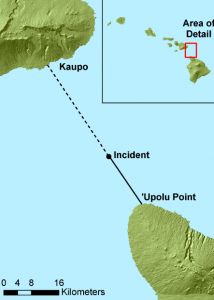
Figure 1 from Honebrink et al. 2011, showing the swimmer's route
Figure 1 from Honebrink et al. 2011, showing the swimmer’s route

As is common practice with long-distance swims, the swimmer was closely followed by a support boat, available just in case the swimmer needed assistance. Once the sun set, the support boat shined lights on the swimmer to make sure they wouldn’t lose him. They soon noticed large numbers of squid, presumably attracted to the lights.

To recap, our long-distance swimmer is now in the middle of the Pacific ocean, swimming over a deep-water canyon, at night, brightly lit from above by floodlights.

Into this unlikely situation came one of the strangest species of sharks, the cookiecutter. These animals generally live in the deep sea, but sometimes venture closer to the surface at night in search of prey, such as squid. They have a peculiar method of feeding that basically involves biting a circular chunk of meat right off the side of their prey.

Here is the painful (but fortunately non-fatal) result of our swimmer’s encounter with a cookiecutter shark (that’s his leg):

Figure 2 from Honebrink et al. 2011, showing the extent of the sharkbite injury after 7 days
Figure 2 from Honebrink et al. 2011,  the extent of the injury after 7 days

By swimming in the middle of the ocean, over a deepwater trench, at night, while being brightly lit from above, our swimmer became the first confirmed human target of a cookiecutter shark bite, and became the victim of what is likely the most preventable shark attack of all time.


ResearchBlogging.org

Randy Honebrink,Robert Buch, Peter Galpin, and George H. Burgess (2011). First Documented Attack on a Live Human by a Cookiecutter Shark. Pacific Science

Share this:

  • Click to share on Bluesky (Opens in new window) Bluesky
  • Click to share on Facebook (Opens in new window) Facebook
  • Click to share on Reddit (Opens in new window) Reddit
  • Click to share on Threads (Opens in new window) Threads
  • Click to share on WhatsApp (Opens in new window) WhatsApp
  • Click to share on Mastodon (Opens in new window) Mastodon

Related

Tags: cookiecutter shark do cookiecutter sharks attack humans? shark attack shark attack prevention

Post navigation

❮ Previous Post: Update from the Cayman Abyss
Next Post: Why a California great white shark scientist opposes CA Endangered Species Act protections ❯

You may also like

Conservation
Thoughts on the shark attacks in Egypt
January 4, 2011
Science
Shark bites snorkeler… who happens to be my friend
September 5, 2011
Science
What to do after the first fatal shark bite in Massachusetts since 1936: 3 experts respond
October 1, 2018
Popular Culture
Shark Week 2010: A big step in the right direction!
August 10, 2010

5 thoughts on “The most preventable shark attack of all time?”

  1. The Saipan Blogger says:
    February 19, 2013 at 10:44 am

    …and surrounded by bait.

  2. Al Brenneka says:
    February 19, 2013 at 12:01 pm

    David,
    You had me going there for a minute thinking we missed a 2011 shark attack or related incident. The incident you are referring to actually happened in 2009 to Mike Spalding. Here is a bit more info on the incident and proof it happened in 2009 not 2011.
    http://sharkattacksurvivors.com/shark_attack/viewtopic.php?f=44&t=1239
    Al Brenneka

  3. David Shiffman says:
    February 19, 2013 at 12:03 pm

    Thanks for the correction, and apologies for the trouble. The paper describing the incident was published in 2011, but the incident happened in 2009. I’ll correct the post.

  4. Rick MacPherson says:
    February 24, 2013 at 2:49 pm

    And covered here in 2009: http://coralnotesfromthefield.blogspot.com/2009/03/attack-of-cookie-monster.html

    🙂

  5. Toby Hewson says:
    March 15, 2013 at 9:38 am

    “By swimming in the middle of the ocean, over a deepwater trench, at night, while being brightly lit from above, our swimmer became the first confirmed human target of a cookiecutter shark bite, and became the victim of what is likely the most preventable shark attack of all time.”

    Is it wrong that I laughed out loud at that?

Comments are closed.

Popular Posts

Shark scientists want their research to help save threatened species, but don’t know how. Our new paper can help.Shark scientists want their research to help save threatened species, but don’t know how. Our new paper can help.December 1, 2025David Shiffman
Norway and Cook Islands put their deep-sea mining plans on pause.Norway and Cook Islands put their deep-sea mining plans on pause.December 3, 2025Andrew Thaler
What Ocean Ramsey does is not shark science or conservation: some brief thoughts on "the Shark Whisperer" documentaryWhat Ocean Ramsey does is not shark science or conservation: some brief thoughts on "the Shark Whisperer" documentaryJuly 2, 2025David Shiffman
The Trouble with Teacup PigsThe Trouble with Teacup PigsOctober 14, 2012Andrew Thaler
2025: My year in writing, public speaking, and media interviews2025: My year in writing, public speaking, and media interviewsDecember 3, 2025David Shiffman
What we know we don't know: impacts of deep-sea mining on whales, dolphins, sharks, turtles, and other migratory species.What we know we don't know: impacts of deep-sea mining on whales, dolphins, sharks, turtles, and other migratory species.November 20, 2025Andrew Thaler
Urea and Shark OsmoregulationUrea and Shark OsmoregulationNovember 15, 2010David Shiffman
Shark of Darkness: Wrath of Submarine is a fake documentaryShark of Darkness: Wrath of Submarine is a fake documentaryAugust 10, 2014Michelle Jewell
How tiny satellites are tracking marine wildlifeDecember 1, 2025Andrew Thaler
Build a dirt cheap, tough-as-nails field computer in a Pelican caseBuild a dirt cheap, tough-as-nails field computer in a Pelican caseJuly 21, 2015Andrew Thaler
Subscribe to our RSS Feed for updates whenever new articles are published.

We recommend Feedly for RSS management. It's like Google Reader, except it still exists.

Southern Fried Science

  • Home
  • About SFS
  • Authors
  • Support SFS


If you enjoy Southern Fried Science, consider contributing to our Patreon campaign.

Copyright © 2025 Southern Fried Science.

Theme: Oceanly Premium by ScriptsTown