Skip to content

Southern Fried Science

Over 15 years of ocean science and conservation online

  • Home
  • About SFS
  • Authors
  • Support SFS

Shark scientists want their research to help save threatened species, but don’t know how. Our new paper can help.

Posted on December 1, 2025 By David Shiffman No Comments on Shark scientists want their research to help save threatened species, but don’t know how. Our new paper can help.
Conservation, Education, Science

Sharks are some of the most threatened animals on Earth, and accordingly many scientists who study sharks want their research to be useful for conservation. However, most scientific training does not include a detailed explanation of the policymaking process, resulting in lots of shark research being positioned as relevant to conservation and policy when it really is not. The phrase “this research is important for the conservation and management of sharks,” which appears frequently in shark research papers and scientific presentations, has become a point of frustration or even mockery by some natural resource managers and conservation advocates.

Our new paper can help! “This research is important for the conservation and management of sharks: a framework for ensuring that this is actually true” is out now in the interdisciplinary environmental science journal Conservation Science and Practice. 
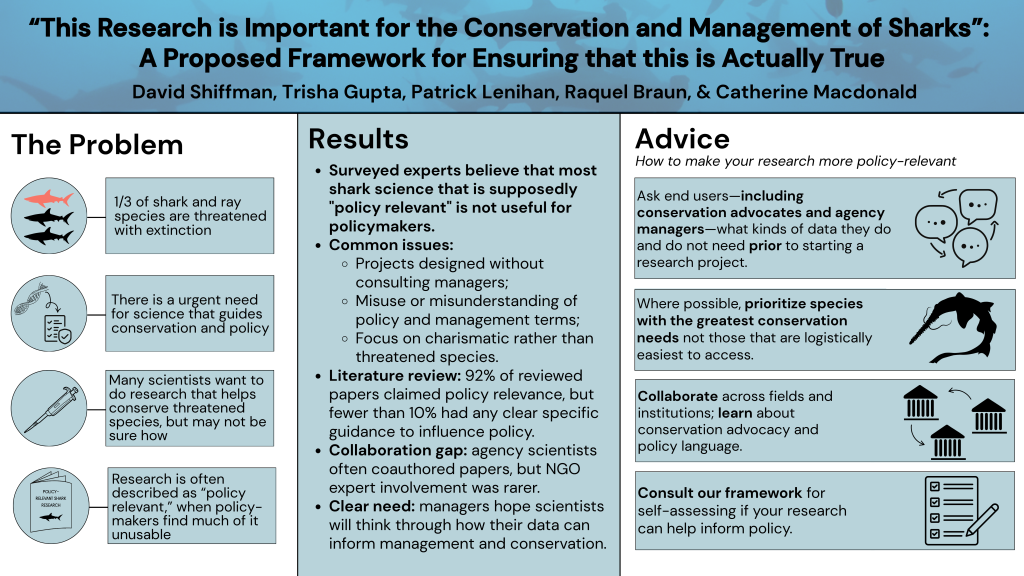
Our team has previously interviewed shark conservation advocates and natural resource managers who implement shark conservation policy. In our new paper, we present those experts’ previously-unpublished thoughts on the state of scientific research intended to be conservation-relevant, and their advice for scientists who want their research to make a real impact in the policy world.

Advice includes “ask natural resource managers what kind of data they need and do not need before you start a research project,” as opposed to assuming that any kind of data will automatically be helpful. Wherever possible, scientists are encouraged to study species with the most pressing conservation needs, as opposed to species that are most charismatic or logistically easy to access. Collaboration, including with government agency employees and environmental advocates, is also encouraged.

We also present a novel framework that can help scientists to assess whether or not their research is likely to be useful for conservation policymaking.

“The most effective conservation policies are based on scientific evidence, but far too few scientists know how to frame their results in ways that policymakers can use,” says lead author Dr. David Shiffman, a marine conservation biologist and ocean conservation policy consultant in Washington, DC. “The advice in this paper can help scientists, conservation advocates, and policymakers to better work together.”

“In the same way that scientists develop hypotheses before beginning a study, they need to consider the applications their work can have for conservation and management as a foundational component of research design,” says senior author Dr. Catherine Macdonald, associate professor at the Rosenstiel School at the University of Miami. “There’s nothing wrong with conducting studies that don’t have direct conservation applications–but where scientists are looking to meaningfully contribute to policy, that goal requires consideration and planning.”

“A lot of shark conservation research doesn’t actually help save sharks,” says coauthor Dr. Trisha Gupta, a conservation scientist at the Zoological Society of London. “Our study shows that small changes in how we design, conduct and communicate research can dramatically improve its usefulness for real-world shark conservation.”

Study authors Dr. David Shiffman, Dr. Catherine Macdonald, and Dr. Trisha Gupta are available for an interview. Please contact Dr. Shiffman (WhySharksMatter @ gmail.com, subject line “MEDIA REQUEST”) with any inquiries.

Share this:

  • Click to share on Bluesky (Opens in new window) Bluesky
  • Click to share on Facebook (Opens in new window) Facebook
  • Click to share on Reddit (Opens in new window) Reddit
  • Click to share on Threads (Opens in new window) Threads
  • Click to share on WhatsApp (Opens in new window) WhatsApp
  • Click to share on Mastodon (Opens in new window) Mastodon

Related

Tags: policy-relevant science science-policy interface shark conservation

Post navigation

❮ Previous Post: What we know we don’t know: impacts of deep-sea mining on whales, dolphins, sharks, turtles, and other migratory species.
Next Post: How tiny satellites are tracking marine wildlife ❯

You may also like

Conservation
The ten best and worst events in shark fisheries management of 2012
January 4, 2013
Blogging
Does Shark Week portrayal of sharks matter?
June 29, 2015
Conservation
Send testimony to help protect Guam’s sharks!
January 26, 2011
Conservation
A global shark conservation challenge from Palau and Micronesia
September 23, 2010

Leave a Reply

Your email address will not be published. Required fields are marked *

This site uses Akismet to reduce spam. Learn how your comment data is processed.

Popular Posts

Shark scientists want their research to help save threatened species, but don’t know how. Our new paper can help.Shark scientists want their research to help save threatened species, but don’t know how. Our new paper can help.December 1, 2025David Shiffman
What Ocean Ramsey does is not shark science or conservation: some brief thoughts on "the Shark Whisperer" documentaryWhat Ocean Ramsey does is not shark science or conservation: some brief thoughts on "the Shark Whisperer" documentaryJuly 2, 2025David Shiffman
Norway and Cook Islands put their deep-sea mining plans on pause.Norway and Cook Islands put their deep-sea mining plans on pause.December 3, 2025Andrew Thaler
What can the funniest shark memes on the internetz teach us about ocean science and conservation?What can the funniest shark memes on the internetz teach us about ocean science and conservation?November 8, 2013David Shiffman
What is a Sand Shark?What is a Sand Shark?November 12, 2017Chuck Bangley
Mermaids: The New Evidence is a Fake DocumentaryMermaids: The New Evidence is a Fake DocumentaryMay 28, 2013Andrew Thaler
Build a dirt cheap, tough-as-nails field computer in a Pelican caseBuild a dirt cheap, tough-as-nails field computer in a Pelican caseJuly 21, 2015Andrew Thaler
Breaking News! "Most Comprehensive Estimate of Mortality": Between 63 and 273 Million Sharks Killed Each YearBreaking News! "Most Comprehensive Estimate of Mortality": Between 63 and 273 Million Sharks Killed Each YearMarch 1, 2013David Shiffman
About Southern Fried ScienceOctober 27, 2013Administrator
I spent 50 days working out in Virtual Reality and everything went better than expected.I spent 50 days working out in Virtual Reality and everything went better than expected.May 16, 2019Andrew Thaler
Subscribe to our RSS Feed for updates whenever new articles are published.

We recommend Feedly for RSS management. It's like Google Reader, except it still exists.

Southern Fried Science

  • Home
  • About SFS
  • Authors
  • Support SFS


If you enjoy Southern Fried Science, consider contributing to our Patreon campaign.

Copyright © 2025 Southern Fried Science.

Theme: Oceanly Premium by ScriptsTown