Today marks the end of Geoff Johns’ 25-issue run as lead writer for Aquaman. It is not hyperbole to say that he revitalized the king of Atlantis and helped cast off the stigma of the Superfriends. Aquaman was no longer a one-trick hero floundering about for relevance, trying to find his plaice in the DC Universe. Johns’ Aquaman had depth. The characters were compelling, the stories engaging. And, after more than 2 years, it was clear that this new Aquaman wasn’t just a fluke.
All puns are most definitely intended.
In honor of Johns’ 25 issue run, it’s time to plumb the depths of his ultimate issue and do what I do best: over-analyze a comic book and dredge up as much tenuous symbolism as possible. This is Southern Fried Science and I’m talking about Aquaman, what else would you expect?
The anglerfish symbolize Aquaman’s relationship with Mera
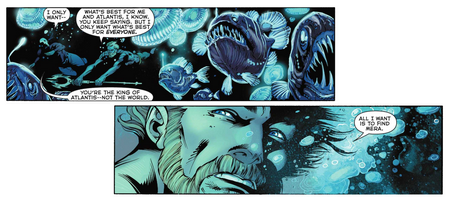
Here we find Aquaman diving deep into the Trench, searching for an army of lost Atlanteans to command. During the course of his dive, we discover that, though Aquaman is fighting to reclaim Atlantis, his one overarching goal is to find his wife, Mera. It is not a coincidence that we see him surrounded by deep-sea anglerfish — Melanocetus johnsonii to be precise. In many ways, the life-history of the anglerfish mimics Aquaman’s relationship to Mera.
Throughout the first 25 issues, Mera has consistently been the stronger character. It is Mera who drives the major story arc. It is Mera’s backstory that leads us to the final events of Death of a King. And it is Mera whose character gets depth and complexity throughout the narrative. Like the bacteria-fueled luminescent illcium on an anglerfish’s dorsal ray , Mera was originally launched into our world from Xebel as a lure to draw in the unwary king of Atlantis. But Mera and Aquaman’s relationship quickly evolved into something more than just predator and prey.
The sexual politics of anglerfish are notable. Sexual dimorphism is dramatic; males may be thousands of times smaller than females. Once a male locates a female, he bites into her side, permanently fuses circulatory systems, and is essentially reduced to auxiliary genitals.
Ok, Aquaman is obviously not a sexual parasite, but the biology of the anglerfish roughly parallels his commitment and dependence on Mera. The final panels even reveal that Aquaman is basically non-functional without Mera around.
The Orcas framed by the Dead King’s Scepter symbolize Aquaman’s desire to free killer whale’s from captivity.
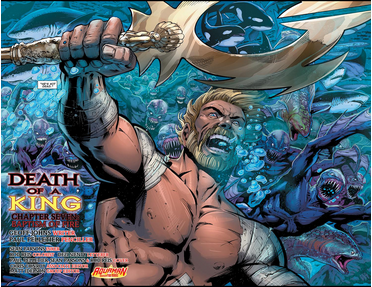
On epic title page for Aquaman #25 we are treated to a menagerie of mighty ocean predators (also, manta rays. Seriously, what are manta rays going to do in this fight? Filter feed Xebel to death?). Prominently framed within the negative space of Aquaman’s two-pronged trident (which is only marginally better than his five-pronged trident) are three killer whales, Orcinus orca.
The implication is clear. The bi-trident encircling the Orcas represents captivity, with only a narrow pathway to freedom. Clearly Aquaman is using this moment to protest the deplorable condition of captive killer whales recently highlighted in the documentary Blackfish. That Aquaman would take the time, during his struggle to free Atlantis, to protest the mistreatment of his cetacean subjects further demonstrates that he is the true king of Atlantis.
Aquaman’s throne symbolizes that deep-sea giant isopods are awesome.
Wait, hold on, is that a Bathynomous giganteus throne?

Yeah, that totally looks like a Bathynomous giganteus throne.

Dude, we should totally fist-bump over how awesome our Bathynomous giganteus thrones are.
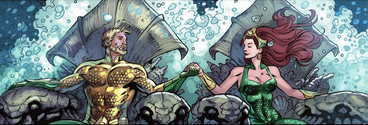
Yes, Bathynomous giganteus, the giant deep-sea isopod, really is that awesome.
httpv://www.youtube.com/watch?v=xtk5t7sSb3s
The cloud of bubbles around Aquaman symbolizes the effects of supercavitation, in that they are the effects of supercavitation.
Finally, we have an answer to one of the questions that has haunted my dreams since my very first Aquaman post — The Horrifying Physiological and Psychological Consequences of being Aquaman — how does the king of Atlantis attain such incredible speeds underwater? In Aquaman #25, we have a solution to that and several other problems.
Aquaman is continuously using supercavitation to produce a bubble of water vapor that surrounds him.
Cavitation occurs when a fluid, like water, is accelerated to the point where it drops below its vapor pressure and undergoes a phase change, forming bubbles of gas. Boat propellers produce cavitation, which can cause problems with a poorly tuned blade. Supercavitation is the process by which an object travelling at high speeds through a fluid undergoes enough cavitation that the cavity completely surrounds the object. This “bubble” dramatically lowers resistance, allowing object to move incredibly fast through the water. Both torpedoes and high-end speedboats have attempted to harness supercavitation to boost speed and efficiency.
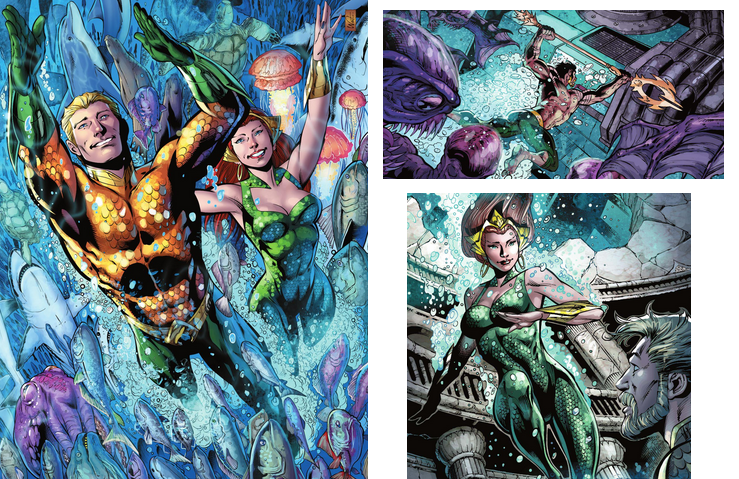
Aquaman and Mera are often surrounded by bubbles.
With no obvious air supply, it’s clear that these bubbles are the traces of a supercavity. Supercavitation produces benefits beyond reduced friction. Water vapor is less conductive than water, which means that, with a permanent supercavity, Aquaman would be able to retain heat much more efficiently, avoiding the need for thick fur or heavy layers of blubber. It would also exaplin why Aquaman was seemingly able to survive in an open volcanic fissure – he had a supercavity to insulate himself.
But wait, you can’t just have a supercavity, you have to constantly accelerate the water around you. How can Aquaman maintain his protective layer when not swimming at high speed? Well, since we’re still in the DC Universe, Aquaman clearly draws some of his power from the speed force.
So there you have it. Aquaman #25 is fantastic and a fitting finale to Geoff Johns epic run. Since this article focuses on the art more than anything else, I should point out that Paul Pelletier, who will be continuing his Aquaman run, has also done an outstanding job.
We are going to have some much fun chatting with you! Did you read about Geoff’s future plans for Aquaman & Atlantis in next year’s Rise of the Seven Seas? He should hire you as a consultant in that storyline dude. If you missed it, its in our feed via @USAToday! — Joe
Thanks! I saw that. Super excited for Rise of the Seven Seas!